Saturday, March 21, 2026

Two Seed Baptist Ideology (L)

The Fulton Convention
of
Primitive Baptists
1900 A.D.
Authors of the Fulton Confession


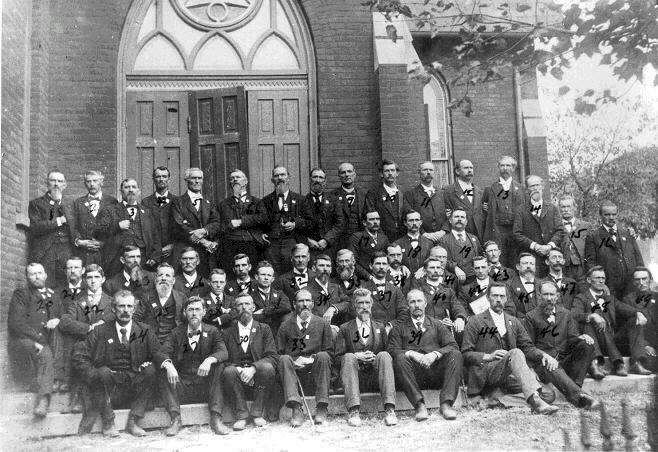
The above picture is of the many "Primitive Baptist" elders in attendance in Fulton, Kentucky, the purpose of which was to unite around a common creed. I used to have this picture in my study when I was a young Hardshell Baptist minister. Elder Potter had passed away several years before this convention. In this convocation the assembly unanimously endorsed the 1689 London Confession of Faith, but put footnotes at the bottom of several sections of that confession for the purpose of giving their interpretation of those sections, which interpretations were diametrically opposite of what the confession said. You can see from those footnotes remnants of Two Seedism in their denial of Gospel means in the eternal salvation of sinners and of what they say about the nature of regeneration and conversion. Under section II of the 1689 Confession the Fulton brethren said:

"(2) We understand the words of “one substance” contradict the idea that God’s people existed eternally in seed or substance in Christ, for this would establish a distinction in substance between the Father and the Son."

By this they show that they were at this time determined to distance themselves from at least one of the tenets of Two Seedism. In chapter XLVII I cited the words of Elder Watson regarding the way Two Seeders handle the word of God in their twisting of scripture. Watson said: "Their doctrine is serpentine, and it has serpentine ways and outlets, and is hard to hold even when caught." The fifty one elders who are pictured above showed this trait in how slippery they handled the 1689 confession.

In this chapter we will focus our attention on what Elder Potter wrote in his book titled "A Treatise On Regeneration And Christian Warfare" (Read it here), written in 1895. We will also have a good bit to say about the Fulton Assembly and the 1689 London Confession, especially since Potter mentions it in the above treatise, as we will see. In chapter one, under "Introductory Remarks," Potter wrote:

"In the publication of this little work I have only one object in view, and that is the defense of gospel truth, and the peace of the Baptists. I have been associated with brethren who differed with me on the new birth, for more than twenty years, and as they were good and precious brethren, I thought that if we could all let that subject alone, and not agitate it, we might get along peaceably together, and yet not see exactly alike on that subject. They knew, however, what I believed on the question, for they had often heard me express myself. I was requested by some of my readers of the ADVOCATE, in Arkansas, to write some on the new birth, through the paper, for their sakes, as they had a minister among them that was leading off on that subject; this was in the fall of 1892."

I find Potter's statement that he thought that brethren who disagreed on the subject of the new birth should "leave that subject alone," especially in view of the fact that he says this in the context of Two Seed views on that subject, which are indeed heretical and heterodox. Why did Potter and his cohorts not feel the same way about their primitive missionary Baptist brethren who supported missionaries and biblical education? I am also bewildered how he could advise a "leave it alone" procedure and then write this book on it. Why did he not have this same attitude towards those "Primitive Baptists" who believed in means? Potter would not leave that issue alone but became the flag bearer for those who opposed means and began to debate "Primitive Baptists" who believed in means, which was the original position of his forefathers. He has even said that he began his paper "The Church Advocate" to combat the means view. 

Potter wrote further:

"I thought the Baptists in our part of the country might get along without agitating that subject, and that we would live in peace and union, as we had always done. But those brethren who differed, finally became intolerant, some of them, and could not bear to hear a brother say "soul and body" or that "it is the spirit that is born again," or speak of the separation of soul and body at death, or "inner man," or that "the soul of man is born of God in time," or any of those intimations of a distinction of soul and body, without making war on the party that made use of the expression."

Potter says - "I thought the Baptists in our part of the country might get along without agitating that subject, and that we would live in peace and union, as we had always done." Why did he not think this way towards those Baptists who supported means, Sunday Schools, theological education, etc.? How could he tolerate the gross absurdities of Two Seedism but not Baptists who believed in supporting missionaries? Of course, as we have seen, Potter himself still held Two Seed ideas, such as saying  that people did not have to hear the Gospel to be saved, and saying that nothing a person did in life determined whether he went to heaven. Further, though he claimed to deny the Two Seed "no change" view of regeneration, yet he and his brethren came to entertain such a view when they began to say that a person could be regenerated while remaining believers in false gods and Messiahs. The Hardshell view evolved, or diverted back to the Two Seed view, so that it became similar to the Two Seed no change view.

Potter wrote further:

"I believe, and the Old School Baptist church believes, the doctrine of the following pages, and in order to set forth the Baptist doctrine, and defend it against the assaults of those who do not believe it, and to teach our people what the doctrine of the church is on this subject, this little book is offered to the public. I have blamed those brethren who differed, for trying to hide from the people, what they really do believe, and for trying to make it appear that the whole fight is on the question of the sinner being born again. But, in order that the reader may know just what they contend for, I will give a statement of what they say they believe, as given by one of the ablest men on that side of the issue. He says:..."

It is ironic that Potter said that he thought brethren should not talk about the things they disagreed about respecting some Two Seed tenets, such as what they believe about regeneration or rebirth, and yet in the above citation he is going against his own counsel and writing upon it and stating that his views are the historic view. Further, it is a characteristic trait of the Hardshells to find ways to hide their views from others to some extent. 

Potter wrote further:

"I would much prefer to quit publishing the ADVOCATE, than to not be allowed to publish what Old Baptists have always believed."

"What Old Baptists have always believed"? I find that statement astounding because though it is true that Two Seedism was a new doctrinal system, what Elder John M. Watson called "modern innovations" and "ultraisms," yet Potter's own view on regeneration and salvation are not the orthodox and historical views of Baptists. The Baptists prior to what B.H. Carroll called "the rise of the Hardshells," in chapter three of his famous treatise titled "The Genesis of American Anti-Missionism" (1902), did not deny that God used the gospel or word of God, and the preachers of it, as instruments in the eternal salvation of sinners, nor that evangelical faith and repentance, or conversion, was essential for being eternally saved. You can read Dr. Carroll's work (here).

In 1900 Potter's ministerial brothers met in Fulton, Kentucky to state their adherence to the 1689 London Baptist Confession which clearly taught differently than Potter and those ministers who assembled in Fulton and is why that convention of ministers felt the need to put footnotes on those sections they disagreed with in order to distort what that old Confession taught. 

In chapter two under "Reasons for Writing on This Subject" Potter wrote:

"In the ADVOCATE, of February 15, 1894, there appeared an article from one of our correspondents, on the subject of man, not on the new birth, but in the article, the writer spoke of the soul as being born again, in time, and the body in the resurrection. The expression so aroused some of our dear brethren that two of them wrote a reply at once."

Potter wrote further:

"THE CHURCH ADVOCATE believes that the sinner, the Adam sinner, is the subject of salvation; that it is the man that is the subject of the new birth, and that this man has a soul and a body, and that the soul is born again, in the work of regeneration in time, and that it goes immediately to heaven when the body dies. We believe that in the resurrection, the body will be born again, and go to heaven, and that the soul and body will be reunited in heaven, and thus the sinner will be born again, and saved. This has been the doctrine of our people for the past two hundred years, provided it was our people who first drew up and published the London Confession of Faith, in England, in the year 1689."

Why does Potter question whether it was his people, the Hardshells, "who first drew up and published the London Confession of Faith"? Potter died a decade or so before the meeting in Fulton. Had he lived till then, what would he think of those ministers who claimed that the authors of the 1689 confession taught Hardshellism? I have written many articles through the years on what took place in Fulton. I showed where many "Primitive Baptists" were honest enough to admit that the ministers of the Fulton convention were purposefully distorting the true meanings of the 1689 confession. For instance I give these citations from Hardshell Baptists:

Elder Bill Allen in an Internet article titled "Article 10 of the London Confession of 1689 Examined," (pastors the Stephenville, Texas "Primitive Baptist Church") writes (emphasis mine - SG):

"Below is just one of the problematic articles, no. 10, of the 1689 with the 3 related Fulton foootnotes.  My problem with the Fulton footnotes is not that they were themselves unsound.  They were quite sound, but the Fulton brethren were deceiving themselves in thinking that the 1689 was basically sound but just not properly understood....If we take the wording of the 1689, particularly in this article, for what it clearly says in plain English it can be easily seen that it is a hopeless wreck of a document that no amount of footnotes, explanations, or wishful thinking can fix...My point is that we should NOT make any endeavors to lay claim to the 1689 Confession but instead should do what the Fulton brethren did not and that is let those who believe such things have it as the Calvinists confession that it clearly is." 

Allen also says:

"...this says the effectual calling is by the Word and Spirit.  It is vital to the understanding of this article to discern exactly what they mean by the use of "Word".  The Fulton brethren correctly insist that on the Living Word, i.e. Christ, is the source of the Effectual Call.  Unfortunately, they would like us to believe that is what this article says.  I contend that this is wishful thinking. They are imposing what we know to be the truth on what other men have said in an effort to white wash something that would have to otherwise rejected if taken for what it says.  I contend the authors of this confession were consistent in their use "Word"." (See here)

Elder David Bartley, a minister of the Absoluter faction, writing about the Fulton Confession in 1901 had these remarks to offer (emphasis mine - SG).

"So now, let us kindly consider this question of disturbance and compare the points at issue with the London Confessionwhich all claim to accept upon those points of difference. But why, then, the need or utility of the Fulton Convention? Why the address, the foot-notes and the appendix added to the good old Confession, which had been good enough for the Old Baptist people through the centuries, until this late upheaval? The plea for all this additional supplementary work of the recent convention has been stated in print frequently, and is thus given in the general address: “Language through the lapse of many years undergoes variations in applications and meanings, whereby certain clauses become more or less obscure in meaning. Wherever, in the opinion of this assembly, the meaning of a section was not apparent, foot-notes were added to bring out the meaning.” But if such a change of meaning and obscurity of language is true of one section of the old Confession, it is also true of every section, and just as true of the whole Bible, which is older than the London Confession. In all candor, then, why were the foot-notes confined to a few sections, and these the very places which treat of the doctrines involved in this new issue! This is very strange indeed, if the old Confession has really become doubtful and dark in meaning because of its age! If this is a valid cause for calling a convention of Baptists, why not bring out in easy and plain words the meaning of the entire Confession, so that all the Baptists may now understand and unite upon its meaning? Then, if the plea is a real and valid one, why not also get up a Baptist Convention to “bring out the more or less obscure meaning “of the ancient Bible!"

These are excellent observations. If these brethren are right, what does it say about the many leading elders who assembled in Fulton and perverted the 1689 confession? If those brethren could twist and distort what the confession said in order to make it agree with their new ideas, why would we not think that they would do so with the scriptures too?

In "An Examination of How the Hardshells Diluted the London Baptist Confession" Bob L. Ross wrote (emphasis mine):

"One of the most reprehensible acts by a group of Primitive Baptist ministers was perpetrated in November 1900.

From the 14th day to the 18th day -- five days of infamy -- "fifty-one ministers, representing three-hundred and thirty-five churches, aggregating fourteen-thousand five-hundred members in direct correspondence with over one-hundred-thousand Baptists," set themselves -- after adorning their nefarious scheme with all the proper and pious camouflage of the most sanctimonious session of the Scribes and Pharisees -- to the work of "clarifying" and "adding some explanations to" the most highly respected confessional document in the history of English-speaking Baptists, The Baptist Confession, set forth in London, England in 1689.

This 20th century "Sanhedrin" was shepherded in part by a couple of well-known elders of Old School craft, James H. Oliphant and John M. Thompson, who proved to be two veritable Jehudi's (Jeremiah 36:23). Not content with their rejection of the London Confession, they found it more to their liking to distort it and perpetrate the distortion under the "unanimous vote" of their ministerial accessories among which "tears filled eyes," contemplating their deed as "doing God service" (John 16:2). This meeting had all the "holy smoke" of a Papal election. And no one can puff more "sweet" and "comforting" holy smoke than the "little lambs" of Hardshellism.

The hallowed ground on which this holy convocation of Hardshell "rabbis" took place was the meeting-house located in Fulton, Kentucky, and the grand product of this enclave in Zion was published under title of A Comprehensive Confession of Faith. I am the proud possessor of a maroon hardback edition of this blessed creation, published by those professing to be "servants" -- E. D. Speir, R. E. Cagle, and E. D. Speir, Jr. -- in this current form in 1981.

These brethren of the Old School, in a humility worthy of the likes of Madam Guyon and St. Thomas of Assisi, announced that they felt themselves "under profound obligations to thank God and labor faithfully for the prosperity of his holy cause," and with "humble gratitude" to the "gracious and divine providence of God," recognizing that "language naturally undergoes some change," they "deemed prudent" the adding of "some explanations to those sections that seemed ambiguous" in the Baptist Confession of 1689.

The sanctified purpose of the "explanations" and "clarifications" was -- of course -- "increased gladness and the sweetest union," "general prosperity," "establishing union and fellowship," and similar attendant blessings within the sweet Old Baptist "home." Who could possibly have ever entertained the doubt that such "obedient servants" as Thompson, Oliphant and their fellow butchers would prove to be triumphant in behalf of their beloved Zion?

But despite their holy fervor, sweet prayers, tears, explanatory abilities, and unanimous vote, it seems that the old Baptist Confession has proved to be too much of a piece of granite, and their efforts at patching up Zion, where she was "torn into factions in so many places," failed; -- tears, rents, and factions are at this late date greater than at the turn of the century. "For many years, I have seen the spiritual decline approaching . . .The problems have obviously become worse," bemoans Elder S. T. Tolley (The Christian Baptist, 4/92, p.5).

Viewed from our own perspective, it would have been far more the act of honesty and candor had this solemn assembly of Scribes and Pharisees simply acknowledged the fact that their own theology was so far removed from that of the 1689 Baptist Confession they must cease the hypocrisy of claiming the Confession, then they should have composed their own confession. This would have at least relieved them of the necessity of the contemptible spectacle of "clarifying" what they and everyone else understood perfectly to be the doctrinal sentiments of the Baptists who set their names to the 1689 Confession.

THE FACT IS, IT WAS "UNDERSTANDING" THE BAPTIST CONFESSION WHICH MADE IT NECESSARY FOR THIS GATHERING OF HARDSHELLS TO HACK AND HEW ON THE CONFESSION IN THE EFFORT TO MAKE IT ACCEPTABLE. All of their pious reasons notwithstanding, the truth is, these Old School Primitive Baptists DID NOT BELIEVE the doctrines of the London Confession and would have set up "bars of fellowship" against every last one of those who originally signed the 1689 Confession had the signatories arisen from the dead and asked for a "home" among these Hardshell brethren.

We have already called attention to Elder S. T. Tolley's repudiation of the London Confession (chapter four) on those chapters of the Confession which he specified, as he called for the composing of a new confession which would accurately represent Primitive Baptists. Another Hardshell, Elder R. V. Sarrels, who wrote a book presenting Hardshell doctrine, ostensibly called a "Systematic Theology," very candidly confesses that Primitive Baptists "do not believe" chapter three of the London Confession, and he charges that the Fulton Convention of 1900 wrote a footnote "to make this old article MEAN WHAT IT DOES NOT SAY" (Systematic Theology, pages 109, 110).

Sarrels indicates that the sweet brethren who gathered at Fulton, Ky. in 1900 were engaged in a "literary effort of TORTURING of language" when they tried to "clarify" and "explain" the London Confession. He says, "Moderate or Non-fatalist Calvinists must either repudiate this statement [in the London Confession] or resign themselves to the endless task of trying to make it mean what it does not say" (page 111).

Why didn't the 1900 Fulton Convention do the honest thing and simply repudiate the London Confession and write their own separate confession? Because they are of the "We-be-Abraham's Seed" progeny, claiming they are the "true," "only," "legitimate" church and ministry in succession back to the 17th century Baptists. To come out and honestly state the truth of the matter, they would thereby be giving up their farcical and spurious claim. To avoid this humiliation, they took the route of adding "clarifications" and "explanations" in footnotes, presuming that naive Baptists didn't have enough sense to read and understand what the 17th century Baptists plainly stated.

Throughout the Confession, significant places were selected by the Hardshell scribes for "footnoting," wherein they have placed their leaven of Hardshell aberrations. The two primary doctrines which merit the most attention are (1) predestination, and (2) "means" in the new birth. On these, the reader is treated to the views of the Hardshells which are clearly in opposition to the views of the 17th century Baptists. The modern Hardshells deny these doctrines as they were believed by the Baptists of the London Assembly of 1689." (History and Heresies of Hardshell Baptists, chapter 5) (See this post where I wrote about the Fulton Confession and cited Brother Ross here)

I also cited from Elder Harold Hunt, who I know personally and who began a web page to give people access to writings of "Primitive Baptists" of the past, called "An Anthology of Primitive Baptist Literature," and who said this (See my post here):

"They reaffirmed what they could accept;  they explained away what they could not accept; and they looked aside, and walked past what they could not explain away." (This sentence was in bold in Hunt's book - SG)

We could multiply such statements by those Hardshells who were honest enough to admit what Brother Ross has said. Further, I am sure that many of the fifty one elders who assembled in Fulton were familiar with the writings of the Baptists who signed the 1689 confession and knew that those brethren did not believe Hardshell views on means and on salvation.

Potter wrote further:

"In our efforts to identify ourselves with the Old Baptists, against the claims of the missionaries, we claim to be identical with these old English brethren in doctrine. THE ADVOCATE does now stand, and always has stood there, especially on the new birth. We hope that none of our brethren will differ from them, and at the same time claim identity with them."

The Fulton brethren knew that they had to align with the 1689 confession (which is almost identical to the Philadelphia Confession) in order to give credence to their claim to be the "primitive" or "original" Baptists who preceded the rise of the Hardshells. Yet, the confession clearly taught against the newly accepted dogmas of the new sect. So, they either had to claim another line of succession, and admit that the Missionary Baptists were the true successors of that old confession, or twist the confession to make it conform to their views. Sadly those fifty one ministers chose the dishonest route.

Earlier Potter calls into question whether it was "our people" who drew up the 1689 confession and then in the above citation speaks of "our efforts to identify ourselves with the Old Baptists" who wrote that old confession. He also says that his Hardshell brethren, after their secession from the Baptist family, claimed to be in league with the 1689 confession "against the claims of the missionaries." He says "we claim to be identical with these old English brethren in doctrine." But, as we have seen, and will see further in the next chapter, this is an unfounded and farcical claim. He then makes a remarkable statement, saying "we hope none of our brethren will differ from them and at the same time claim identity with them." But, this is exactly what the "Primitive Baptists" have done. 

The elders gathered together in Fulton should have simply been honest enough to have stated that they were not the descendants of those English Baptists. Instead they endorsed that confession and in a highly dishonest and deceitful way totally changed what the confession said via their inglorious footnotes.

In the next chapter we will continue to review what the Fulton assembly said about the 1689 confession.

 

Wednesday, March 18, 2026

Two Seed Baptist Ideology (XLIX)


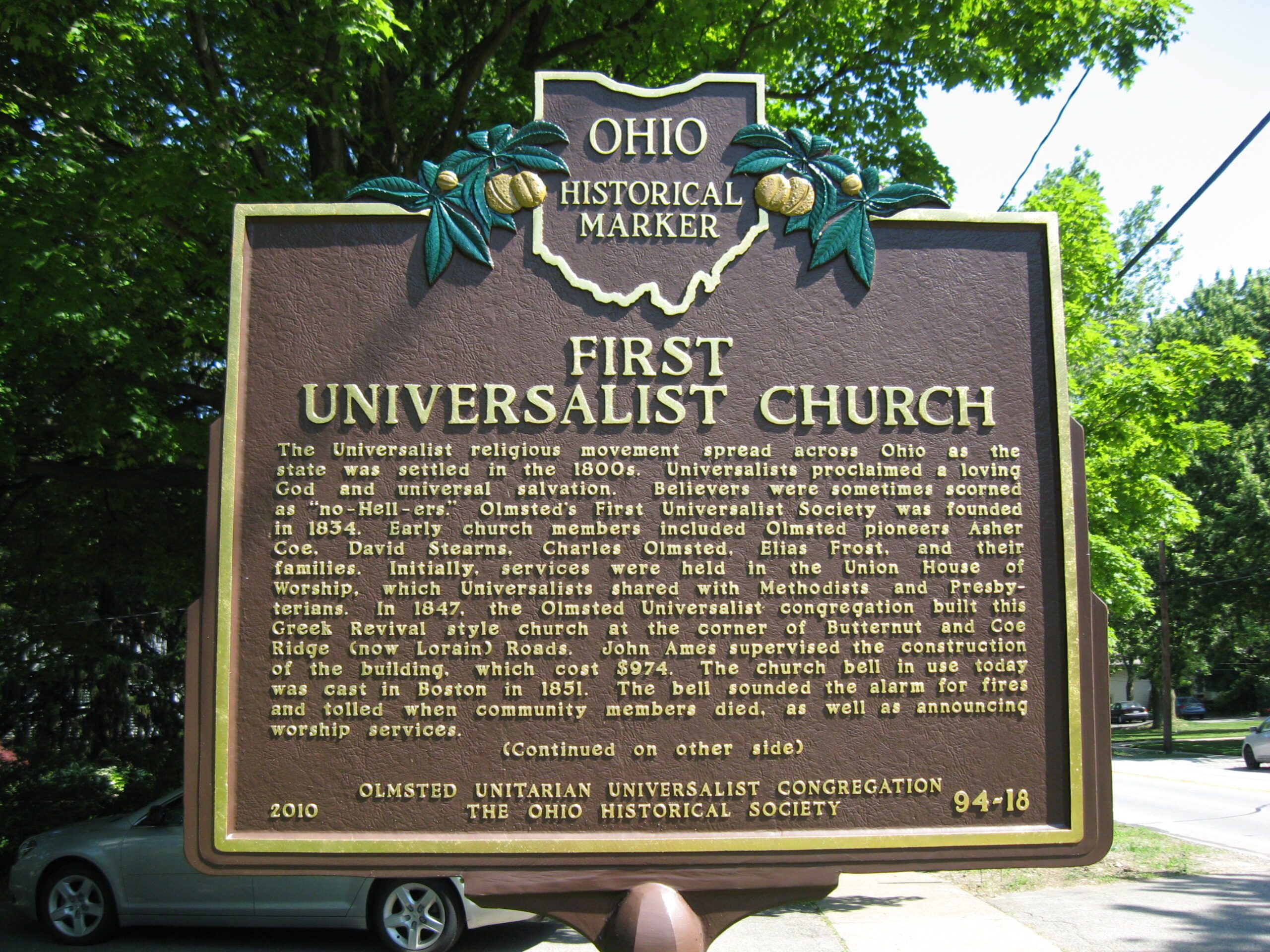
The above is a typical marker found in Ohio, Indiana, Illinois, and states that came out of the northwest territory. I saw several of them in Butler County, Ohio, the place of my birth and raising. American Universalism spread to the Northwest Territory (primarily Ohio) in the early 1800s, establishing over 50 churches by 1850. Following 1770s New England roots, Universalists moved westward, with Ohio serving as a major hub where churches were established by the mid-19th century. By the late 19th and early 20th centuries, many of these individual congregations became foundational in what would later merge into the Unitarian Universalist Association (UUA). 

So, why do I mention these things in a series on Two Seedism? Well, because "Primitive Baptists" are 1) quasi Universalists, believing that only a few (minority) of the race will go to Hell and that a majority will go to Heaven, and 2) some "Primitive Baptists" did become Universalists, and so we have a sect called "Primitive Baptist Universalist," and 3) some Two Seed "Primitive Baptists" did believe that all of Adam's race would be saved, but did not believe that the Devil's seed were human beings made in God's image, nor Adam's descendants, and 4) because the Universalists described above gave a weird view concerning "regeneration" or being "born again," which is very similar to that of the Two Seeders "no change" view of it, and 5) because many "Primitive Baptists" felt a need to debate the Universalists, and 6) because many of the first "Primitive" or "Old School" were anti-Trinitarians or Unitarians. Potter debated them, as did Elders John R. Daily at least twice (against Ballard and Hughs), George Stipp (several debates with them), Samuel Williams (2 debates with them), Benjamin Lampton, Newton Peters, S.F. Cayce, etc. 

With this introduction we will now return to citing from Elder Lemuel Potter's writings against Primitive Baptist Two Seedism. In chapter twenty one of "Life and Travels of Lemuel Potter" Potter wrote:

"In the month of February, 1881, I held a three days' discussion with a gentleman by the name of Williams, in Franklin County, Illinois, on the following proposition: —The scriptures teach that there will be a general resurrection of the bodies of all the sons and daughters of the first man Adam, or natural man, some of them to endless life, and some to endless punishment." Mr. Williams was a Universalist and while he professed to believe in the salvation of "all men," as he said, he did not believe that Adam's posterity would be saved."

The words highlighted in red sounds so much like the belief of many Two Seed Primitive Baptists. They too would endorse the idea that all of Adam's race would be saved, but would exclude the idea that the Devil's seed was of Adam's race. 

In chapter 27 Potter wrote:

"Elder Shields and Elder Dalby were two leading men of their respective Associations. Shields was a member of the Wabash district, and Dalby a member of the Okaw Association. They differed very materially on the subject of the new birth. Elder Dalby was said to be the originator of the no-soul doctrine, which I have already mentioned in connection with Elder Paine. Elder Shields fought that doctrine, and at the time of this meeting the two men were on very unpleasant terms."

Potter more than once referred to what he called "the Dalby doctrine." I have searched the Internet on this preacher (George W. Dalby) and have found little information. He obviously represented one of the sub-groups of Two Seeders, the group who denied the existence of a soul. However, I have lately found the following information from this Web Page (here) which gives information on the Martin family of Illinois yet has information about George W. Dalby. There we read (emphasis mine):

"Rezin Charles Martin was a Baptist preacher, and though he died when but slightly past middle age, he had won distinction both as a thinker and a public speaker. George W. Dalby, who was a competent judge in such a case, said that his name, Rezin, was well given and that it should have been spelled "Reason." I will add here a note on George Wade Dalby, who was the most noted preacher in his church for thirty or forty years after about 1850. About the year 1869, he and several other preachers got into a controversy with an eloquent and forceful preacher, John Shields, who lived near Paris and was pastor of the largest Baptist church known at that time (about 300 members). Dalby's associates in the controversy were several eloquent preachers in Indiana -- Joseph Skeeters, two brothers named Darnell and George W. Paine, and James S. Whitlock. Most of the preachers sided with Dalby and Skeeters, but did not get deeply into the controversy. Skeeters was the leader in the attack. He had said, "why Shields is preaching a typical Methodist heaven, the kind that produces the camp meeting shouting orgies. I am going to hit that the first chance I get." And he did, at an association meeting held at a church in Shelby County. Both he and Shields delivered sermons on Sunday, and Shields, who was first, repeated his description of the heavenly life, a spiritual existence which followed immediately after death; he argued that it was only the sinful flesh that died, but the soul, which he said was the real man or woman, went directly to an eternal bliss." (pgs. 120-121)

I will not have much commentary to offer on these citations but simply include them here and in this series for the benefit of others who do historical research into the "Primitive Baptists" or the Two Seeders. 

We read further:

"Skeeters in his sermon did not mention Shields or what he had said, but declared his own belief that the Christian faith was grounded on the promise of the resurrection, and if that failed, "all our hopes are vain." He said this was what Paul had in mind when he declared, "If there be no resurrection from the dead, then we of all men are the most miserable." This is briefly and in substance what both men said. I know because while I was not present at this particular meeting, I have heard both of them discuss the matter several times. It might have passed away as only a difference of opinion, but soon after, it may have been before they left the meeting, Shields, who was very indignant, met Skeeters and a wordy dispute followed in which Shields told him he was a "soul sleeper." At that time, preachers did not often go by train, but would go across country usually holding meetings wherever they stopped at night. Monday evening after the association meeting closed, Shields had an appointment at the Lynn Creek Church. Skeeters, Dalby, W.H. Darnell, and G.W. Paine came along, but took seats in the audience, and Shields had the pulpit all to himself. I heard that sermon, and in some way I had heard of the controversy on the day before. The Church was crowded, many people expecting a renewal of the controversy, but Shields did not mention the disputed doctrine."

Recall that Potter spoke about Elder Paine and I gave what he said about him in the preceding chapters.

We read further:

"Four years later the disputed doctrine was discussed again at a meeting of the association held at Lynn Creek. In this meeting, W.H. Darnell followed Shields and made a very strong presentation of their position. Dalby, who was moderator (Chairman) of the meeting and who sat at the front of the platform by the side of the speaker, fervently shook the hands of Darnell at the conclusion."

"The next morning I saw Shields and Darnell meet near the speakers stand and saw men hurrying toward them, evidently expecting something like what occurred four years before. But the conversation, though serious and dignified, was quite friendly. Skeeters had preceded Shields (they always had three sermons at these Sundays and all of them too long). I heard Skeeters talking to a group of men and saying: "He did not make an attack. He gave his own views and said nothing he did not have a right to say. 
 
But the feud gathered strength largely on account of Shields' aggressiveness. I remember hearing him say, "I would not talk to any of those men (meaning perhaps Dalby, Skeeters, the Darnells and Paine) without witnesses, because," he said, "I know they will lie." He was an older man than the others, and was nearly blind. (Skeeters became blind too in his old age.) The lay leaders of the Shields party were all old men with their families and others under their influence." (pg. 121) 
 
"The controversy did not much disturb the churches in Indiana, where Skeeters and the Darnells and their friends had full sway. But in the Illinois associations, it was different. Wherever Shields had personal influence, there was trouble except in his own association, where he appeared to have a united following."
(pg. 122)

We read further:

"The preachers of the Skeeters and Dalby school, while they did not hesitate to declare their position on the disputed question, seldom elaborated or explained it. They did not like the taunt of "soul-sleeper." Some of the small preachers of the Shields faction went to a spiritualistic extreme. Dalby in private and friendly conversation went much further than he ever did in the pulpit. My father never joined in argument over the disputed doctrine, but I think he favored the Skeeters and Dalby position. Anyway, he remained in that church party. Dalby once said in private talk "When a man sleeps he is unconscious of his surroundings. He may sleep so soundly that he does not dream or is at least unable to remember a dream. Now if a man were in a deep, dreamless sleep and if something should occur to end his life, do you think this man, who at the moment apparently knows nothing, will at the next moment, in death, know everything? It is nonsense I tell you; when a man is dead, he is dead." But he had faith in the Resurrection!" (pg. 122-123)

We read further:

"Dalby was at first a preacher in the "Separate" Baptist church, and it is said that he went to hear R.C. Martin preach to get his points on "Predestination," which is the principal difference between the two Baptist churches. He did this for the purpose of answering them as he was also an eager and talented controversialist. He was impressed in a way different from what he expected. He put off his answer and returned for another hearing and finally acknowledged conversion to the older doctrine, and was for many years a leading preacher among Baptists of the old school (the people of other churches call them "Hardshells"). John R. Eden, who knew Dalby well, said of him that he had the "keenest" mind he ever encountered. He had once been Dalby's attorney, and was surprised at his ability to understand a point of law on the instant it was presented. He said if Dalby had been a little better educated and had studied and practiced as a lawyer, he would have been brilliantly successful."

Keep in mind that these citations are on a web page that deals with the history of the Martin family of Illinois, and in the above citation there is mention of "R.C. Martin." Also, the one who is writing these things is of the Martin clan.

Also, what the lawyer John R. Eden said of George Dalby, about him having a "keen" mind, has also been said of other Two Seed preachers, such as Elder Daniel Parker and Elder Wilson Thompson. 

Now let us return to what Potter said further in his autobiography. Potter wrote further in the same chapter:

"These two brethren had been accused by each other of taking very extreme positions against each other. Elder Shields has been accused of denying that the body was any part of the child of God. Whether he was guilty or not, I do not remember his ever saying so, but I do know that he claimed to believe in the resurrection of the body. Elder Dalby had been accused of denying that there is anything about man except the physical part of him. He believed that it is the man that is born again in the work of regeneration. It seems that this controversy was so hot between the two that it was impossible for one of them to preach in the presence of the other without referring to it. Elder Shields preached first that night and in the course of his remarks he took hold of his coat and drew it around him, stating that he had said that John Shields did not believe The Bible. I was very much surprised at that statement, but I felt that he intended to be understood that John Shields was the outer man, or body, and that it had not yet been regenerated, but that the soul had and was a believer. I felt that it was an extreme position for a man to take and I still think it was."

Both sides, the one represented by Dalby and the one represented by Shields, were Two Seeders, but disagreed on certain tenets peculiar to that sect. Some Two Seeders denied a bodily resurrection, some did not. Some Two Seeders denied that man had a soul, some did not. Some Two Seeders believed in soul sleep, others did not. The charade by Shields reminds me of what history professor John Crowley wrote in his book "Primitive Baptists of the Wiregrass South" from which I cited in several postings. Crowley showed that the original "Primitive Baptist" position affirmed that God used means in the eternal salvation of sinners. Wrote Crowley:

"During this time, a major dispute erupted between the Alabaha and its parent organization, the Suwannee River Association. In 1860, Job E. W. Smith, moderator of the Suwannee River Association, preached at the Alabaha River Association’s annual meeting. During his sermon, Smith unequivocally advocated for the antimeans position when he held up the Bible and told the congregation, “You have been told that this is the word of God; do you believe it? I say it is not, it is ink and paper.” Smith also stated “the Gospel had no saving efficacy in it to the awakening of sinners; it was only for the feeding of the flock.” The Alabaha, who had long advocated the instrumentality of the Gospel, declared that Smith’s words were “a departure from the faith” and recommended “that this body withdraw her correspondence from the Suwannee Association until she becomes reclaimed.” (pg. 34)

You can read my postings on Crowley's book (here and here). Shields taking his coat and wrapping it around himself and saying that the one in the coat was not him is similar to the above named anti-means preacher who held up the Bible and said "this is not the word of God." 

In "History of the Baptists of Illinois" by Edward P. Brand, in CHAPTER XXXIV under the sub-title "New Associations," we find where he wrote the following (See here; emphasis mine)

"The Okaw is in Coles county and vicinity, on the same ground as the Mattoon Association. These two small bodies were the result of the cleavage in the Wabash Association on account of Parker's "Two Seed" doctrine, and they are the only representatives of that teaching left in Illinois. They are not in fellowship with the other Predestinarian Baptists in the state, and correspond only with each other and two small Associations of similar faith in Indiana. Their going out left the Wabash with but ten churches, part of them in Indiana. Their going out left no Two Seed churches in Crawford county, Eld. Parker's home, and this rejection of his teachings had such an effect upon him that in the summer of 1833 he gathered a dozen families into a colony and a church and emigrated to Anderson county, Texas. The result is that the antimission churches of Texas are divided over this thing about as they are in this state."

Elder Parker brought division among the Baptist churches wherever he went. So it was said of him:

"Doctor Carroll, of Texas, in a speech before the Southern Baptist Convention at Hot Springs, Arkansas, in 1900, compared Parker in his violence to a wild boar rooting up the tender plants in a garden." (William Dudley Nowlin The Anti-Missionary Controversy of Baptists in Kentucky from 1832 to 1842; See here

Brand wrote further:

"The Two Seed theory, that the elect and the lost are different races and eternally separate, is a fascinating one for many no-effort preachers. It makes so clear the conclusion that it is useless and wrong to labor for the Seed that are outside the gospel. It resembles the slaveholding theory that slaves are not of the human race. It is to Old School theology what rationalism is to the biblical critic, his constant dread and yet his constant tendency."

This is so true. I plan to enlarge upon this in my closing chapters of this series. In the next chapter we will continue to look at what Elder Potter wrote about Two Seedism.


Saturday, March 14, 2026

Two Seed Baptist Ideology (XLVIII)


The above is a picture of one of the many books that are now being published by "Welsh tract publications" and you can see them at their web page (here). Welsh Tract church is one of the oldest in the Philadelphia Baptist Association, formed in 1707, and is the oldest Baptist Association in America. I don't know much about Guillermo Santamaria, but he has written several books giving the history of the Old School Baptists and especially of the Two Seeders and anti-Trinitarians within that sect. The web page has a tremendous amount of old writings from the first generation of Old School or Two Seed Primitive Baptists.

In this chapter we will give more citations from Elder Lemuel Potter, a man who had Two Seed leanings when he first began to preach for the "Primitive" or "Regular" Hardshell Baptists and who in his later life began to write polemically against Two Seedism, as we have seen in the immediate preceding chapters dealing with those writings of Potter. This and the next chapter we will look at some various articles Elder Potter wrote against some of the leading tenets of Two Seedism, especially as it relates to the doctrine of regeneration or of the new birth

We have already reviewed what he said about the Two Seed doctrine of "eternal children," or "eternal vital union," and about the "preexisting humanity of Christ, and about the "non-resurrection" belief, and about the Two Seed idea about "unconditional election," etc. We have looked at citations from Potter's book titled "Unconditional Election Stated And Defined; Or, A Denial Of The Doctrine Of Eternal Children, Or Two Seeds In The Flesh" and from his autobiography titled "Labors and Travels of Elder Lemuel Potter" from which we will continue to cite from in this chapter. In the next chapters we will cite also from Potter's 1895 work titled "A Treatise On Regeneration And Christian Warfare." You can read that work at the Primitive Baptist Library's Web Page (here).

It is interesting that Elder Potter does not say anything about the Two Seed denial of angels, and of their view that angels are human messengers, which is because it was such a bugaboo or taboo subject so that even the opposers of full blown Two Seedism avoided the topic or simply went along with the common view that sin never occurred in heaven. In previous chapters we wrote about this issue at length. He says nothing about the fall of the angels nor of the origin and fall of Satan, as did Elder John M. Watson. Elder Potter claimed Watson as one of their first leaders or founders when they became a separate sect, as did Elders Sylvester Hassell, Gilbert Beebe, and others. 

Potter, in his debate with Throgmorton (which we cited from in the previous chapter), argued that Watson did not believe in means in regeneration or eternal salvation, which was a falsehood, and I believe Potter knew it was, and if true, then why do the present day descendants of the Two Seeders, aka the "Primitive Baptists," continue to hold Potter up so highly? How could Potter deny that Watson believed in means seeing it is so clearly taught in Watson's Book "The Old Baptist Test" and through Watson's periodicals such as "The Old Baptist Banner," the "Correspondent," etc.? He was familiar with the editors of "The Baptist Watchman" that I mentioned earlier, nearly all who were physicians like Watson, and who believed in means and in the perseverance of the saints in faith. They all believed that they were carrying on the work of Watson in his fight with the Two Seeders and their beliefs, one such tenet said that the Gospel was not a means in saving sinners from sin nor in coming to have faith. 

Potter used to write to the "The Baptist Watchman" that was begun by fellow ministers and doctors of Elder Watson, namely Elders R.W. Fain, J. Bunyan Stephens, and E.B. Mullins. It started after the civil war (late 1860s) and continued till the latter end of the 1870s. It was published out of Nashville, and was a weekly periodical with a wide readership and the elders who published it carried on the work and beliefs of Watson, fighting against Two Seedism, and against the view that the Gospel is no means in the eternal salvation of sinners. So, Potter no doubt knew that these brethren believed in means, in perseverance and not mere preservation, and other things that Potter would later reject along with those who followed him. So, I can only conclude that he told a falsehood. He certainly did when he also said that John Gill did not believe in means, which is another falsehood. In my series "The Hardshell Baptist Cult" I have several chapters titled "Hardshells On Gill" (chapter 58-65) where I show where Gill clearly believed in means. (See that series here)

In Potter's debate on the "means question" in 1890 with Elder W. T. (Tom) Pence, Potter admits that J. Bunyan Stephens believed in means, and in so doing agrees that the means view was taught by the supporters of Watson. Potter said the following in that debate:

"He (Pence) undertook to show that Elder Clark was agreed with him on the subject of means. In this he gloriously failed, for I showed him from Zion's Advocate, that on the occasion of Elder Booten's ordination, Elder Clark was the moderator of the Presbytery, and that Elder Booten was interrogated on this very point, as to whether he believed in the Spirit's work in the regeneration of sinners, without, and independent of, all means and instrumentalities whatever. A correspondence between Elder J. B. Stephens, of Nashville, Tenn., and Elder Clark, concerning this matter, which was published in Zion's Advocate, shows that Elder Clark emphatically denied the use of any means or agencies outside of the divine Spirit in the regeneration of sinners. I am not prepared to give the date of the Advocate in which this correspondence occurred. In reply to my idea that the gospel was the power of God to the saved, Elder Pence rather made light, saying: "The power of God unto salvation to the man already saved?" (I have cited this statement several times, such as in this post here).

First, I have shown how Potter was wrong about Elder John Clark of Virginia, a first generation leader of the newly formed "Primitive" or "Old School" Baptist sect, in saying that Clark denied means. This same claim was made years later in the famous "Mt. Carmel Church Trial." (1909) In that trial the means side of the "Primitive Baptist" church testified that Elder Clark, editor of "Zion's Advocate," did not deny means, and even cited articles of his from "Zion's Advocate" that showed that to be the case. I spent a whole day driving to Duke University years ago and reading old issues of the periodical and I saw clearly that Clark, like Stephens, believed in means. The means view was the original view of most of those who were part of the "anti-mission" movement, and the "no means" view was a later view begun by the Two Seeders who came after Elder Daniel Parker. My blog "The Old Baptist Test" (named after Watson's book title) is filled with Clark's writings that show this to be true. I also show that other first generation leaders were believers in the traditional Orthodox Baptist view that avers that the Gospel or written word of God is a means God uses in bringing about the birth of the Spirit and the eternal salvation of sinners. I also have citations from many other first generation Hardshells which prove this thesis, such as Elder R.W. Fain, Elder James Osbourn, Elder Mark Bennett, Elder Joshua Lawrence, Elder Samuel Trott, Elder C.B. Hassell, etc. 

Potter in "Labors and Travels of Elder Lemuel Potter" wrote the following in chapter nineteen (See here; emphasis mine):

"During the year 1871, and '72, I began to get acquainted with the brethren of Wabash District Association. I visited their Association once or twice, and visited a number of their churches, and found that among them and some of their correspondents, the question was being agitated as to what it is that is born again in the work of regeneration. Some of the preachers of that, and some other Associations, differed so widely about it that they were accused of taking positions that were very extreme. One man was accused of claiming that the body was no part of the child of God. Another denied any distinction of soul and body, claiming that the man that was born again, to use their own language, was, the man that ate bacon and cabbage. There might have been other issues among the people, but about, that time I met a man by the name of G. W. Paine, who denied the doctrine that the soul was born again in the work of regeneration, and who made light of the idea that any part of the man went to heaven when the body died. The first hint that I ever had from him on this question, was in a conversation which I overheard between him and another brother in Paris, Illinois. As soon as I had an opportunity, I asked him if he believed that there was a distinction between the soul and body, and if he believed that the soul went to heaven when the body died. He held forth the idea that man went to the grave and remained there until the resurrection, and that if he went to the grave he did not go to heaven. He denied being a soul-sleeper, but at the same time in speaking of the state of the dead, he had the whole man in the grave. He said when the Bible said soul it meant man, and when it said man it meant soul. According to his own definitions, I sometimes called him soul-sleeper, and sometimes accused him of believing that man had no soul, the latter, I think perhaps is the most proper name." 

The controversy over regeneration has plagued the "Primitive," "Old School," "Old Regular," or "Hardshell" Baptists since it began via the anti-mission movement of the 1820s and 1830s. The controversy involved several points, one of which is mentioned by Potter in the above. It concerned stating "what is it that is born again?" Another question involved describing what occurred in regeneration, what changes, if any, occurred to a sinner when he was regenerated or born again. Another question involved whether regeneration is the same as spiritual rebirth. Another question involved whether the begetting was distinct from the birthing. Another question involved whether those "born" of the Spirit were "begotten" in eternity past. Another involved the question about whether regeneration involved conversion, or evangelical faith and repentance, whether a sinner could be regenerated without being converted. Another question involved whether a person did anything in order to be regenerated. Another question involved whether God used human means, or the means of the Gospel or word of God in his work of regeneration. Another question involved whether regeneration was in any sense a renovation or restoration of the fallen nature of sinners. Another question involved discerning what are the causes and effects of regeneration. Another question involved the doctrine of vital union with Christ, whether regeneration brought about this union or whether the union was from eternity.

Potter continued:

"He also held forth the idea that the flesh and bones of Jesus Christ had existed from all eternity, and that no part of the body of the Savior was taken from the Virgin Mary except the blood. In conversation with him, I asked him this question; "Jesus Christ said to the thief on the cross. 'To-day shalt thou be with me in paradise.' Where is paradise of which the Savior spoke on that occasion?" He said it was the grave. I then asked him, “If the grave was paradise, why would not both the thieves be in paradise when they went to the grave?" This question he did not answer, if I remember correctly. He finally began to make visits among the churches and country where I lived, and as is always the case, when heresy is introduced among a people, he had a following. I opposed his doctrine, and I also opposed him as a man. Finally the churches refused to open their doors to him to preach, because he advocated the doctrine that I have already mentioned in this chapter." 

About the idea that Christ's body existed from eternity we have already addressed, and quite extensively. It is one of the ideas that helped to produce the Two Seed sect in the Baptist family.

Potter continued:

"During the agitation of this question among our brethren, I became more discouraged in the ministry than at any other one thing that could have happened. I did not believe that doctrine. I believed that there was a distinction of soul and body in the man, and that the soul was born again in the work of regeneration, that it went to heaven at the dissolution of the body, and that in the resurrection, the body would be changed and taken to heaven, and that soul and body thus united would make a complete man, capable of enjoying heaven with all that heaven means. I still believe that doctrine. There has never been a moment of time when I thought on that subject that these have not been my sentiments, and so far as the pre-existence of the children of God is concerned, I never have believed that they actually existed. I have believed that God has known them from all eternity, and that it was as easy for Him to know them before they existed as afterwards. I believe that God made his people, both soul and body, and I have never believed that he brought any part of them down from heaven."

I believe Potter is equating "soul" with "spirit" in the above words. Therefore he seems to take the view that man is dichotomous rather than trichotomous. My departed father, a minister with the "Primitive Baptists" for over fifty years, held to the dichotomy view, which I did also until I studied the matter more fully and came to believe in the trichotomy view. In either case, the argument of Potter, if true, destroys one of the leading tenets of Two Seedism. How is that? Because the Two Seeders believed that there was no change to the "old man," to the fallen man, to the "Adam man"; not to his soul, spirit, mind, heart, or body. They rather believed that something outside the man was "deposited" or "implanted" within the Adam man and did not change the Adam man, like a rabbit's entering into a hollow log, which does not change the log (hence the "hollow log" doctrine that we spoke about in previous chapters). 

The truth is, of course, that God's internal work in a sinner, begun in what is called "regeneration," is the beginning of a transformation process which is changing the man in all his inward parts, his soul, spirit, heart, and mind. The body is not changed, nor his "fleshly" nature obliterated, but by God's work in "progressive sanctification" he assures that the new nature, the divine nature, will ultimately win in its battle with the old depraved nature. So Paul wrote:

"And I am sure of this, that he who began a good work in you will bring it to completion at the day of Jesus Christ." (Phil. 1: 6 (esv)

"Even though our outward man is perishing, yet the inward man is being renewed day by day." (II Cor. 4: 16 nkjv)

"But we all, with unveiled face, beholding as in a mirror the glory of the Lord, are being transformed into the same image from glory to glory, just as by the Spirit of the Lord." (II Cor. 3: 18 nkjv)

These verses show that by God's internal work the invisible parts of man's constitution are continuously and progressively being changed, restored, reconstituted, reformed, being a kind of spiritual metamorphoses.

Potter says "I never have believed that they (children of God) actually existed" in eternity past when God foreknew and predestined them to become his sons and daughters. However, later in the book he writes:

"When I first joined the church and began to preach, there was a great deal said about the Two Seed doctrine, and the most of our preachers of southern Illinois believed it. It was nothing uncommon to hear a minister speak out in favor of that doctrine in his sermons. It seemed that in our immediate connection, it had the ascendency (sic). Some of the Associations in our correspondence passed resolutions that the belief or disbelief of that doctrine should not be a bar to fellowship. For several years after I commenced preaching, I rather favored it, enough to accept it at least, and without any investigation of the matter, I did not know but what it was the doctrine of our people generally. I finally began to study the matter for myself, and I soon became satisfied that if it was the Baptist doctrine I did not believe it. After trying to discourage the agitation of it for a few years, I studied the matter so much that I finally concluded to write on that subject, which I did, and put out a small work, giving my objections to it, in the year 1880." (pg. 262) 

Is he saying that he never believed in the "eternal children" doctrine, but did believe in some of the other Two Seed tenets? He also said: "I did not know but what it was the doctrine of our people generally." I find that statement to be a head-scratcher. 

Wrote Potter further:

"I also believe that Jesus Christ took everything from the Virgin Mary, his mother, that pertains to his humanity. I do not now, nor have I ever believed in the pre-existence of human nature. Because I contended for what I believed on these things, and opposed what I did not believe, some of the brethren thought very hard of me, especially the admirers of Mr. Paine. One man who had been, and is yet a friend of mine, spoke to me on one occasion concerning the matter about this way: "Let me tell you as a friend, that when you undertake to fight Elder Paine, you are killing yourself. You are jealous of him—that is the trouble. He can beat you preaching. He does not even leave you the bone to gnaw on, that is the reason you are opposed to him." I replied to him that if my opposition to Elder Paine and his doctrine killed me, to just let me die. I expected to oppose him and his doctrine as long as I was able to do so, and thought it necessary. His doctrine is heresy, and it is not good for the church."

In chapter twenty Potter wrote:

"Among other things that Elder Paine preached, besides the no-soul doctrine, as I have stated in another chapter, was that the flesh and bones of Christ and his human nature had existed in heaven from all eternity. I had about as little use for this as for the no-soul doctrine, or the non-resurrection doctrine, and I had frequent conversations with him upon that subject."

Again, we have in previous chapters spoken of this leading tenet of Hyper Calvinists of the early 18th century (Hussey, et. al) and how it (preexisting humanity of Christ) became one of the pillars of Two Seed ideology.

Potter continued:

"Then I began to make inquiries and was told that Elder Paine himself had gone away and told the people that he preached the eternal flesh and bones of Jesus in my pulpit, and that I and my brethren endorsed it, and that I called on them to come forward and give him their hand as a token that they endorsed his doctrine. I did not feel much surprised, when I was told that Elder Paine had so willfully misrepresented what I had said, for he had prevaricated so many times, while he was in our part of the country, on different occasions, that I had lost confidence in his veracity. I was not alone in that view. A number of other brethren soon found out that it would not do to depend too much on his word."

Potter continued:

"He was at Mount Pleasant Church on one occasion, and the brethren requested him to come out on those points plainly in his Sunday discourse, so they would know just where he stood, but he politely declined and preached a good sermon, that I suppose no Primitive Baptist would make any serious objections to. But afterwards he preached at a brother's house in the neighborhood—and in his discourse stated that he could prove by the Scriptures that Jesus Christ was on earth three times before he was born of the Virgin Mary, and that he ate meat, and after his meeting was over he walked around among the brethren, and seemed to feel very much elated with the thought that all those brethren were going to take his doctrine...I was told that he thought very hard of me for opposing him in that country, but I feel thankful that his preaching, with all the zeal and ability that he possessed, did not effect a division among our people, and perhaps very few if any of the brethren of the Skillet Fork Association fell in with his doctrines, concerning what it is that is born again in the work of regeneration in time, and the pre-existence of the flesh and bones of Jesus Christ."

Of course, the pre-incarnate appearances of Christ, as the "angel of the LORD," or "Malek Yahweh," the eternal Son of God, in a human form does not prove that the Son of God has always had a human body. These are called "theophanies" by theologians. Some wonder, because of these theophanies, why Christ needed to be born of woman to obtain a human body. In reply we say that by being conceived in Mary, Jesus took on human flesh so that He could be our “kinsman-redeemer.” As a literal descendant of Adam, Jesus could be the perfect sacrifice for Adam's offspring. The Messiah was prophesied to be the "seed of the woman" and the "seed of Abraham" and the "seed of David." The bodily forms in which Jesus appeared in the old testament did not fit this description. Notice these words of the writer of Hebrews:

"14 Inasmuch then as the children have partaken of flesh and blood, He Himself likewise shared in the same, that through death He might destroy him who had the power of death, that is, the devil, 15 and release those who through fear of death were all their lifetime subject to bondage...17 Therefore, in all things He had to be made like His brethren, that He might be a merciful and faithful High Priest in things pertaining to God, to make propitiation for the sins of the people." (Heb. 2: 14-16, 17 nkjv)

Recall that this was a favorite proof-text of Gilbert Beebe in his affirmation of Two Seedism. He thought that it taught that Christ's incarnation was the same as the children of God, that just as Christ existed prior to his assumption of a human body, so likewise did the children of God (or elect) exist from eternity before becoming incarnate in human bodies. That view of course no one ascertains by reading the text, prima facie. You have to see it through the spectacles of a Two Seeder. However, the verse does show that Christ partook of flesh and blood. So, the question is, when did he do this? Certainly it was not from eternity. The apostle John wrote:

"And the Word became flesh and dwelt among us, and we beheld His glory, the glory as of the only begotten of the Father, full of grace and truth." (John 1: 14 nkjv)

Clearly John is referring to Christ being begotten in the womb of his mother, the virgin Mary.

Other angels, other than the uncreated "angel of the LORD," appeared in human bodies in the old testament time period. But, angels do not have physical human bodies. So said Jesus: "a spirit hath not flesh and bones, as ye see me have" (Luke 24: 39) and scripture tells us that angels are disembodied spirits. (He. 1: 14). So, just as angels appearing in human forms do not prove that they have had human bodies from the very beginning of their existence, so too Christ appearing in human form in the old testament does not prove that he had a human body from eternity.

Saturday, March 7, 2026

Two Seed Baptist Ideology (XLVII)


Since we have been looking at what Elder Potter said about many Two Seeders denying a physical resurrection of the body, we will return to look at what Elder John M. Watson in "The Old Baptist Test" wrote on that point. Following that we will have a couple chapters where we give some more citations from Potter on certain Two Seed tenets.

Watson, in Section VI of his book "The Old Baptist Test" titled "The Resurrection" wrote:

"There has been much figurative language used with respect to the resurrection, which some have seized upon and tried thereby to reduce the whole to a figure, but instead of the truth of a real resurrection..." (pg. 228)

It is a funny thing that Two Seeders were too literal in Bible interpretation in some ways and yet too non-literal (or figurative) in other ways. They interpreted texts that speak of people being the children of the Devil in a most literal manner but scriptures dealing with a physical resurrection in a most figurative way, thereby denying a literal bodily resurrection. The only way to deny the resurrection of the bodies of the just and unjust is to deny that the texts that speak of it are literal. We have already seen in the preceding chapters where Elder Sylvester Hassell saw the ill effects of overly spiritualizing many literal texts in the Bible, a thing that still characterizes many of today's "Primitive Baptists." 

Watson wrote further:

"But after all the revealed light we have on the subject of the resurrection of our bodies, and the examples given of it, the Parkerite will not admit it, but entertains a notion about it subversive of the whole matter. His conception is predicated of the erroneous propositions that only the elect fell in Adam, that all human souls are eternal, and were infused into Adam at the time of the formation of his body, and that the multiplication of the woman's conception was to engender bodies for the abode of a seed from Satan. Human bodies, therefore, are held in low estimation by them, and, when they die, go to the dust from whence they were formed, the soul to God, with a mystic, imaginary body of its own, and the seed of the devil back to him, and the body in which it dwelt, like that of the Saint, to the dust, never to rise again. Thus the bodies, both of the just and unjust, are never to rise again, but the soul returns to God to be again confounded with him, and can have no distinctive existence or being of its own, while the seed of the devil returns to Him to be one with Him again-so, in the winding up of the whole affair, there will be one God and one evil spirit. This is a fair induction from their erroneous premises-a palpable reductio ad absurdum." (pg. 228)

In the above citation Watson gives several Two Seed propositions, one of which says that the Two Seeders believe "that all human souls are eternal." But, that is a correct proposition. Surely Watson does not deny the immortality of the soul. Perhaps he means "that all human souls are eternal AND were infused into Adam at the time of the formation of his body." That would have been clearer had he not put a comma after "eternal" and before "and." In this case Watson would deny that all souls were in Adam when he was created and would be taking what is called the "creationist" view of the origin of the soul, which says that each soul is created by God in the womb after the female egg is fertilized by the male seed. The other view is called Traducianism, which posits that both body and soul are derived from parents through natural procreation, with souls passed down from Adam. I think, however, that the Two Seed view is a modification of the Traducian view, for it does not simply say that the souls of all are derived from the first soul in Adam or Eve but that the souls were actually present in them. Many Creationists would not deny that all souls were represented in Adam, but not that each soul preexisted in Adam.

Watson also says that the Two Seed view has a low estimation of the human body. Recall that in the first chapters of this treatise we saw how Two Seedism borrowed much from Gnosticism, and a chief idea in it is to say that the material or physical world is evil and that salvation was to be delivered from it. They therefore would naturally see the idea of living forever in human bodies as a bad thing.

Next, Watson gives a list of the several items in the "Parkerite creed." Watson wrote:

"We will now take a general retrospect of what we have written, and compare tenets with our opponents. Let us, then, make out a synopsis of the Parkerite creed:

1. They believe there is an uncreated, self-existent and eternal God, infinite in Wisdom, Power and Holiness.
2. They believe there is an uncreated self-existent, eternal Evil Spirit, or Devil, intelligent, wicked, cunning and antagonistic to God.
3. They say that the soul of Christ is uncreated and eternal.
4. They fancy that the souls of the Children of God, or the Elect, are uncreated and eternal, and were always in actual union with God.
5. They contend that all the souls of the Children of God were infused into Adam, and pass, by a procreation of human bodies, into the persons of the elect.
6. They assert that the reprobates have no souls, and that their bodies are a multiplication of the woman's conception for the reception of a connate Satanic seed, uncreated and eternal, instead of souls, with which Satan was eternally united.
7. They affirm that, at death, the soul returns to God, and the seed of Satan to him.
8. They deny the resurrection of the bodies of the just and unjust." (pg. 229)

Tenet number one, of course, is true. We have thus far looked at the above errors and of others not in the list. However, it is strange that Watson left out several other false tenets, although he does mention them in other places. He does not mention the errors of Two Seeders concerning "regeneration" or "rebirth," the "no change" view of it, nor their denial of God's use of the means of his word in that work. It is also strange that in a list of their beliefs he lists one item that is true but seven that are false. Perhaps he is just willing to grant them some degree of orthodoxy by mentioning that one item. However, as we have seen, they really do not believe item number one, for they believe the Devil is uncreated and self existent, and that he created or procreated his children. They may believe that God is as stated in item number one, but they do not believe he is the only one who fits that description.

Watson makes this observation on Two Seedism:

"Their doctrine is serpentine, and it has serpentine ways and outlets, and is hard to hold even when caught." (pg. 231)

I think that this was not only true with the Two Seeders in Watson's day, but it is also true in later days, in the twentieth and twenty first centuries among those who call themselves "Primitive Baptists," with the exception of those who are of a different strain, such as the Eastern Association of Primitive Baptists. They are slippery in a deceitful way, and this is true with cults. By this I mean that they can be shifty, sneaky, deceptive, crafty, etc. When they are confronted with biblical texts that refute their erroneous premises, they can show some cunning craftiness in the ways they can twist a text to make it say what it does not say upon first glance. When I was with the Hardshells I often saw this slippery activity. They not only show this slippery serpentine activity in how they twist scripture but also in the ways they alienate preachers who do not toe the line from the affections of the Hardshell community.

Watson wrote:

"We were then willing to bear with the sparse amount of Parkerism, which then showed itself, while its advocates were careful to keep back its most objectionable tenets; but since then, it has been preached even to the extent of a full denial of the resurrection of our natural bodies, with its other unscriptural and hurtful doctrines; in consequence of which five of our churches have passed resolutions that it shall not be preached in their pulpits, and some of its advocates have been, from time to time, kindly entreated to forbear preaching such things. Moreover, an association lately constituted, which came out from among the Parkerites, or non-resurrectionists, has been received into our correspondence. Notwithstanding all this, we again entreat the advocates of Parkerism to desist from preaching their tenets; yea, we say if one or two of its leading advocates would desist, our associated union might be preserved, and oh! how fearful is the responsibility which now rests on them." (pg. 233-234) 

As we saw in previous chapters, for several decades of the 19th century the "Primitive" or "Old School" Baptists who opposed Two Seed heresies were far too willing to bear with Parkerism. In the previous chapter we saw how Dr. Throgmorton stated this very thing in his debate with Elder Potter. Some did begin to declare non-fellowship with Two Seeders in the 1840s and onward, but most did not. It was not until the 19th century neared its end that there began to be a widespread declaration against Two Seedism. Further, as we have shown, remnants of Two Seedism still remain among the "Primitive Baptists" of the Hardshell variety. How any of them could have tolerated the presence of those who denied a bodily resurrection for even a short time is amazing. It is also bewildering how they could declare non-fellowship against those who believed in supporting mission organizations, seminaries, Sunday Schools, etc. but not do so against Two Seed heresies. 

Watson wrote:

"Most of the evils, which have convulsed and shook the world, at different times, emanated, from perversions of Divine Truth. Have I perverted any text of Holy Scripture, and in that way opened a fountain tributary to the great time stream of error? Let me search it out and repent of it, and seal it up forever with a hearty recantation."

I wish that those who call themselves "Primitive Baptists," with but few exceptions, had this attitude. I have labored hard for the past thirty five years, and especially the past twenty years in writing against Hardshellism in my various blogs, to get them to do some honest investigation of their beliefs, to come here and discuss their heterodox views on Bible doctrine. I am thankful that we have helped many to come out of Hardshellism (with its remnants of Two Seedism) and others from going into it, but I wish there had been more. If Lemuel Potter, C.H. Cayce, John R. Daily, etc., were here today, I believe they would come here and debate their heresies. But, where are the debaters today?

Watson wrote:

"Who of us are thus feeding and sustaining the Man of Sin, aiding in building Babylon, or sinning in propagating Protestant heresies, or Old Baptist ultraisms. We can readily see the absurdities of Romanism, the errors of many Protestant sects, and avoid them, but we do not recognize, as heresies, those hurtful ultraisms which are eating, as doth a canker, upon our very vitals as a denomination--a denomination which very justly boasts of its antiquity, and of having never acknowledged any other rule of faith and practice but that of the Bible. But some of our brethren are interpreting many of its blessed truths in such a way as to lead off their hearers from the Old Baptist platform of principles. Some of them have pursued that perverse thing, Parkerism, with such obstinacy of opinion, and such perversions of the Scriptures, that we have been compelled to withdraw reluctantly from them. I will now show, most conclusively, that Parkerite ultraisms have changed some of the Old Order of Baptists into a new sect." (pg. 235-236) 

Watson believes that a person sins when he propagates heresies. I agree. I also believe that those who bid heretics God speed sin in doing so. So, it is a serious thing to believe and teach heresy. He speaks of what he calls "Old Baptist ultraisms." Many of those heretical ultraisms involved Two Seed tenets, and certainly included a denial of means in eternal salvation, a denial that a person must believe and repent to be eternally saved, affirming that nothing that a person does in life determines whether he goes to heaven or hell. He says those heresies and ultraisms were eating, like a cancer or gangrene, "our very vitals as a denomination." That cancer has indeed spread far so that very little of their denomination is yet living. He says that Parkerite Two Seed tenets have made the Hardshells "into a new sect." It is therefore highly ironic, and grossly inappropriate, for them to claim that they are "Primitive," meaning "original" Baptists.

Of course, Watson was not correct to say that the "Primitive Baptist" denomination that was created as a result of the anti-mission movement of the late 1820's and 1830s had an ancient ancestry so as to be able to "justly boast of its antiquity." Of course, Elder Watson and his segment of "Primitive Baptists" could make a better claim on that score than those "Primitive Baptists" who 1) began to deny that God used the means of gospel preaching to save his elect, and 2) began to deny that evangelical faith and repentance were essentials for eternal salvation, and 3) taught a no change view of regeneration, 4) and taught other Two Seed ideas.

Watson wrote:

"Parkerites are frequently heard to say, "that nothing will ever go to heaven but what came from there!" and, to prove the assertion, quote this text: "He that descended is the same also that ascended." Eph 4:10. They mean, that as the same person ascended who had descended, and as that person was Christ, his glorified human body was not taken up into heaven; thereby hinting darkly at the non-resurrection of our bodies-a heretical tenet which has been embraced by many of them!" (pg. 243) 

In previous chapters I have called attention to this motto of the Two Seeders that says "nothing will go to heaven but what came from there." This proposition is not given in scripture but is a man-made one, and it is taken to scripture and the scriptures made to conform to it by twisting scripture. This is true with many man-made propositions that cults and heresies invent. Today's "Primitive Baptists" have several of these as I have shown in previous chapters. Recall another Two Seed proposition that says that nothing a person does in his life determines whether he goes to heaven or hell. Believing that proposition is inspired, they make scripture to agree with it by perverting scripture. Another one says that if a salvation text has a condition to it then it is a mere time salvation, but if there is no condition then it is eternal. Accepting this proposition as inspired they make the scriptures to conform to it.