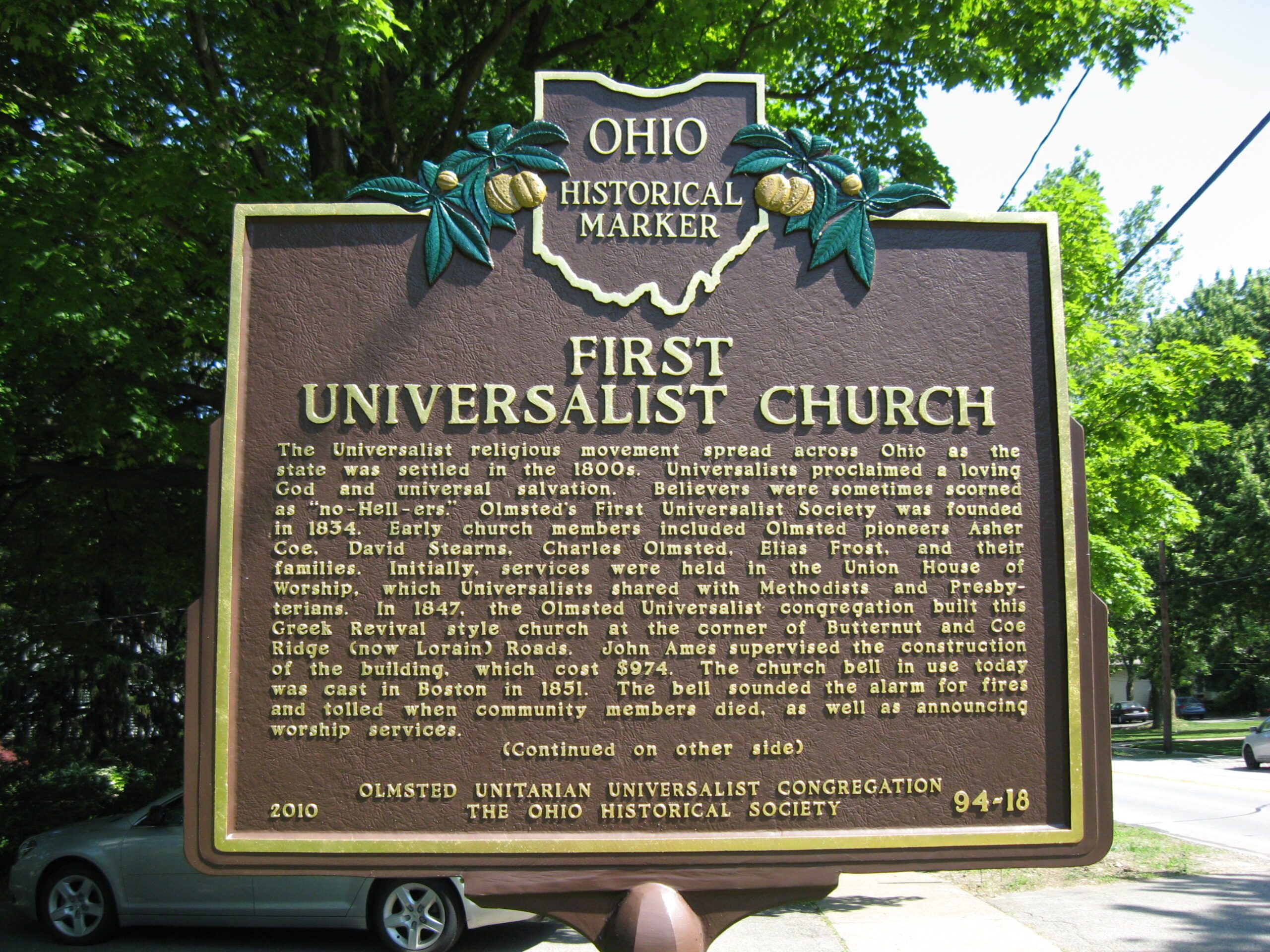
The above is a typical marker found in Ohio, Indiana, Illinois, and states that came out of the northwest territory. I saw several of them in Butler County, Ohio, the place of my birth and raising. American Universalism spread to the Northwest Territory (primarily Ohio) in the early 1800s, establishing over 50 churches by 1850. Following 1770s New England roots, Universalists moved westward, with Ohio serving as a major hub where churches were established by the mid-19th century. By the late 19th and early 20th centuries, many of these individual congregations became foundational in what would later merge into the Unitarian Universalist Association (UUA).
So, why do I mention these things in a series on Two Seedism? Well, because "Primitive Baptists" are 1) quasi Universalists, believing that only a few (minority) of the race will go to Hell and that a majority will go to Heaven, and 2) some "Primitive Baptists" did become Universalists, and so we have a sect called "Primitive Baptist Universalist," and 3) some Two Seed "Primitive Baptists" did believe that all of Adam's race would be saved, but did not believe that the Devil's seed were human beings made in God's image, nor Adam's descendants, and 4) because the Universalists described above gave a weird view concerning "regeneration" or being "born again," which is very similar to that of the Two Seeders "no change" view of it, and 5) because many "Primitive Baptists" felt a need to debate the Universalists, and 6) because many of the first "Primitive" or "Old School" were anti-Trinitarians or Unitarians. Potter debated them, as did Elders John R. Daily at least twice (against Ballard and Hughs), George Stipp (several debates with them), Samuel Williams (2 debates with them), Benjamin Lampton, Newton Peters, S.F. Cayce, etc.
With this introduction we will now return to citing from Elder Lemuel Potter's writings against Primitive Baptist Two Seedism. In chapter twenty one of "Life and Travels of Lemuel Potter" Potter wrote:
"In the month of February, 1881, I held a three days' discussion with a gentleman by the name of Williams, in Franklin County, Illinois, on the following proposition: —The scriptures teach that there will be a general resurrection of the bodies of all the sons and daughters of the first man Adam, or natural man, some of them to endless life, and some to endless punishment." Mr. Williams was a Universalist and while he professed to believe in the salvation of "all men," as he said, he did not believe that Adam's posterity would be saved."
The words highlighted in red sounds so much like the belief of many Two Seed Primitive Baptists. They too would endorse the idea that all of Adam's race would be saved, but would exclude the idea that the Devil's seed was of Adam's race.
In chapter 27 Potter wrote:
"Elder Shields and Elder Dalby were two leading men of their respective Associations. Shields was a member of the Wabash district, and Dalby a member of the Okaw Association. They differed very materially on the subject of the new birth. Elder Dalby was said to be the originator of the no-soul doctrine, which I have already mentioned in connection with Elder Paine. Elder Shields fought that doctrine, and at the time of this meeting the two men were on very unpleasant terms."
Potter more than once referred to what he called "the Dalby doctrine." I have searched the Internet on this preacher (George W. Dalby) and have found little information. He obviously represented one of the sub-groups of Two Seeders, the group who denied the existence of a soul. However, I have lately found the following information from this Web Page (here) which gives information on the Martin family of Illinois yet has information about George W. Dalby. There we read (emphasis mine):
"Rezin Charles Martin was a Baptist preacher, and though he died when but slightly past middle age, he had won distinction both as a thinker and a public speaker. George W. Dalby, who was a competent judge in such a case, said that his name, Rezin, was well given and that it should have been spelled "Reason."
I will add here a note on George Wade Dalby, who was the most noted preacher in his church for thirty or forty years after about 1850. About the year 1869, he and several other preachers got into a controversy with an eloquent and forceful preacher, John Shields, who lived near Paris and was pastor of the largest Baptist church known at that time (about 300 members). Dalby's associates in the controversy were several eloquent preachers in Indiana -- Joseph Skeeters, two brothers named Darnell and George W. Paine, and James S. Whitlock. Most of the preachers sided with Dalby and Skeeters, but did not get deeply into the controversy. Skeeters was the leader in the attack. He had said, "why Shields is preaching a typical Methodist heaven, the kind that produces the camp meeting shouting orgies. I am going to hit that the first chance I get." And he did, at an association meeting held at a church in Shelby County. Both he and Shields delivered sermons on Sunday, and Shields, who was first, repeated his description of the heavenly life, a spiritual existence which followed immediately after death; he argued that it was only the sinful flesh that died, but the soul, which he said was the real man or woman, went directly to an eternal bliss." (pgs. 120-121)
I will not have much commentary to offer on these citations but simply include them here and in this series for the benefit of others who do historical research into the "Primitive Baptists" or the Two Seeders.
We read further:
"Skeeters in his sermon did not mention Shields or what he had said, but declared his own belief that the Christian faith was grounded on the promise of the resurrection, and if that failed, "all our hopes are vain." He said this was what Paul had in mind when he declared, "If there be no resurrection from the dead, then we of all men are the most miserable." This is briefly and in substance what both men said. I know because while I was not present at this particular meeting, I have heard both of them discuss the matter several times.
It might have passed away as only a difference of opinion, but soon after, it may have been before they left the meeting, Shields, who was very indignant, met Skeeters and a wordy dispute followed in which Shields told him he was a "soul sleeper." At that time, preachers did not often go by train, but would go across country usually holding meetings wherever they stopped at night. Monday evening after the association meeting closed, Shields had an appointment at the Lynn Creek Church. Skeeters, Dalby, W.H. Darnell, and G.W. Paine came along, but took seats in the audience, and Shields had the pulpit all to himself. I heard that sermon, and in some way I had heard of the controversy on the day before. The Church was crowded, many people expecting a renewal of the controversy, but Shields did not mention the disputed doctrine."
Recall that Potter spoke about Elder Paine and I gave what he said about him in the preceding chapters.
We read further:
"Four years later the disputed doctrine was discussed again at a meeting of the association held at Lynn Creek. In this meeting, W.H. Darnell followed Shields and made a very strong presentation of their position. Dalby, who was moderator (Chairman) of the meeting and who sat at the front of the platform by the side of the speaker, fervently shook the hands of Darnell at the conclusion."
"The next morning I saw Shields and Darnell meet near the speakers stand and saw men hurrying toward them, evidently expecting something like what occurred four years before. But the conversation, though serious and dignified, was quite friendly. Skeeters had preceded Shields (they always had three sermons at these Sundays and all of them too long). I heard Skeeters talking to a group of men and saying: "He did not make an attack. He gave his own views and said nothing he did not have a right to say.
But the feud gathered strength largely on account of Shields' aggressiveness. I remember hearing him say, "I would not talk to any of those men (meaning perhaps Dalby, Skeeters, the Darnells and Paine) without witnesses, because," he said, "I know they will lie." He was an older man than the others, and was nearly blind. (Skeeters became blind too in his old age.) The lay leaders of the Shields party were all old men with their families and others under their influence." (pg. 121)
"The controversy did not much disturb the churches in Indiana, where Skeeters and the Darnells and their friends had full sway. But in the Illinois associations, it was different. Wherever Shields had personal influence, there was trouble except in his own association, where he appeared to have a united following."
(pg. 122)
We read further:
"The preachers of the Skeeters and Dalby school, while they did not hesitate to declare their position on the disputed question, seldom elaborated or explained it. They did not like the taunt of "soul-sleeper."
Some of the small preachers of the Shields faction went to a spiritualistic extreme. Dalby in private and friendly conversation went much further than he ever did in the pulpit.
My father never joined in argument over the disputed doctrine, but I think he favored the Skeeters and Dalby position. Anyway, he remained in that church party.
Dalby once said in private talk "When a man sleeps he is unconscious of his surroundings. He may sleep so soundly that he does not dream or is at least unable to remember a dream. Now if a man were in a deep, dreamless sleep and if something should occur to end his life, do you think this man, who at the moment apparently knows nothing, will at the next moment, in death, know everything? It is nonsense I tell you; when a man is dead, he is dead." But he had faith in the Resurrection!" (pg. 122-123)
We read further:
"Dalby was at first a preacher in the "Separate" Baptist church, and it is said that he went to hear R.C. Martin preach to get his points on "Predestination," which is the principal difference between the two Baptist churches. He did this for the purpose of answering them as he was also an eager and talented controversialist. He was impressed in a way different from what he expected. He put off his answer and returned for another hearing and finally acknowledged conversion to the older doctrine, and was for many years a leading preacher among Baptists of the old school (the people of other churches call them "Hardshells").
John R. Eden, who knew Dalby well, said of him that he had the "keenest" mind he ever encountered. He had once been Dalby's attorney, and was surprised at his ability to understand a point of law on the instant it was presented. He said if Dalby had been a little better educated and had studied and practiced as a lawyer, he would have been brilliantly successful."
Keep in mind that these citations are on a web page that deals with the history of the Martin family of Illinois, and in the above citation there is mention of "R.C. Martin." Also, the one who is writing these things is of the Martin clan.
Also, what the lawyer John R. Eden said of George Dalby, about him having a "keen" mind, has also been said of other Two Seed preachers, such as Elder Daniel Parker and Elder Wilson Thompson.
Now let us return to what Potter said further in his autobiography. Potter wrote further in the same chapter:
"These two brethren had been accused by each other of taking very extreme positions against each other. Elder Shields has been accused of denying that the body was any part of the child of God. Whether he was guilty or not, I do not remember his ever saying so, but I do know that he claimed to believe in the resurrection of the body. Elder Dalby had been accused of denying that there is anything about man except the physical part of him. He believed that it is the man that is born again in the work of regeneration. It seems that this controversy was so hot between the two that it was impossible for one of them to preach in the presence of the other without referring to it. Elder Shields preached first that night and in the course of his remarks he took hold of his coat and drew it around him, stating that he had said that John Shields did not believe The Bible. I was very much surprised at that statement, but I felt that he intended to be understood that John Shields was the outer man, or body, and that it had not yet been regenerated, but that the soul had and was a believer. I felt that it was an extreme position for a man to take and I still think it was."
Both sides, the one represented by Dalby and the one represented by Shields, were Two Seeders, but disagreed on certain tenets peculiar to that sect. Some Two Seeders denied a bodily resurrection, some did not. Some Two Seeders denied that man had a soul, some did not. Some Two Seeders believed in soul sleep, others did not. The charade by Shields reminds me of what history professor John Crowley wrote in his book "Primitive Baptists of the Wiregrass South" from which I cited in several postings. Crowley showed that the original "Primitive Baptist" position affirmed that God used means in the eternal salvation of sinners. Wrote Crowley:
"During this time, a major dispute erupted between the Alabaha and its parent organization, the Suwannee River Association. In 1860, Job E. W. Smith, moderator of the Suwannee River Association, preached at the Alabaha River Association’s annual meeting. During his sermon, Smith unequivocally advocated for the antimeans position when he held up the Bible and told the congregation, “You have been told that this is the word of God; do you believe it? I say it is not, it is ink and paper.” Smith also stated “the Gospel had no saving efficacy in it to the awakening of sinners; it was only for the feeding of the flock.” The Alabaha, who had long advocated the instrumentality of the Gospel, declared that Smith’s words were “a departure from the faith” and recommended “that this body withdraw her correspondence from the Suwannee Association until she becomes reclaimed.” (pg. 34)
You can read my postings on Crowley's book (here and here). Shields taking his coat and wrapping it around himself and saying that the one in the coat was not him is similar to the above named anti-means preacher who held up the Bible and said "this is not the word of God."
In "History of the Baptists of Illinois" by Edward P. Brand, in CHAPTER XXXIV under the sub-title "New Associations," we find where he wrote the following (See here; emphasis mine)
"The Okaw is in Coles county and vicinity, on the same ground as the Mattoon Association. These two small bodies were the result of the cleavage in the Wabash Association on account of Parker's "Two Seed" doctrine, and they are the only representatives of that teaching left in Illinois. They are not in fellowship with the other Predestinarian Baptists in the state, and correspond only with each other and two small Associations of similar faith in Indiana. Their going out left the Wabash with but ten churches, part of them in Indiana. Their going out left no Two Seed churches in Crawford county, Eld. Parker's home, and this rejection of his teachings had such an effect upon him that in the summer of 1833 he gathered a dozen families into a colony and a church and emigrated to Anderson county, Texas. The result is that the antimission churches of Texas are divided over this thing about as they are in this state."
Elder Parker brought division among the Baptist churches wherever he went. So it was said of him:
"Doctor Carroll, of Texas, in a speech before the Southern Baptist Convention at Hot Springs, Arkansas, in 1900, compared Parker in his violence to a wild boar rooting up the tender plants in a garden." (William Dudley Nowlin The Anti-Missionary Controversy of Baptists in Kentucky from 1832 to 1842; See here)
Brand wrote further:
"The Two Seed theory, that the elect and the lost are different races and eternally separate, is a fascinating one for many no-effort preachers. It makes so clear the conclusion that it is useless and wrong to labor for the Seed that are outside the gospel. It resembles the slaveholding theory that slaves are not of the human race. It is to Old School theology what rationalism is to the biblical critic, his constant dread and yet his constant tendency."
This is so true. I plan to enlarge upon this in my closing chapters of this series. In the next chapter we will continue to look at what Elder Potter wrote about Two Seedism.

No comments:
Post a Comment