The Fulton Convention
of
Primitive Baptists
1900 A.D.
Authors of the Fulton Confession
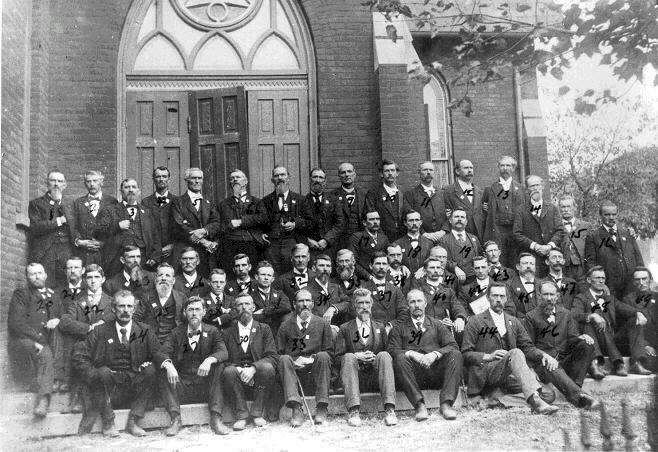
The above picture is of the many "Primitive Baptist" elders in attendance in Fulton, Kentucky, the purpose of which was to unite around a common creed. I used to have this picture in my study when I was a young Hardshell Baptist minister. Elder Potter had passed away several years before this convention. In this convocation the assembly unanimously endorsed the 1689 London Confession of Faith, but put footnotes at the bottom of several sections of that confession for the purpose of giving their interpretation of those sections, which interpretations were diametrically opposite of what the confession said. You can see from those footnotes remnants of Two Seedism in their denial of Gospel means in the eternal salvation of sinners and of what they say about the nature of regeneration and conversion. Under section II of the 1689 Confession the Fulton brethren said:
"(2) We understand the words of “one substance” contradict the idea that God’s
people existed eternally in seed or substance in Christ, for this would
establish a distinction in substance between the Father and the Son."
By this they show that they were at this time determined to distance themselves from at least one of the tenets of Two Seedism. In chapter XLVII I cited the words of Elder Watson regarding the way Two Seeders handle the word of God in their twisting of scripture. Watson said: "Their doctrine is serpentine, and it has serpentine ways and outlets, and is hard to hold even when caught." The fifty one elders who are pictured above showed this trait in how slippery they handled the 1689 confession.
In this chapter we will focus our attention on what Elder Potter wrote in his book titled "A Treatise On Regeneration And Christian Warfare" (Read it here), written in 1895. We will also have a good bit to say about the Fulton Assembly and the 1689 London Confession, especially since Potter mentions it in the above treatise, as we will see. In chapter one, under "Introductory Remarks," Potter wrote:
"In the publication of this little work I have only one object in view, and that is the defense of gospel truth, and the peace of the Baptists. I have been associated with brethren who differed with me on the new birth, for more than twenty years, and as they were good and precious brethren, I thought that if we could all let that subject alone, and not agitate it, we might get along peaceably together, and yet not see exactly alike on that subject. They knew, however, what I believed on the question, for they had often heard me express myself. I was requested by some of my readers of the ADVOCATE, in Arkansas, to write some on the new birth, through the paper, for their sakes, as they had a minister among them that was leading off on that subject; this was in the fall of 1892."
I find Potter's statement that he thought that brethren who disagreed on the subject of the new birth should "leave that subject alone," especially in view of the fact that he says this in the context of Two Seed views on that subject, which are indeed heretical and heterodox. Why did Potter and his cohorts not feel the same way about their primitive missionary Baptist brethren who supported missionaries and biblical education? I am also bewildered how he could advise a "leave it alone" procedure and then write this book on it. Why did he not have this same attitude towards those "Primitive Baptists" who believed in means? Potter would not leave that issue alone but became the flag bearer for those who opposed means and began to debate "Primitive Baptists" who believed in means, which was the original position of his forefathers. He has even said that he began his paper "The Church Advocate" to combat the means view.
Potter wrote further:
"I thought the Baptists in our part of the country might get along without agitating that subject, and that we would live in peace and union, as we had always done. But those brethren who differed, finally became intolerant, some of them, and could not bear to hear a brother say "soul and body" or that "it is the spirit that is born again," or speak of the separation of soul and body at death, or "inner man," or that "the soul of man is born of God in time," or any of those intimations of a distinction of soul and body, without making war on the party that made use of the expression."
Potter says - "I thought the Baptists in our part of the country might get along without agitating that subject, and that we would live in peace and union, as we had always done." Why did he not think this way towards those Baptists who supported means, Sunday Schools, theological education, etc.? How could he tolerate the gross absurdities of Two Seedism but not Baptists who believed in supporting missionaries? Of course, as we have seen, Potter himself still held Two Seed ideas, such as saying that people did not have to hear the Gospel to be saved, and saying that nothing a person did in life determined whether he went to heaven. Further, though he claimed to deny the Two Seed "no change" view of regeneration, yet he and his brethren came to entertain such a view when they began to say that a person could be regenerated while remaining believers in false gods and Messiahs. The Hardshell view evolved, or diverted back to the Two Seed view, so that it became similar to the Two Seed no change view.
Potter wrote further:
"I believe, and the Old School Baptist church believes, the doctrine of the following pages, and in order to set forth the Baptist doctrine, and defend it against the assaults of those who do not believe it, and to teach our people what the doctrine of the church is on this subject, this little book is offered to the public. I have blamed those brethren who differed, for trying to hide from the people, what they really do believe, and for trying to make it appear that the whole fight is on the question of the sinner being born again. But, in order that the reader may know just what they contend for, I will give a statement of what they say they believe, as given by one of the ablest men on that side of the issue. He says:..."
It is ironic that Potter said that he thought brethren should not talk about the things they disagreed about respecting some Two Seed tenets, such as what they believe about regeneration or rebirth, and yet in the above citation he is going against his own counsel and writing upon it and stating that his views are the historic view. Further, it is a characteristic trait of the Hardshells to find ways to hide their views from others to some extent.
Potter wrote further:
"I would much prefer to quit publishing the ADVOCATE, than to not be allowed to publish what Old Baptists have always believed."
"What Old Baptists have always believed"? I find that statement astounding because though it is true that Two Seedism was a new doctrinal system, what Elder John M. Watson called "modern innovations" and "ultraisms," yet Potter's own view on regeneration and salvation are not the orthodox and historical views of Baptists. The Baptists prior to what B.H. Carroll called "the rise of the Hardshells," in chapter three of his famous treatise titled "The Genesis of American Anti-Missionism" (1902), did not deny that God used the gospel or word of God, and the preachers of it, as instruments in the eternal salvation of sinners, nor that evangelical faith and repentance, or conversion, was essential for being eternally saved. You can read Dr. Carroll's work (here).
In 1900 Potter's ministerial brothers met in Fulton, Kentucky to state their adherence to the 1689 London Baptist Confession which clearly taught differently than Potter and those ministers who assembled in Fulton and is why that convention of ministers felt the need to put footnotes on those sections they disagreed with in order to distort what that old Confession taught.
In chapter two under "Reasons for Writing on This Subject" Potter wrote:
"In the ADVOCATE, of February 15, 1894, there appeared an article from one of our correspondents, on the subject of man, not on the new birth, but in the article, the writer spoke of the soul as being born again, in time, and the body in the resurrection. The expression so aroused some of our dear brethren that two of them wrote a reply at once."
Potter wrote further:
"THE CHURCH ADVOCATE believes that the sinner, the Adam sinner, is the subject of salvation; that it is the man that is the subject of the new birth, and that this man has a soul and a body, and that the soul is born again, in the work of regeneration in time, and that it goes immediately to heaven when the body dies. We believe that in the resurrection, the body will be born again, and go to heaven, and that the soul and body will be reunited in heaven, and thus the sinner will be born again, and saved. This has been the doctrine of our people for the past two hundred years, provided it was our people who first drew up and published the London Confession of Faith, in England, in the year 1689."
Why does Potter question whether it was his people, the Hardshells, "who first drew up and published the London Confession of Faith"? Potter died a decade or so before the meeting in Fulton. Had he lived till then, what would he think of those ministers who claimed that the authors of the 1689 confession taught Hardshellism? I have written many articles through the years on what took place in Fulton. I showed where many "Primitive Baptists" were honest enough to admit that the ministers of the Fulton convention were purposefully distorting the true meanings of the 1689 confession. For instance I give these citations from Hardshell Baptists:
Elder Bill Allen in an Internet article titled "Article 10 of the London Confession of 1689 Examined," (pastors the Stephenville, Texas "Primitive Baptist Church") writes (emphasis mine - SG):
"Below is just one of the problematic articles, no. 10, of the 1689 with the 3 related Fulton foootnotes. My problem with the Fulton footnotes is not that they were themselves unsound. They were quite sound, but the Fulton brethren were deceiving themselves in thinking that the 1689 was basically sound but just not properly understood....If we take the wording of the 1689, particularly in this article, for what it clearly says in plain English it can be easily seen that it is a hopeless wreck of a document that no amount of footnotes, explanations, or wishful thinking can fix...My point is that we should NOT make any endeavors to lay claim to the 1689 Confession but instead should do what the Fulton brethren did not and that is let those who believe such things have it as the Calvinists confession that it clearly is."
Allen also says:
"...this says the effectual calling is by the Word and Spirit. It is vital to the understanding of this article to discern exactly what they mean by the use of "Word". The Fulton brethren correctly insist that on the Living Word, i.e. Christ, is the source of the Effectual Call. Unfortunately, they would like us to believe that is what this article says. I contend that this is wishful thinking. They are imposing what we know to be the truth on what other men have said in an effort to white wash something that would have to otherwise rejected if taken for what it says. I contend the authors of this confession were consistent in their use "Word"." (See here)
"Below is just one of the problematic articles, no. 10, of the 1689 with the 3 related Fulton foootnotes. My problem with the Fulton footnotes is not that they were themselves unsound. They were quite sound, but the Fulton brethren were deceiving themselves in thinking that the 1689 was basically sound but just not properly understood....If we take the wording of the 1689, particularly in this article, for what it clearly says in plain English it can be easily seen that it is a hopeless wreck of a document that no amount of footnotes, explanations, or wishful thinking can fix...My point is that we should NOT make any endeavors to lay claim to the 1689 Confession but instead should do what the Fulton brethren did not and that is let those who believe such things have it as the Calvinists confession that it clearly is."
Allen also says:
"...this says the effectual calling is by the Word and Spirit. It is vital to the understanding of this article to discern exactly what they mean by the use of "Word". The Fulton brethren correctly insist that on the Living Word, i.e. Christ, is the source of the Effectual Call. Unfortunately, they would like us to believe that is what this article says. I contend that this is wishful thinking. They are imposing what we know to be the truth on what other men have said in an effort to white wash something that would have to otherwise rejected if taken for what it says. I contend the authors of this confession were consistent in their use "Word"." (See here)
Elder David Bartley, a minister of the Absoluter faction, writing about the Fulton Confession in 1901 had these remarks to offer (emphasis mine - SG).
"So now, let us kindly consider this question of disturbance and compare the points at issue with the London Confession, which all claim to accept upon those points of difference. But why, then, the need or utility of the Fulton Convention? Why the address, the foot-notes and the appendix added to the good old Confession, which had been good enough for the Old Baptist people through the centuries, until this late upheaval? The plea for all this additional supplementary work of the recent convention has been stated in print frequently, and is thus given in the general address: “Language through the lapse of many years undergoes variations in applications and meanings, whereby certain clauses become more or less obscure in meaning. Wherever, in the opinion of this assembly, the meaning of a section was not apparent, foot-notes were added to bring out the meaning.” But if such a change of meaning and obscurity of language is true of one section of the old Confession, it is also true of every section, and just as true of the whole Bible, which is older than the London Confession. In all candor, then, why were the foot-notes confined to a few sections, and these the very places which treat of the doctrines involved in this new issue! This is very strange indeed, if the old Confession has really become doubtful and dark in meaning because of its age! If this is a valid cause for calling a convention of Baptists, why not bring out in easy and plain words the meaning of the entire Confession, so that all the Baptists may now understand and unite upon its meaning? Then, if the plea is a real and valid one, why not also get up a Baptist Convention to “bring out the more or less obscure meaning “of the ancient Bible!"
"So now, let us kindly consider this question of disturbance and compare the points at issue with the London Confession, which all claim to accept upon those points of difference. But why, then, the need or utility of the Fulton Convention? Why the address, the foot-notes and the appendix added to the good old Confession, which had been good enough for the Old Baptist people through the centuries, until this late upheaval? The plea for all this additional supplementary work of the recent convention has been stated in print frequently, and is thus given in the general address: “Language through the lapse of many years undergoes variations in applications and meanings, whereby certain clauses become more or less obscure in meaning. Wherever, in the opinion of this assembly, the meaning of a section was not apparent, foot-notes were added to bring out the meaning.” But if such a change of meaning and obscurity of language is true of one section of the old Confession, it is also true of every section, and just as true of the whole Bible, which is older than the London Confession. In all candor, then, why were the foot-notes confined to a few sections, and these the very places which treat of the doctrines involved in this new issue! This is very strange indeed, if the old Confession has really become doubtful and dark in meaning because of its age! If this is a valid cause for calling a convention of Baptists, why not bring out in easy and plain words the meaning of the entire Confession, so that all the Baptists may now understand and unite upon its meaning? Then, if the plea is a real and valid one, why not also get up a Baptist Convention to “bring out the more or less obscure meaning “of the ancient Bible!"
These are excellent observations. If these brethren are right, what does it say about the many leading elders who assembled in Fulton and perverted the 1689 confession? If those brethren could twist and distort what the confession said in order to make it agree with their new ideas, why would we not think that they would do so with the scriptures too?
In "An Examination of How the Hardshells Diluted the London Baptist Confession" Bob L. Ross wrote (emphasis mine):
"One of the most reprehensible acts by a group of Primitive Baptist ministers was perpetrated in November 1900.
From the 14th day to the 18th day -- five days of infamy -- "fifty-one ministers, representing three-hundred and thirty-five churches, aggregating fourteen-thousand five-hundred members in direct correspondence with over one-hundred-thousand Baptists," set themselves -- after adorning their nefarious scheme with all the proper and pious camouflage of the most sanctimonious session of the Scribes and Pharisees -- to the work of "clarifying" and "adding some explanations to" the most highly respected confessional document in the history of English-speaking Baptists, The Baptist Confession, set forth in London, England in 1689.
This 20th century "Sanhedrin" was shepherded in part by a couple of well-known elders of Old School craft, James H. Oliphant and John M. Thompson, who proved to be two veritable Jehudi's (Jeremiah 36:23). Not content with their rejection of the London Confession, they found it more to their liking to distort it and perpetrate the distortion under the "unanimous vote" of their ministerial accessories among which "tears filled eyes," contemplating their deed as "doing God service" (John 16:2). This meeting had all the "holy smoke" of a Papal election. And no one can puff more "sweet" and "comforting" holy smoke than the "little lambs" of Hardshellism.
The hallowed ground on which this holy convocation of Hardshell "rabbis" took place was the meeting-house located in Fulton, Kentucky, and the grand product of this enclave in Zion was published under title of A Comprehensive Confession of Faith. I am the proud possessor of a maroon hardback edition of this blessed creation, published by those professing to be "servants" -- E. D. Speir, R. E. Cagle, and E. D. Speir, Jr. -- in this current form in 1981.
These brethren of the Old School, in a humility worthy of the likes of Madam Guyon and St. Thomas of Assisi, announced that they felt themselves "under profound obligations to thank God and labor faithfully for the prosperity of his holy cause," and with "humble gratitude" to the "gracious and divine providence of God," recognizing that "language naturally undergoes some change," they "deemed prudent" the adding of "some explanations to those sections that seemed ambiguous" in the Baptist Confession of 1689.
The sanctified purpose of the "explanations" and "clarifications" was -- of course -- "increased gladness and the sweetest union," "general prosperity," "establishing union and fellowship," and similar attendant blessings within the sweet Old Baptist "home." Who could possibly have ever entertained the doubt that such "obedient servants" as Thompson, Oliphant and their fellow butchers would prove to be triumphant in behalf of their beloved Zion?
But despite their holy fervor, sweet prayers, tears, explanatory abilities, and unanimous vote, it seems that the old Baptist Confession has proved to be too much of a piece of granite, and their efforts at patching up Zion, where she was "torn into factions in so many places," failed; -- tears, rents, and factions are at this late date greater than at the turn of the century. "For many years, I have seen the spiritual decline approaching . . .The problems have obviously become worse," bemoans Elder S. T. Tolley (The Christian Baptist, 4/92, p.5).
Viewed from our own perspective, it would have been far more the act of honesty and candor had this solemn assembly of Scribes and Pharisees simply acknowledged the fact that their own theology was so far removed from that of the 1689 Baptist Confession they must cease the hypocrisy of claiming the Confession, then they should have composed their own confession. This would have at least relieved them of the necessity of the contemptible spectacle of "clarifying" what they and everyone else understood perfectly to be the doctrinal sentiments of the Baptists who set their names to the 1689 Confession.
THE FACT IS, IT WAS "UNDERSTANDING" THE BAPTIST CONFESSION WHICH MADE IT NECESSARY FOR THIS GATHERING OF HARDSHELLS TO HACK AND HEW ON THE CONFESSION IN THE EFFORT TO MAKE IT ACCEPTABLE. All of their pious reasons notwithstanding, the truth is, these Old School Primitive Baptists DID NOT BELIEVE the doctrines of the London Confession and would have set up "bars of fellowship" against every last one of those who originally signed the 1689 Confession had the signatories arisen from the dead and asked for a "home" among these Hardshell brethren.
We have already called attention to Elder S. T. Tolley's repudiation of the London Confession (chapter four) on those chapters of the Confession which he specified, as he called for the composing of a new confession which would accurately represent Primitive Baptists. Another Hardshell, Elder R. V. Sarrels, who wrote a book presenting Hardshell doctrine, ostensibly called a "Systematic Theology," very candidly confesses that Primitive Baptists "do not believe" chapter three of the London Confession, and he charges that the Fulton Convention of 1900 wrote a footnote "to make this old article MEAN WHAT IT DOES NOT SAY" (Systematic Theology, pages 109, 110).
Sarrels indicates that the sweet brethren who gathered at Fulton, Ky. in 1900 were engaged in a "literary effort of TORTURING of language" when they tried to "clarify" and "explain" the London Confession. He says, "Moderate or Non-fatalist Calvinists must either repudiate this statement [in the London Confession] or resign themselves to the endless task of trying to make it mean what it does not say" (page 111).
Why didn't the 1900 Fulton Convention do the honest thing and simply repudiate the London Confession and write their own separate confession? Because they are of the "We-be-Abraham's Seed" progeny, claiming they are the "true," "only," "legitimate" church and ministry in succession back to the 17th century Baptists. To come out and honestly state the truth of the matter, they would thereby be giving up their farcical and spurious claim. To avoid this humiliation, they took the route of adding "clarifications" and "explanations" in footnotes, presuming that naive Baptists didn't have enough sense to read and understand what the 17th century Baptists plainly stated.
Throughout the Confession, significant places were selected by the Hardshell scribes for "footnoting," wherein they have placed their leaven of Hardshell aberrations. The two primary doctrines which merit the most attention are (1) predestination, and (2) "means" in the new birth. On these, the reader is treated to the views of the Hardshells which are clearly in opposition to the views of the 17th century Baptists. The modern Hardshells deny these doctrines as they were believed by the Baptists of the London Assembly of 1689." (History and Heresies of Hardshell Baptists, chapter 5) (See this post where I wrote about the Fulton Confession and cited Brother Ross here)
"One of the most reprehensible acts by a group of Primitive Baptist ministers was perpetrated in November 1900.
From the 14th day to the 18th day -- five days of infamy -- "fifty-one ministers, representing three-hundred and thirty-five churches, aggregating fourteen-thousand five-hundred members in direct correspondence with over one-hundred-thousand Baptists," set themselves -- after adorning their nefarious scheme with all the proper and pious camouflage of the most sanctimonious session of the Scribes and Pharisees -- to the work of "clarifying" and "adding some explanations to" the most highly respected confessional document in the history of English-speaking Baptists, The Baptist Confession, set forth in London, England in 1689.
This 20th century "Sanhedrin" was shepherded in part by a couple of well-known elders of Old School craft, James H. Oliphant and John M. Thompson, who proved to be two veritable Jehudi's (Jeremiah 36:23). Not content with their rejection of the London Confession, they found it more to their liking to distort it and perpetrate the distortion under the "unanimous vote" of their ministerial accessories among which "tears filled eyes," contemplating their deed as "doing God service" (John 16:2). This meeting had all the "holy smoke" of a Papal election. And no one can puff more "sweet" and "comforting" holy smoke than the "little lambs" of Hardshellism.
The hallowed ground on which this holy convocation of Hardshell "rabbis" took place was the meeting-house located in Fulton, Kentucky, and the grand product of this enclave in Zion was published under title of A Comprehensive Confession of Faith. I am the proud possessor of a maroon hardback edition of this blessed creation, published by those professing to be "servants" -- E. D. Speir, R. E. Cagle, and E. D. Speir, Jr. -- in this current form in 1981.
These brethren of the Old School, in a humility worthy of the likes of Madam Guyon and St. Thomas of Assisi, announced that they felt themselves "under profound obligations to thank God and labor faithfully for the prosperity of his holy cause," and with "humble gratitude" to the "gracious and divine providence of God," recognizing that "language naturally undergoes some change," they "deemed prudent" the adding of "some explanations to those sections that seemed ambiguous" in the Baptist Confession of 1689.
The sanctified purpose of the "explanations" and "clarifications" was -- of course -- "increased gladness and the sweetest union," "general prosperity," "establishing union and fellowship," and similar attendant blessings within the sweet Old Baptist "home." Who could possibly have ever entertained the doubt that such "obedient servants" as Thompson, Oliphant and their fellow butchers would prove to be triumphant in behalf of their beloved Zion?
But despite their holy fervor, sweet prayers, tears, explanatory abilities, and unanimous vote, it seems that the old Baptist Confession has proved to be too much of a piece of granite, and their efforts at patching up Zion, where she was "torn into factions in so many places," failed; -- tears, rents, and factions are at this late date greater than at the turn of the century. "For many years, I have seen the spiritual decline approaching . . .The problems have obviously become worse," bemoans Elder S. T. Tolley (The Christian Baptist, 4/92, p.5).
Viewed from our own perspective, it would have been far more the act of honesty and candor had this solemn assembly of Scribes and Pharisees simply acknowledged the fact that their own theology was so far removed from that of the 1689 Baptist Confession they must cease the hypocrisy of claiming the Confession, then they should have composed their own confession. This would have at least relieved them of the necessity of the contemptible spectacle of "clarifying" what they and everyone else understood perfectly to be the doctrinal sentiments of the Baptists who set their names to the 1689 Confession.
THE FACT IS, IT WAS "UNDERSTANDING" THE BAPTIST CONFESSION WHICH MADE IT NECESSARY FOR THIS GATHERING OF HARDSHELLS TO HACK AND HEW ON THE CONFESSION IN THE EFFORT TO MAKE IT ACCEPTABLE. All of their pious reasons notwithstanding, the truth is, these Old School Primitive Baptists DID NOT BELIEVE the doctrines of the London Confession and would have set up "bars of fellowship" against every last one of those who originally signed the 1689 Confession had the signatories arisen from the dead and asked for a "home" among these Hardshell brethren.
We have already called attention to Elder S. T. Tolley's repudiation of the London Confession (chapter four) on those chapters of the Confession which he specified, as he called for the composing of a new confession which would accurately represent Primitive Baptists. Another Hardshell, Elder R. V. Sarrels, who wrote a book presenting Hardshell doctrine, ostensibly called a "Systematic Theology," very candidly confesses that Primitive Baptists "do not believe" chapter three of the London Confession, and he charges that the Fulton Convention of 1900 wrote a footnote "to make this old article MEAN WHAT IT DOES NOT SAY" (Systematic Theology, pages 109, 110).
Sarrels indicates that the sweet brethren who gathered at Fulton, Ky. in 1900 were engaged in a "literary effort of TORTURING of language" when they tried to "clarify" and "explain" the London Confession. He says, "Moderate or Non-fatalist Calvinists must either repudiate this statement [in the London Confession] or resign themselves to the endless task of trying to make it mean what it does not say" (page 111).
Why didn't the 1900 Fulton Convention do the honest thing and simply repudiate the London Confession and write their own separate confession? Because they are of the "We-be-Abraham's Seed" progeny, claiming they are the "true," "only," "legitimate" church and ministry in succession back to the 17th century Baptists. To come out and honestly state the truth of the matter, they would thereby be giving up their farcical and spurious claim. To avoid this humiliation, they took the route of adding "clarifications" and "explanations" in footnotes, presuming that naive Baptists didn't have enough sense to read and understand what the 17th century Baptists plainly stated.
Throughout the Confession, significant places were selected by the Hardshell scribes for "footnoting," wherein they have placed their leaven of Hardshell aberrations. The two primary doctrines which merit the most attention are (1) predestination, and (2) "means" in the new birth. On these, the reader is treated to the views of the Hardshells which are clearly in opposition to the views of the 17th century Baptists. The modern Hardshells deny these doctrines as they were believed by the Baptists of the London Assembly of 1689." (History and Heresies of Hardshell Baptists, chapter 5) (See this post where I wrote about the Fulton Confession and cited Brother Ross here)
I also cited from Elder Harold Hunt, who I know personally and who began a web page to give people access to writings of "Primitive Baptists" of the past, called "An Anthology of Primitive Baptist Literature," and who said this (See my post here):
"They reaffirmed what they could accept; they explained away what they could not accept; and they looked aside, and walked past what they could not explain away." (This sentence was in bold in Hunt's book - SG)
We could multiply such statements by those Hardshells who were honest enough to admit what Brother Ross has said. Further, I am sure that many of the fifty one elders who assembled in Fulton were familiar with the writings of the Baptists who signed the 1689 confession and knew that those brethren did not believe Hardshell views on means and on salvation.
Potter wrote further:
"In our efforts to identify ourselves with the Old Baptists, against the claims of the missionaries, we claim to be identical with these old English brethren in doctrine. THE ADVOCATE does now stand, and always has stood there, especially on the new birth. We hope that none of our brethren will differ from them, and at the same time claim identity with them."
The Fulton brethren knew that they had to align with the 1689 confession (which is almost identical to the Philadelphia Confession) in order to give credence to their claim to be the "primitive" or "original" Baptists who preceded the rise of the Hardshells. Yet, the confession clearly taught against the newly accepted dogmas of the new sect. So, they either had to claim another line of succession, and admit that the Missionary Baptists were the true successors of that old confession, or twist the confession to make it conform to their views. Sadly those fifty one ministers chose the dishonest route.
Earlier Potter calls into question whether it was "our people" who drew up the 1689 confession and then in the above citation speaks of "our efforts to identify ourselves with the Old Baptists" who wrote that old confession. He also says that his Hardshell brethren, after their secession from the Baptist family, claimed to be in league with the 1689 confession "against the claims of the missionaries." He says "we claim to be identical with these old English brethren in doctrine." But, as we have seen, and will see further in the next chapter, this is an unfounded and farcical claim. He then makes a remarkable statement, saying "we hope none of our brethren will differ from them and at the same time claim identity with them." But, this is exactly what the "Primitive Baptists" have done.
The elders gathered together in Fulton should have simply been honest enough to have stated that they were not the descendants of those English Baptists. Instead they endorsed that confession and in a highly dishonest and deceitful way totally changed what the confession said via their inglorious footnotes.
In the next chapter we will continue to review what the Fulton assembly said about the 1689 confession.

No comments:
Post a Comment