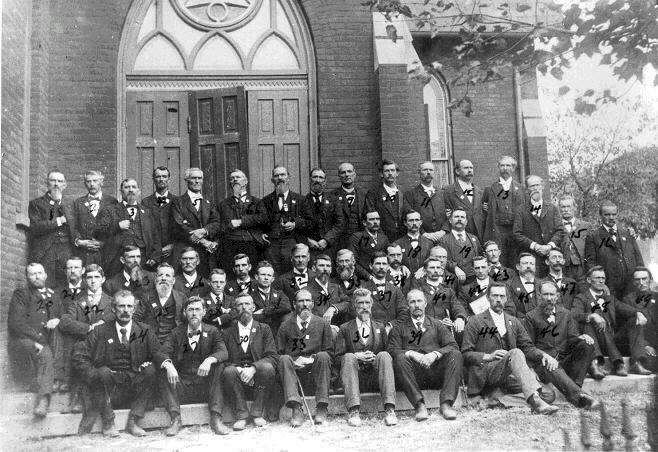
The Fulton Convention
of
Primitive Baptists
1900 A.D.
Authors of the Fulton Confession
In this chapter we will continue to look at what the Fulton Convention of "Primitive Baptists" said about the 1689 London Baptist confession. We will begin by again citing from Bob L. Ross, from chapter four of his book "History and Heresies of Hardshellism." Brother Ross was a close friend of mine and I loaned him my Hardshell books before he wrote the above booklet. He paid for me to fly to Pasadena, Texas in 1993 to do a series of Videos on the Hardshells, which were done through Larry Wessels and they are available on YouTube. Brother Ross wrote the following (you can read his work here)
"Elder S. T. Tolley, a Primitive Baptist leading minister of Atwood, Tennessee has long been the Editor and Publisher of The Christian Baptist magazine, a periodical which obviously speaks the views of many Primitive Baptist churches and preachers. A few years ago, I had a cordial visit with Bro. Tolley at his address and briefly toured the "Christian Baptist Library" which houses quite a collection of books, minutes, and other historical materials. I was a subscriber to this magazine, and have a collection of Elder Tolley's publication going back many years."
I was also a close friend of Elder Tolley as was my father (who was a "Primitive Baptist" minister for over fifty years). I spent time visiting in his home more than once, in Atwood, Tennessee. Elder Tolley was a good and honest man, unlike the fifty one elders who attempted to pervert the 1689 London Confession of Faith in Fulton, Kentucky. My father was one of the leading ministers on the editorial staff of the "Christian Baptist." I also wrote articles for it.
Ross wrote further (emphasis mine):
"In one of them -- the June 1971 issue -- Elder Tolley headlines a front-page article entitled A Re-Statement of Our Faith Needed. One of the primary targets of the article is the London Confession of 1689. Here are a few excerpts from Bro. Tolley's remarks:
Although the "London Confession" does set forth much of what we believe -- it does not clearly set forth our full and proper views on several points of doctrine.
Although we do accept most of the London Confession of Faith, we certainly do NOT agree with ALL of it! And we would not agree with the wording on some of the points even though we would agree with the sentiments.
To show that the "London Confession" does not set forth the beliefs of Primitive Baptists in full I will here give some excerpts from it: [then follows quotes from chapters 2, 10, 14, and 15].
This quote [from chapter seven of the Confession] has overtones of "Arminianism" in it . . . If a Primitive Baptist preacher should set forth such a statement from his pulpit you would clearly see the clamor that it would justly provoke.
They [signatories of the London Confession] believed that the "elect" are ordinarily called to regeneration and salvation by the medium of the preached word. Primitive Baptists do NOT believe this.
This [chapter 10] is NOT the concept that Primitive Baptists hold relative to "Effectual Calling."
Does this [chapter 14] sound like Primitive Baptists sentiment? It is not.
We believe that there will be millions of the "elect" saved in heaven who have never, nor will they ever, hear the gospel of the Son of God. [Tolley's comment on chapter 15, paragraph 5 of the Confession].
There are several similar expressions in the "London Confession" that we do not agree with, and some statements that need to be more fully explained in order to show just what is intended."
I find it quite interesting how Elder Tolley can call certain articles of the 1689 confession "Arminianism" and yet find other Hardshell elders, such as we cited in the previous chapter, who call the confession a "Calvinist" "Missionary Baptist" document. Yet, the introduction to the 1689 Confession finds the authors saying that in publishing their confession that they were "denying Arminianism."
Ross wrote further:
"In Elder Tolley's "Library News," in this same issue, he says:
I have for several years talked with many ministers and other interested individuals about this ["a statement (confession) of faith of the Primitive Baptists of our times"] and there has been much interest in this long needed work.
If any of our readers will read the "London Confession of Faith" (this is the confession of faith that Primitive Baptists are said to believe) you will clearly see the need for re-stating our beliefs -- as we hold today."
In Elder Tolley's January 1983 issue of The Christian Baptist, he is still "grinding an ax" about the London Confession. He refers to chapters 3, 5, 7, 8, 9, 10, 11, 14, and 15, and says:
It would be hard to understand how any man could fully endorse all that is stated therein and remain in good standing and full fellowship with Primitive Baptists. No one could be well informed on the doctrine and beliefs of the Strict Baptists of England and not understand that they were and are, today, different from Primitive Baptists of America on several important points.
The men who drew up the London Confession of Faith held what we call "absolute" tendencies, and, although they believed in predestination and election, they also believed that the gospel was ordinarily God's ordained means to call the elect to regeneration . . . We have published several articles in THE CHRISTIAN BAPTIST pointing out these discrepancies."
Tolley, like others, was being honest in his interpretation of the 1689 confession. However, in being honest he indicts the fifty one ministers who dishonestly attempted to distort the confession by their footnotes.
Ross wrote further:
"In the August 31, 1957 issue of The Baptist Examiner, I wrote a short editorial comment concerning the purpose of the Gospel as viewed by Arminians, Calvinists, and Hardshells. W. J. Berry, then Editor of the Old Faith Contender magazine in Elon College, North Carolina, quoted from the editorial and proposed the question to his readers, "Is this the 'Hardshell' Position?" He gave several issues of his magazine to letters from readers who wished to comment on the question, then he followed-up with his own commentary on the matter. Here is what he wrote:
Now we knew that except for minor variations this editor [Bob L. Ross] has described too accurately the position of present-day Primitive Baptists. We also knew that what he gave as the Arminian position was that generally held by Baptists just prior to 1633 (Hassell's History, p. 335, 336), and that what he gave as the Calvinistic doctrine was held by Presbyterians before Baptists espoused it, and was the position formerly held by all doctrinally sound Baptists in America prior to 1800. [As quoted in the Oct. 4, 1958 BAPTIST EXAMINER, p. 2].
In the same article, Elder Berry alleged that Primitive Baptists of this day have "almost completely abandoned" the position of early American Baptists "in actual practice."
So here is a second well-known minister who, in effect, alleged that modern Primitive Baptists are not really "Primitive," so far as having a doctrinal identity with early American Baptists, or the 17th century English Particular Baptists. The Confessions of Faith are the most conclusive "standards" whereby to determine such an issue, and by their own ADMISSION the modern Primitives do not consider the Confessions to be representative of Primitive Baptist doctrine."
It is true that Hardshell historian Sylvester Hassell acknowledges that the forefathers of the Kehukee Association of Primitive Baptist churches were Arminian. The Kehukee churches became Calvinists, and perhaps truly saved, when the Philadelphia Baptist Association sent a missionary to eastern North Carolina, a preacher named John Gano. After his visit in 1754 he reported the "melancholy condition" of North Carolina churches. In 1755, the Philadelphia Association sent ministers, specifically including Benjamin Miller and Peter P. Vanhorn, to North Carolina to reform "General Baptist" churches into "Regular Baptist" (Calvinist) churches. These efforts influenced the establishment of the Kehukee Association (organized 1765/1769), which adopted the strict Calvinist Philadelphia Confession.
I have numerous articles in the "Old Baptist Test" blog under the heading "What The First Hardshells Believed" which show that the general view of the first Anti-Mission Baptists believed in means just as the 1689 confession says, and I have other articles that show that the "no means" view was what Elder Watson called an "innovation." I have given evidence that shows that the "no means" view, and the view that evangelical faith and repentance were not essentials for eternal salvation, originated with the Two Seeders who came after Daniel Parker. This post (here) will give the reader links to those posts. On the question of means both Arminian and Calvinists nigh unanimously agree that God uses the preaching of the Gospel in the salvation of sinners. The Two Seed view is truly aberrant.
Ross wrote the following under the sub-heading "Hatchet-Job" Done to the London Confession
by Hardshell Book":
"Several years ago, a well-known Hardshell preacher, Elder Lee Hanks, compiled a number of historical items and published them under the title, The Church of God. I have the reprinted edition of 1982, published by Elder S. T. Tolley's Christian Baptist Publishing Company, and I have also examined an original edition.
The book mutilates the London Confession, not only omitting significant words (indicated by a series of dots), but it even cuts-out entire chapters! It omits chapters 5, 14, 15, and 17 thru 25. It is significant that the material which is omitted includes the same points of doctrine which Hardshells such as Tolley admittedly do not believe, particularly those that express the Baptist position on the use of the Word, or Gospel, in regeneration.
At this writing, I have twice written to Elder Tolley and asked him who was responsible for this "hatchet-job" on the London Confession of Faith, but he has not responded. I assume Hanks is responsible until other evidence is presented."
In my historical studies of the "Primitive" or "Old School" Baptists I have learned a good bit about Elder Lee Hanks. I am the one who loaned Brother Ross my copy of the "history" book authored by Hanks wherein he, on one hand, seems to claim affinity with the 1689 confession, but then on the other hand, eliminated large sections of it that he didn't agree with, by the use of the ellipsis (using the "..."). In my writings I have shown where this has been a common practice by the Hardshells. They will often cite from the works of others and use the ellipsis to excise those parts that they don't like, and by cutting out those sections they often totally pervert what the writers they are citing really meant. I wrote about this practice in these posts (here and here). In the latter post I cite where Brother Ross said the same thing, writing:
"...we have learned to watch the Hybrids* carefully when they start "quoting" someone whom they would like to array in their camp on "born again before faith." For some reason, they might fail to give the complete picture."
*By "Hybrids" he includes the "Primitive Baptists."
It is interesting that Hanks was one of the ministers who was at the Fulton convention and endorsed the 1689 confession and admitted that this was the confession that his forefathers accepted as a statement of their beliefs.
Ross wrote further:
"This is simply further evidence that the Hardshells of today are not the "original" Baptists, but in reality they have departed from the Baptist faith and constitute a cult formed around their opposition to the preaching of the Gospel to the unregenerate as a "means" used by the Holy Spirit in bringing about to the New Birth. Some may question my use of the term "cult," but when one becomes acquainted with the exclusivism of the Hardshells and their claims, it is obvious that "cult" is the most appropriate term."
This is also what I have shown in my own historical work "The Hardshell Baptist Cult" (you can read all the chapters in that massive work in its own blog here).
Now let us notice some citations from the "Fulton Confession" and show the articles of the 1689 confession that they felt the need to rewrite in their footnotes.
CHAPTER I. OF THE HOLY SCRIPTURES
7. All things in Scripture are not alike (l) plain in themselves, not alike clear unto all; yet those things which are necessary to be known, believed, and observed for salvation are so (m) clearly propounded and opened in some place of Scripture or other, that not only the learned but the unlearned, in due use of ordinary means, may attain to a sufficient understanding of them. (2)
Now, here is the footnote the Fulton Sanhedrin attached to this 1689 article:
"(1) We do not understand this section to teach that eternal life is obtained by the understanding of or obedience to the scriptures."
They are being deceitful in this statement for the articles above show that the 1689 confession taught that the scriptures were a means in saving sinners and giving eternal life. Many "Primitive Baptists" as we have seen agree that these fifty one elders were purposely denying what the confession says. The 1689 articles say that there is a certain "knowledge of God and His will which is necessary unto salvation" and that this knowledge can only be obtained through the scriptures.
CHAPTER II. OF GOD AND THE HOLY TRINITY
Of God and the Holy Trinity Chapter 2
Paragraph 3
"In this divine and infinite Being there are three subsistences, the Father, the Word or Son, and Holy Spirit,27 of one substance, power, and eternity, each having the whole divine essence, yet the essence undivided:28 the Father is of none, neither begotten nor proceeding; the Son is eternally begotten of the Father;29 the Holy Spirit proceeding from the Father and the Son;30 all infinite, without beginning, therefore but one God, who is not to be divided in nature and being, but distinguished by several peculiar relative properties and personal relations; which doctrine of the Trinity is the foundation of all our communion with God, and comfortable dependence on Him."
Now here is the Fulton footnote:
"(2) We understand the words of “one substance” contradict the idea that God’s people existed eternally in seed or substance in Christ, for this would establish a distinction in substance between the Father and the Son."
This is not the only footnote that mentions a Two Seed tenet. So, in the year 1900 the "Primitive Baptists" of the faction represented in Fulton felt a need to distance themselves from Two Seedism. By this footnote we surmise that there must have been some Two Seed Primitive Baptists who tried to argue that the words "one substance" in the old confession included the Lord's seed or children.
CHAPTER III. OF GOD’S DECREE
"6. As God hath appointed the elect unto glory, so He hath by the eternal and most free purpose of His will foreordained (m) all the means thereunto; wherefore they who are elected, being fallen in Adam, (n) are redeemed by Christ, are effectually (o) called unto faith in Christ, by His Spirit working in due season, are justified, adopted, sanctified, and kept by His power through faith (p) unto salvation; neither are any other redeemed by Christ, or effectually called, justified, adopted, sanctified and saved, but the elect (q) only. (3)
Now here is the footnote of the Fulton ministers:
"(3) We do not understand the words “all the means thereunto” include other means than those especially set out in this section: “Redeemed in Christ”, “effectually called”, “by His Spirit”, etc."
Of course, when they say "we do not understand" they simply mean "we do not believe," and involve these ministers saying that this is what the writers of the 1689 confession meant. One of the scriptures given by the 1689 confession to support what they mean by "all the means" is this text:
"But we are bound to give thanks alway to God for you, brethren beloved of the Lord, because God hath from the beginning chosen you to salvation through sanctification of the Spirit and belief of the truth: Whereunto he called you by our gospel, to the obtaining of the glory of our Lord Jesus Christ." (II Thess. 2: 13-14 kjv)
So, the authors of the 1689 confession clearly believed that the effectual call was "by our gospel" and the salvation to which the elect were chosen was effected by a "sanctification of the Spirit AND belief of the truth." The means are not limited to the things the Fulton footnotes mention. The article clearly says that "faith" is a means, and they agree with the apostle Paul that "faith comes by hearing, and hearing by the word of God." (Rom. 10: 17)
CHAPTER VII. OF GOD’S COVENANT
"2. Moreover, man having brought (b) himself under the curse of the law by his fall, it pleased the Lord to make a Covenant of Grace, wherein He freely offereth unto sinners (c) life and salvation by Jesus Christ, requiring of them faith in Him, that they may be saved; and (d) promising to give unto all those that are ordained unto eternal life His Holy Spirit, to make them willing and able to believe. (1)"
Now, here is the Fulton footnote:
"(1) By the words “offereth unto sinners life and salvation”, etc., we do not understand that the gift of eternal life is offered to alien sinners, but should be understood as meaning the assurance or enjoyment of spiritual or divine life, as is taught in John 20:30-31; Galatians 6:7-8. The following places in the Confession describe the alien sinners as being unable to accept an offer of life: Chapter XX., Section 4; Chapter IX., Section 3; Chapter III., Section 6; and for further explanation of the doctrine herein set forth and from which said doctrine is deducible, see Chapter XVII., Section 3; Chapter XVIII., Sections 3 and 4; Chapter X., Section 4; Chapter XX., Sections 1 and 4; and 2 Peter 1:10-11."
Again, we have the words "by the words...we understand or do not understand." But, all see, if they are honest, that the words of the confession do mean that God offers eternal life to alien sinners and does not mean offering "the assurance or enjoyment of spiritual or divine life." Further, it is true that the confession does say that alien sinners are unable to accept the offer, but this does not negate the fact that it is offered, for the authors of this confession believed that the power to believe and receive was of God and not of the sinner. When Jesus said to the man with the paralyzed hand "stretch forth your hand" it did imply that the man had in himself the power to obey, the power to obey came from the Lord.
Elder John Clark, a founding father of the "Primitive Baptist" sect, and editor of Zion's Advocate (1854), believed in means as did many other first generation leaders in the anti-mission movement, and I have many citations from him that show this to be true. In one of my posts I give the following citation which answers the objections raised by the above Fulton footnote:
"But some object and say, Why preach repentance to dead sinners? They can neither hear, see nor understand. That is true; that they hear not, see not, understand not, so far as the preacher is concerned or is able to effect them; but why did the prophet call upon the dry bones to hear the word of the Lord? He answered, “And I prophesied as I was commanded.” That was authority then for all who feared God, and it is still the authority for all such. This objection, however, will lie against all the exhortations and admonitions to the saints as it does against addresses to the ungodly, for the Christian has no more power than the unbeliever. The difference between them is not in the power, but in the will; as it written: "To will is present with me, but to perform that which is good I find not.”"
The theory that we must preach to men according to the power they possess to obey is sublimated Arminianism, and yet; the advocates of it are very fraid of being called Arminians. Christians know, however, by the word of his grace, and by the revelation of that word in their hearts, when it comes in power and in the Holy Ghost, and in much assurance, that Christ’s word is true which says, “Without me you can do nothing.” The Spirit takes the word of Christ and shows it to his people, and thus it is verified in the experience.
To preach to men upon the ground that they have power to do what is commanded, or to refuse to preach to them because they have not the power, shows that the confidence is in the flesh and not in God; that they depend upon the will of the flesh and not upon the power God, and that is the very essence, double refined, of Arminianism.
The minister of Christ does not preach to any class of men upon the consideration of their ability or inability. He has the sentence of death in himself, and therefore cannot trust in himself; and he has no confidence in the flesh of any other, but his confidence, his faith and hope, is in God, from whence alone are his expectations."
("What To Preach and How To Preach" Written by John Clark in Zion's Advocate--August 1875)
The theory that we must preach to men according to the power they possess to obey is sublimated Arminianism, and yet; the advocates of it are very fraid of being called Arminians. Christians know, however, by the word of his grace, and by the revelation of that word in their hearts, when it comes in power and in the Holy Ghost, and in much assurance, that Christ’s word is true which says, “Without me you can do nothing.” The Spirit takes the word of Christ and shows it to his people, and thus it is verified in the experience.
To preach to men upon the ground that they have power to do what is commanded, or to refuse to preach to them because they have not the power, shows that the confidence is in the flesh and not in God; that they depend upon the will of the flesh and not upon the power God, and that is the very essence, double refined, of Arminianism.
The minister of Christ does not preach to any class of men upon the consideration of their ability or inability. He has the sentence of death in himself, and therefore cannot trust in himself; and he has no confidence in the flesh of any other, but his confidence, his faith and hope, is in God, from whence alone are his expectations."
("What To Preach and How To Preach" Written by John Clark in Zion's Advocate--August 1875)
Keep in mind that the Hardshell convention of ministers was attempting to uphold the Two Seed ideas that said "nothing a person does in his life determines whether he will be saved" and said "the gospel or written word of God is only for the temporal benefit of those already saved." We cited elders John M. Watson and Hosea Preslar in earlier chapters who stated this very thing. We also cited from the 1879 minutes of the Powell Valley Association which affirmed this fact.
CHAPTER IX. OF FREE WILL
"4. When God converts a sinner, and translates him into the state of grace, (g) He freeth him from his natural bondage under sin, and by His grace alone enables him (h) freely to will and to do that which is spiritually good; yet so as that, by reason of his (i) remaining corruptions, he doth not perfectly nor only will that which is good, but doth also will that which is evil. (2)"
Now, here is one of the footnotes to this article:
"(2) We understand the expression “when God converts” to mean when God regenerates."
Yes, the Hardshells may "understand" that conversion is not regeneration, but this is not what the authors of the old confession believed. In fact, I have cited many of the old articles of faith of many "Primitive" or "Old School" Baptist churches that say "we believe all the elect will be regenerated AND converted," which shows that they believed that all the elect would be converted to faith in Christ and not regenerated only. In fact, nearly all the old Puritans, and the old Baptists who authored the 1689 confession, saw evangelical conversion as being regeneration. I have numerous proofs of this in my Old Baptist Test blog. I have numerous articles in the Old Baptist Test blog which shows this is the case. For instance, I cite these words from the learned W.G.T. Shedd (as cited by me here):
W. G. T. Shedd, in his "Dogmatic Theology," Volume 2, pages 492-494, confessed much the same, saying:
"The divines of the seventeenth century very generally do not distinguish between regeneration and conversion, but employ the two as synonyms. Owen does this continually: On the Spirit, III. v. And Charnock likewise: Attributes, Practical Atheism. The Westminster [Confession] does not use the term regeneration. In stead of it, it employs the term vocation, or effectual calling. This comprises the entire work of the Holy Spirit in the application of redemption."
"The divines of the seventeenth century very generally do not distinguish between regeneration and conversion, but employ the two as synonyms. Owen does this continually: On the Spirit, III. v. And Charnock likewise: Attributes, Practical Atheism. The Westminster [Confession] does not use the term regeneration. In stead of it, it employs the term vocation, or effectual calling. This comprises the entire work of the Holy Spirit in the application of redemption."
CHAPTER X. OF EFFECTUAL CALLING
"1. Those whom God hath predestinated unto life, He is pleased in His appointed and accepted time (a) effectually to call by His Word and Spirit out of that state of sin and death, in which they are by nature, to grace and salvation (b) by Jesus Christ; enlightening their minds, spiritually and savingly, to (c) understand the things of God; taking away their (d) heart of stone, and giving unto them an heart of flesh; renewing their wills, and by His almighty power determining them (e) to that which is good, and effectually drawing them to Jesus Christ; yet so as they come (f) most freely, being made most willing by His grace. (1)"
Now here is the Fulton footnote:
"(1) We do not understand that sinners are effectually called by the written word in any sense out of that state of sin and death in which they are by nature to grace and salvation but by Christ, the Word of God. The quickening and renewing of the Holy Spirit prepares the sinner to answer the gospel call, as seen in Section 2; 2 Timothy 1:9; 1 John 4:6."
What these Fulton brothers refused to understand about this article of the old confession is what is clearly affirmed by it. By "word" in the above article is not Jesus, and many later "Primitive Baptists" have agreed that this is not what the authors of the confession meant. Not only this, but the Hardshells often do the same with scripture. When they find texts which say that God uses means in the eternal salvation of sinners, they will say "we do not understand this to mean" what it plainly says and so will distort it or explain it away by any means.
"2. This effectual call is of God’s free and special grace alone, (g) not from anything at all foreseen in man, nor from any power or agency in the creature co-working with His special grace; (h) the creature being wholly passive therein, being dead in sins and trespasses, until, being quickened and renewed by the Holy Spirit, he is thereby enabled to answer this call, and to embrace the grace offered and conveyed in it, and that by no less (i) power than that which raised up Christ from the dead.
3. Elect infants dying in infancy are (j) regenerated and saved by Christ through the Spirit, who worketh when and where and (k) how He pleaseth; so also are all other elect persons, who are incapable of being outwardly called by the ministry of the word. (2)
4. Others not elected, although they may be called by the ministry of the word, (l) and may have some common operations of the Spirit; yet, not being effectually drawn by the Father, they neither will nor can truly (m) come to Christ, and therefore cannot be saved; much less can men that receive not the Christian religion (n) be saved, be they never so diligent to frame their lives according to the light of nature and the law of that religion they do profess. (3)"
Now here are the Fulton footnotes:
"(2) We understand this section to teach that all persons dying in infancy are of the elect, and will therefore be saved. We do not understand from this that infants and insane persons are saved in a manner different from the manner in which all other elect persons are saved. The word “others” in Section 4 has no reference to infants, but adults who are subjects of the ministry of the Word.
(3) We understand for man to spiritually profited by the gospel he must have been born of God and made partaker of His divine nature, and by the words “common operations of the Spirit” is understood as teaching that the gospel has an enlightening and moral influence upon all rational men."
Again, what a dishonest and gross misinterpretation of what these articles say! The articles clearly say that anyone who does not receive the Christian religion is not saved. However, that is not what today's "Primitive Baptists" generally believe.
CHAPTER XI. OF JUSTIFICATION
"1. Those whom God effectually calleth He also freely (a) justifieth, not by infusing righteousness into them, but by (b) pardoning their sins, and by accounting and accepting their persons as (c) righteous; not for anything wrought in them, or done by them, but for Christ’s sake alone; not by imputing faith itself, the act of believing, or any other (d) evangelical obedience to them, as their righteousness, but by imputing Christ’s active obedience unto the whole law, and passive obedience in His death, for their whole and sole righteousness; they (e) receiving and resting on Him and His righteousness by faith, which they have not of themselves; it is the gift of God. (1)
2. Faith, thus receiving and resting of Christ and His righteousness, is the (f) alone instrument of justification; yet it is not alone in the person justified, but is ever accompanied with all other saving graces, and is no dead faith, (g) but worketh by love."
Now here is the Fulton footnote:
"(1) We understand this section to teach that the elect are justified in the sight of the law by the actual work of Christ when He satisfied the law for them, and we believe this is applied to the elect in the work of regeneration, bringing personal righteousness or making their persons righteous in heart. (2) These sections have relation to God’s spiritual and parental government over His children in this world."
Notice how the Fulton Two Seeders omitted any reference to "faith" and its being "the alone instrument of justification" and the way sinners receive Christ and his righteousness. Why is this? Is it not because they believe that faith in Christ is not essential for being saved? How anyone can read the old confession and conclude that they taught that unbelievers may be saved and regenerated is bewildering.
CHAPTER XIV. OF SAVING FAITH
"1. The grace of faith, whereby the elect are enabled to believe to the saving of their souls, the work of the Spirit of CHRIST (a) in their hearts, and is ordinarily wrought by the ministry of the (b) word; by which also, and by the administration of baptism and the Lord’s Supper, prayer, and other means appointed of God, it is increased (c) and strengthened. (1)"
Now here is the Fulton footnote:
"(1) By the words “faith as ordinarily wrought by the Word” we are taught to distinguish between life and the motions or fruits of life, because faith as one of the acts of life may be instrumentally produced by the Word. (Romans 10:17.) While life itself is the immediate gift of the Almighty, (Romans 6:23), and is antecedent to and the foundation of faith."
This footnote is diametrically opposed to what the article clearly says and it shows just how dishonest and deceitful were these stalwarts of Hardshellism and Two Seedism.
CHAPTER XX. OF THE GOSPEL, AND OF THE EXTENT OF THE GRACE THEREOF
"1. The covenant of works being broken by sin, and made unprofitable unto life, God was pleased to give forth the promise of Christ, (a) the Seed of the woman, as the means of calling the elect, and begetting in them faith and repentance; in this promise the (b) gospel, as to the substance of it, was revealed, and was therein effectual for the conversion and salvation of sinners.
2. This promise of Christ, and salvation by Him, is revealed only by (c) the word of God; neither do the works of creation or providence, with the light of nature, (d) make discovery of Christ, or of the grace by Him, so much as in a general or obscure way; much less that men destitute of the revelation of Him by the promise or gospel, (e) should be enabled thereby to attain saving faith or repentance. (1)
4. Although the gospel be the only outward means of revealing Christ and saving grace, and is, as such, abundantly sufficient thereunto; yet that men who are dead in trespasses may be born again, quickened or regenerated, there is moreover necessary an effectual, insuperable (h) work of the Holy Spirit upon the whole soul, for the producing in them a new spiritual life, without which no other means will effect (i) their conversion unto God."
Now here is the Fulton footnote:
"(1) We are taught by this section that nature does not reveal the scheme of human redemption to man. Nevertheless this fact does not render the work of Christ and the Spirit impossible in the regeneration and eternal salvation of sinners, even in the absence of the preached Word."
Here the Fulton footnote says that the articles of the old confession teach that people who have not the word of God or know not Christ nor the Gospel may be saved and yet this is clearly not what the articles teach. Who were these fifty one elders think they were fooling by these footnotes? The only ones would be the Hardshell lay members who would simply take what these elders said without checking them out.
CHAPTER XXXI. OF THE STATE OF MAN AFTER DEATH, AND OF THE RESURRECTION OF THE DEAD
"1. The bodies of men after death return to the dust (a) and see corruption; but their souls, which neither die nor sleep, having an immortal subsistence, immediately (b) return to God who gave them; the souls of the righteous, being then made perfect in holiness, are received into paradise, where they are with Christ, and behold the face of God in light and (c) glory, waiting for the full redemption of their bodies; and the souls of the wicked are cast into hell, where they remain in torment and utter darkness, reserved to (d) the judgment of the great day; besides these two places for souls separated from their bodies the Scripture acknowledgeth none. (1)"
Now here is the Fulton footnote:
"(1) By the words “immortal subsistence” is not meant that the souls of men are eternal as God is eternal, but that they are eternal in the sense that they possess endless being or shall never cease to exist or die."
Here again we see an allusion to the Two Seed view that the souls of the elect are without beginning, being "eternal children," having been begotten in the Son of God from eternity. What is ironic is that though the Fulton brethren tried to distance themselves from some of the tenets of Two Seedism, yet they still retained some of those tenets.
In the next chapter we will continue this line of thought.

No comments:
Post a Comment