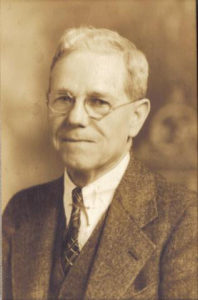
The following citations from the editorials of Elder C.H. Cayce in his paper "The Primitive Baptist" were titled by him as "The Curtain Raised" which was so titled in order to uncover what was transpiring in the first quarter of the twentieth century among "The Primitive Baptists." We will begin with what he wrote under this title for September 5, 1916. Cayce wrote (emphasis mine):
"Our readers are well aware of the fact that a war has been waged in some sections for some time. In Texas the war has been on for quite awhile. One side has been charging the other side with believing what they term the whole man doctrine. Elder J. S. Newman and those who are in line with him, or who affiliate with him, have been charged with believing that doctrine, although he and others have repeatedly denied believing it. For some time there have been some who have been charging the same thing upon us. In our issue of November 16, 1915, we gave our views on the question of regeneration, and hoped that would satisfy those who had been thus charging us; but it seems that it failed to satisfy some. For a good while those who are in line with Elders Webb, Redford & Co., of Texas, would not say whether they endorsed our editorial or not. Finally two of these preachers came out in an article in the Trumpet in reply to our article. We have continued to remain silent and to take no part in this unholy war, trusting or hoping that it might cease, and that these brethren who seem determined to have strife and confusion would tire of their unholy course and stop their unbrotherly thrusts and unholy warfare. But it seems that they are determined not to even hush, and are determined to make us engage in war with them. Some have been saying that we had been working in a secret way; and it has been told to some of the members of our home church that we had something hid, behind the curtain, etc. Now, it seems to be our imperative duty to remain silent no longer."
By "Redford" Cayce means S.N. Redford (1872-1950) and by "Webb" he means J. G. Webb (1849-1927), who was the father of another Hardshell preacher named T.L. Webb Sr. and grandfather of Elder T.L. Webb Jr., also a "Primitive Baptist" minister, and who I met in my younger days. Newman, Redford, and Webb were three leaders of the "Primitive Baptist" church in the state of Texas. Texas is the place where Elder Daniel Parker moved to along with the church he had established and was the first Baptist church in that state, and Texas Hardshell churches had been infected with Two Seedism very early on. In my early days as a young Hardshell minister I was a close friend of Elder Sonny Pyles of Texas and he often spoke of his interactions with the remaining remnants of those old Two Seed Primitive Baptists. He spoke of how he was introduced to the subject of the Devil's origin and the controversy surrounding that question by the Two Seeders he conversed with in Texas.
It is interesting to note how one of the debatable questions in the Two Seed controversy over regeneration was still a dividing issue among many "Primitive Baptists" well into the twentieth century. Cayce speaks of a "war," an "unholy war," that had been raging on the nature and definition of regeneration. Actually, however, the entire history of the "Primitive" or "Old School" Baptist church is one of "strife and confusion" and "unholy war," with numerous schisms, factions, and declarations of non-fellowship. In the previous chapter I cited from "The History of the Baptists of Tennessee with Particular Attention to the Primitive Baptists of East Tennessee," by Lawrence Edwards (1941). In CHAPTER V, titled "THE TWO-SEED HERESY AND ABSOLUTE PREDESTINATION" Edwards spoke of this divisiveness among them, writing as follows:
What was true of the Powell Valley Association of Primitive Baptists was a microcosm of the whole denomination. I was a witness of such divisiveness in the years I was with them. I wrote about this in a post back in 2012. (See here) In another article I cited from Elder Joe Hildreth (a minister I met when I was a young Hardshell elder and who used to pastor the "Primitive Baptist" church in Chattanooga) wherein Hildreth talked about how the "Primitive Baptist" church had declined so dramatically. I cited these words of Hildreth which gives one of the reasons for this decline:
"(6) Frequent splits and divisions in the early part of the 20th Century were traumatic and dishonoring to the Cause of Christ...These splits and controversies had traumatic effects upon our people. Especially was the absoluter division devastating."
The early 20th century is the time period we are examining now. However, the "splits and divsions" also characterized the 19th century. In chapter two of my series "The Hardshell Baptist Cult" I also addressed how divisions have characterized the Hardshell sect from their very beginning. (See here)
Cayce wrote further:
"We are also conscious of the fact that when a person goes to an extreme and another person begins to contend against that extreme, it is a very easy matter for him to go to an extreme also, but in the opposite direction."
I find it highly ironic that Cayce fails to see how he and his Hardshell Baptist brethren did the very thing Cayce is warning against! They went to an extreme themselves in fighting what they thought was an extreme.
Cayce wrote further, citing what Elder R.V. Sarrels and the church he pastored declared non-fellowship for those who he thought held to the "whole man" doctrine. He said:
"Whereas, Elder J. B. Downing has, in our own stand and from the pulpit of his own church, affirmed, contrary to (Galatians 5:17), that it is not the flesh or physical being of man, but the sinful principle in man, that is opposed to God and holiness; and Whereas, He holds that the flesh (which we know to be natural, vile, sinful, unholy, and corrupt) is an essential constituent or part of the now real child of God; and Whereas, There are some among us who hold that there is some kind of change of quality or condition produced on the flesh in regeneration; We, Harmony Church of Christ, believing the above-named things to be heresy, do therefore solemnly declare that we have no fellowship for said heresy; and hence, have no fellowship for its advocates, and will not affiliate with them. Done by order of the church while in conference February 28, 1914."
ELDER R. V. SARRELS, Mod. H. H. WARREN, Church Clerk
I have cited from Elder Sarrels in my series "The Hardshell Baptist Cult" because he wrote the only "Systematic Theology" written by a "Primitive" or "Hardshell" Baptist. In his section on "regeneration" he absolutely teaches some heretical notions about it, affirming that a heathen's worship of false deities is evidence of regeneration! I cite in this chapter (here) where he said:
"God has not explained just what he does to the soul of man to fit it for the heavenly state, and it is probable that if he had explained it, we still could not understand it." (pg. 339)
In this chapter (here) I cited from Sarrels again, where he wrote:
"We here give some attention to a matter mentioned earlier in this chapter: Since we hold, (a) that God, without the use of the gospel as a means, regenerates his loved ones in heathen lands as well as in cultured lands, and, (b) that in all of these lands, both heathen and cultured, the Holy Spirit performs his convicting work, we make the following differential observation: As the innate knowledge of God's existence, or First Truths, may exist in only faintly discernible ideas about the Supreme Being, and may range from this all but dormant and little understood stamp of the Maker to the highest and most enlightened concept of God's existence, so the facts connected with conviction--and conversion--may begin with the faintly dim ideas about sin, righteousness, and judgment, about repentance, faith, and justification, and range from this to the most advanced intellectual concepts concerning these progressive steps in the experience of a believer in gospel lands." (pages 365, 366)
"...in perhaps the vast majority of cases the elements of conversion--repentance, faith, and justification--may be present only embryonically, an analysis of these elements brings us to a fuller appreciation of the conversion experience." (ibid)
"We have the mind of Christ," says Paul (I Cor. 2:16)...However embryonic this mind of Christ may be in one's conscious life, even among civilized people, or however indistinct and distorted this may be in saved people who have no knowledge of Christ in the gospel sense, the mind of Christ is there; as something absolutely native to the new creation, it is there in every person on earth. Paul did not preach ANOTHER God to the men of Athens who had gathered on Mars' Hill; he preached to them the very God WHOM THEY INGNORANTLY WORSHIPPED." (Ibid)
"Not only does this view limit salvation to areas where the gospel is preached; it actually limits salvation to those who believe the gospel and obey it. The Moslems, the Buddhists, the Brahmans, and all other non-Christian adherents, even in gospel lands, are according to the strict sense of this view doomed. Not only this--strictly interpreted and applied, this view would exclude Jews and Unitarians, and, by some, even Catholics, who do not believe what is preached as some religious groups would present the matter. These are hard facts which need to be placed before the world. For reasons which are but briefly alluded to in some parts of the work, but developed more fully in other parts, we hold that God, despite the teachings of man, saves his chosen people all over the world." (page 434)
This is enough to show that Sarrels knows nothing about what the Bible says about being saved, born again, or regenerated.
In reply to the action of Sarrels and the church he pastored in declaring non-fellowship for the "whole man" doctrine, Cayce wrote:
"The above resolution shows for itself what has been advocated by some who are charging that others are advocating what they call the whole man doctrine. In the first place, this resolution denies that it is the sinful principle in man that is opposed to God and holiness, and sets forth the idea that it is the material body, the body of flesh in the abstract sense, that is opposed to God and holiness."
Sarrels's view shows elements of Gnosticism and Two Seedism. In earlier chapters we addressed this. The Gnostics believed that the material or physical world was evil, the source of all man's woe. Salvation involved being freed from this world. Two Seedism, as we saw, borrowed much from Gnosticism.
Also, the debate over whether the physical body of a believer is a child of God needs some light from the scriptures. It seems that the error in the reasoning of those who held to the "whole man" doctrine was in their belief that for the body to belong to Christ and be part of what it means to be a "child of God" it had to undergo a regeneration or rebirth just as the soul or spirit. I find that strange because both sides of this debate believed that people are styled "children of God" before they are born again by virtue of their having been elected to become children of God. So when the angel says to Joseph "you shall call his name Jesus for he shall save his people from their sins" (Matt. 1: 21) they all agreed that this was a reference to the elect. The same is true with this text:
"Now this he did not say on his own authority; but being high priest that year he prophesied that Jesus would die for the nation, and not for that nation only, but also that He would gather together in one the children of God who were scattered abroad." (John 11: 51-52 nkjv)
So, it was not necessary for the advocates of the whole man doctrine to think that the body needed to experience regeneration in order to become children of God in the sense of election or in the sense of belonging to God.
The other aspect of the debate, as we see from the above citations, is on whether the "sinful nature" or "principle" or "flesh" includes the physical body. Cayce denies that the physical body is involved in this sinful nature and is therefore "opposed to God and holiness." Both sides, in my view, were wrong in some of their conclusions.
Though the body is decaying and dying as a result of God's curse, this does not mean that it does not belong to the Lord and is a part of the child of God. Second, salvation involves saving the body, which salvation does not occur in this life, but in the coming resurrection of the just. Third, the body, as well as the other parts of man, were purchased by Christ when he redeemed man. I wrote about this in this article (here).
"Jesus," said the apostle Peter, in his great sermon on the day of Pentecost, "has God made both Lord and Christ." (Acts 2: 36) Lordship involves ownership. Christ is "Lord of all" (Acts 10: 36) and by his redemptive work he purchased all men and all things. Christ is Lord and owner of even those who are not his by a new birth. That is why they will confess that Christ is their Lord in the day of judgment. (Phil. 2: 11) However, believers are Christ's "special possession" (I Peter 2: 9; etc.) by purchase. Recall that in the parable of the treasure hidden in a field that the person seeking to obtain the treasure bought the whole field. (Matt. 13: 44) In the parable of the wheat and tares the "field" was said to be the "world." (Matt. 13: 38) The apostle Peter says that Christ "bought" even those who deny him. (II Peter 2: 1)
So, just because the body is owned by the Lord, or is his special possession, does not mean that the body is changed when the soul or spirit is regenerated. It belongs to the Lord though its change into an immortal spiritual body will not occur until the resurrection of the righteous. Further, the body of the believer is holy or sanctified. So wrote the apostle Paul:
"I beseech you therefore, brethren, by the mercies of God, that ye present your bodies a living sacrifice, holy, acceptable unto God, which is your reasonable service." (Rom. 12: 1 kjv)
He also not only spoke of the body as being "holy" but also of Christians having "holy hands."
"I will therefore that men pray every where, lifting up holy hands, without wrath and doubting." (I Tim. 2: 8 kjv)
Many Two Seeders wrongly thought, however, that since the body and hands of believers are holy that they must have therefore been changed by regeneration as well as the soul or spirit. However, being holy does not mean that there is necessarily a change in the substance or physics of the body. Many utensils in the old testament service were holy, but there was no change in the physics of the utensils. A holy spoon is simply a spoon that had been set aside for use only in the service of the temple and not used for common purposes. There was no change in the spoons. So we read:
"And thou shalt take the anointing oil, and anoint the tabernacle, and all that is therein, and shalt hallow it, and all the vessels thereof: and it shall be holy." (Exo. 40: 9 kjv)
So the body of the believer is sinful in its nature but holy because it is set apart by the renewed spirit and controlled by the Christian. So too are a believer's hands, feet, tongue, etc. holy in this way. So Paul wrote:
"For just as you presented your members as slaves of uncleanness, and of lawlessness leading to more lawlessness, so now present your members as slaves of righteousness for holiness." (Rom. 6: 19b nkjv)
By "members" is meant the members of the body, such as hands and feet. These bodily members were once used for doing what is wrong and immoral but are now to be used for doing righteous deeds and for holiness.
Cayce continued:
"We know that Old Baptists have always contended that it is the sinful life or nature which man possesses that is opposed to God and holiness, and that this is the teaching of the apostle in (Galatians 5:17). In that text the apostle says, "For the flesh lusteth against the Spirit, and the Spirit against the flesh: and these are contrary the one to the other: so that ye cannot do the things that ye would." The apostle could not have meant in this that the material body, the mere lump of flesh, "lusteth against the Spirit." There could not possibly be any such thing as lust in the flesh, the material body, in the absence of life. Hence, he must have meant that the natural life, which the man possesses, lusts against the Spirit. Or, in other words, he meant that the old, sinful, depraved nature we possess lusts against the Spirit."
I agree that often the word "flesh" in scripture denotes not a person's skin, nor his physical body, but often denotes man's depraved nature. So, when the apostle Paul said "I know that in my flesh dwells no good thing" (Rom. 7: 18) he alludes to his sinful nature. In Romans 8: 3 Paul speaks of Christ being made "in the likeness of sinful flesh," which however does not seem to denote a sinful nature but a sinful physical body. How could Christ be made in the likeness of sinful nature? Though "flesh" often denotes the sinful nature, yet that does not mean that sinful inclinations don't arise from man's body or physical being or is excluded from that nature.
In Romans 6: 6 he speaks of "the body of sin" and to me this refers to man's physical body. In verse twelve we read: "Therefore do not let sin reign in your mortal body, that you should obey it in its lusts." Here "mortal body" clearly refers to the human physical body. "Sin" is in it and actually "reigns" over the body in most people. "Lusts" also originate in the physical body. Christians are exhorted to not let sin "reign" in their bodies, to not let bodily urges control them, but for them to rather control their bodily desires. The body is the physical vessel through which the inclinations of the depraved mind and will are carried out in the physical world. But, sinful urges may also originate from the physical body, for the brain is part of the physical body. Paul wrote:
"For if you live according to the flesh you will die; but if by the Spirit you put to death the deeds of the body, you will live." (Rom. 8: 13 nkjv)
Here we have the words "flesh" and "body." By "body" does the apostle mean "flesh" or does he mean physical body? Some say "body" and "flesh" are the same in this text, and that may well be the case. People who are controlled by their bodily cravings are acting like animals. In Romans 7: 24 Paul queries: "who shall deliver me from the body of this death?" In that instance I think Paul alludes to an ancient form of punishment where a murderer had a dead body tied to his back so that he had to carry around that rotting corpse. Though "flesh" (Grk. "sarx") may mean "sinful nature," yet "body" (Grk. "soma") in the above text is not a synonym for "sinful nature" but does indicate that the physical body has a sinful nature also.
Some say the body is morally neutral, including some Calvinists. Is that true? If that is true, then does it not show that depravity is not "total"? If, however, depravity be total, infecting every aspect of man's nature and being, then of course his body would be depraved. Though "flesh" often refers to the sinful nature, and not to the human body, yet the sinful nature encompasses the body.
Further, the same apostle spoke of the "carnal mind" and the sinful mind. We know that the "heart" is said to be the place where thoughts originate, even evil thoughts. (Matt. 15: 19; Prov. 23: 7) Paul also spoke of how it is the "spirit" within a person that thinks and knows. (I Cor. 2: 11) So, does "mind" exclude the physical brain?
Also, if the body were not sinful then it would not die. In fact, in I Corinthians chapter fifteen, where Paul is speaking of the resurrection from death of physical bodies, he wrote: "The sting of death is sin, and the strength of sin is the law." (vs. 56 nkjv) The body dies because the body is sinful. Notice these words of the same apostle:
"13 Foods for the stomach and the stomach for foods, but God will destroy both it and them. Now the body is not for sexual immorality but for the Lord, and the Lord for the body. 14 And God both raised up the Lord and will also raise us up by His power. 15 Do you not know that your bodies are members of Christ? Shall I then take the members of Christ and make them members of a harlot? Certainly not!--18 Flee sexual immorality. Every sin that a man does is outside the body, but he who commits sexual immorality sins against his own body. 19 Or do you not know that your body is the temple of the Holy Spirit who is in you, whom you have from God, and you are not your own? 20 For you were bought at a price; therefore glorify God in your body and in your spirit, which are God’s." (I Cor. 6: 13-15; 18-20 nkjv)
Clearly "body" in these words means the physical body. In these words we see that the body may engage in "sexual immorality" or in sinful deeds. In Romans 6: 12 we have already seen where the apostle speaks of the "lusts" of the "mortal body." Yet, though the bodies of believers remain sinful after they have been initially regenerated in their hearts, minds, or spirits, they nevertheless "belong" to the Lord, so Paul says "your bodies are members of Christ." How members of Christ? Not by regeneration, but by having been purchased by Christ to become his special possession or treasure. So Paul says your body and soul belong to the Lord for this reason -- "for you were bought with a price," and not "for your bodies have been regenerated as has your soul or spirit."
What does Paul mean when he says "every sin that a man does is outside the body"? Commentators are all over the place in interpreting that expression. Many translations will add the word "other" to the text and translate it as "every other sin." However, some of them will italicize the word "other" to let the reader know that it is not in the Greek text. Is Paul saying that the only sin in which the body participates is sexual sin? What about gluttony? Or those people whose "god is their belly"? (Phil. 3: 19) Are there not numerous texts that speak of the bodily members as sinful or engaged in sin, such as the tongue. (James 3: 2-12) James calls the tongue "a world of iniquity" (vs. 6), "an unruly evil" (vs. 8), that "defiles" the "whole body." (vs. 7) He says the tongue, as well as the whole body, needs to be "tamed." He also says that "a perfect man" is one who is "able also to bridle the whole body" so as to make it obey us.
I could add many more texts which show that the physical body is sinful, that it has its own lusts. Further, it does not have to be changed in this life for it to belong to the Lord. It will be changed in the resurrection of the just.
Wrote Cayce further:
"...the term flesh in verse 17 does not have reference to the material body but to the sinful life or nature which we possess. The child of God has two natures. So this text teaches. Old Baptists have always said that this text teaches that the child of God has two natures--one sinful and corrupt, and the other holy and divine. The sinful and corrupt nature is received in the natural birth, and the divine nature is received in the new birth, or in regeneration. In regeneration it is the man, the sinner of Adam's race, that receives the divine nature. That divine nature is implanted in the soul or spirit of the man by the direct and immediate operation of the Holy Spirit, and the man then possesses two natures--the sinful nature and the divine nature. These two natures are opposite to each other. They spring from opposite sources. They are contrary to each other."
So, is Cayce denying that the material body has a sinful nature? He says "the sinful and corrupt nature is received in the natural birth." Would the body be excluded from this corrupt nature? David said that he "was shapen in iniquity" and "conceived in sin." (Psa. 51: 5) Shapen and conceived seem to include the body. Was his body not conceived in sin?
If the new divine nature is "implanted in the soul or spirit" and "cannot sin" (as Cayce believes), then where does the sinful nature reside? If Cayce does not believe that the sinful nature or principle no longer resides in the regenerated spirit, but is still present in the regenerated person, then where does it reside?
Wrote Cayce further:
"According to that declaration, it is down-right heresy to say that the body "is an essential constituent or part of the now real child of God." There you are! If the body is no part of the now real child of God, then real children of God are spirits only, and the bodies are children of wrath, or children of the devil, as you may be pleased to term it. Then if the spirit only is the child of God, and the body is no part of the child of God, then the child of God lives in the Adam man, or in the child of wrath, until the Adam man dies; and the Adam man dies and goes to the grave a child of wrath. If he is raised in the last day, he will be raised a child of wrath, or else he will be changed some time between death and the resurrection."
The error Cayce is attacking is one that says that since the body is a "part of the child of God" it must therefore have been born again or regenerated along with the soul or spirit.
Wrote Cayce further:
"A denial that the body is a part of the child of God is eternal Two-Seedism. That is precisely what the eternal Two-Seeders would say. If we have to say that the body is no part of the child of God in order to be an Old Baptist, we have never been one. But we do not have to say that in order to be an Old Baptist, for the Old Baptists have never believed any such heresy."
The body is a part of the child of God, but it is not because it has been reborn of the Spirit but because it has been purchased by the Lord to be his special possession. It is true that those who are children of God by election from the foundation of the world do not actually become children of God until they have been begotten of God. It is also true that though the bodies of the saints belong to the Lord they will not experience redemption until the resurrection, what Paul called "the redemption of the body." (Rom. 8: 23)