Thursday, January 15, 2026
Two Seed Baptist Ideology (XXXVI)
Thursday, January 8, 2026
Two Seed Baptist Ideology (XXXV)
"According to Parker, "the nature and certainty of the relationship or union which exists in Christ with his Church" was a crucial issue in his two-seeds doctrine. Parker said that an eternal oneness existed between Christ and His Church." (pg. 55)
"I wish to be understood as believing, and now aiming to prove, that Christ and his Church are one; and if they are now, or ever will be one, that, that oneness has existed as long as Christ has existed, as it is as impossible for a head to exist without a body, as for a body to exist without the head." (pg. 55)
"This oneness or union, while existing prior to God's creation, was demonstrated in the creation itself." (pg. 55)
"Having come into the world, the Church sinned. Adam, who stood with the Church (the elect) in him, partook of the forbidden fruit, causing him and the Church to deserve God's wrath. But because of Christ's union with and love for the Church, he married her human nature, assumed her debt of sin, and redeemed her from the curse of the law. Such a manifestation of love, while having no equal, was a logical outgrowth of the eternal union which existed between Christ and his Church." (pg. 56)
When Parker said - "because of Christ's union with and love for the Church, he married her human nature, assumed her debt of sin," he was denying the Calvinistic doctrine of "unconditional election" which affirms that the choice of sinners to salvation was not based upon any difference in the ones chosen from those not chosen. As we have seen, Elder Grigg Thompson dealt much with this consequence of the Two Seed doctrine, and so too did Elder Lemuel Potter.
The idea of an eternal "vital" or "actual" union of Christ and his elect people is a foundational belief of all Two Seeders, and involves the idea that the elect existed in Christ from eternity. As we have seen, this belief had adverse effects for two bible doctrines, one dealing with unconditional election by grace, and the other with the nature and causes of regeneration or rebirth in the spirit.
Watson was correct in affirming that the Two Seeders who followed Parker did generally promote the idea that God did not use such means. Lee implies that Watson was wrong. But, that is not true. Watson never said that Parker himself denied means. We have given other testimonies of other elders of the 19th century who also all said that a denial of means was a Two Seed idea. We also saw this from my citation from the 1879 minutes of the Powell Valley Association of Primitive Baptists. Some Two Seeders taught that no such means were used by God to "regenerate" or "beget" sinners, but did teach that such means were used to "birth" those who were previously begotten and they connected this birthing with evangelical conversion. See my post titled "Elder Samuel Trott On Means" (here) and also chapter 52 of "The Hardshell Baptist Cult" series titled "Beebe Trott Model" (here).
Wrote Lee:
"Some groups which held generally to the two-seed views rejected certain portions of the doctrine. One such group, the Old School Baptists of Bethel and Muddy River Associations (Illinois), strenuously denied that the proclamation of the gospel had anything to do in bringing sinners to a knowledge of the truth. Daniel Parker had declared just as strenuously that God used such means to bring sinners to repentance." (pg. 63-64)
Wednesday, January 7, 2026
Two Seed Baptist Ideology (XXXIV)
Elder Lemuel Potter's (1841 - 1897) book against Two Seedism is titled "UNCONDITIONAL ELECTION STATED AND DEFINED; OR, A DENIAL OF THE DOCTRINE OF ETERNAL CHILDREN, OR TWO SEEDS IN THE FLESH" and can be read (here) and was written in 1880. The book above is only one of several books he wrote and published.
"Hence we believe that the whole family of Adam stood in him, and by his transgression fell under the law. Out of Adam's posterity, God chose a people for his name as the objects of his mercy and grace, for whom he made all the rich provisions of his grace in Christ before the world began; not because they had any right to be chosen, or that he was under any obligations whatever to choose them, only his own eternal purpose to do so."
Sunday, January 4, 2026
Two Seed Baptist Ideology (XXXIII)
Elder Lemuel Potter
1841 - 1897
I have two chapters on "Eternal Vital Union" and one on "Hollow Log Doctrine" from my writings titled "The Hardshell Baptist Cult" (which has its own blog with 128 chapters, which I began writing back in 2008; See here). Those chapters can be read in that blog (here, and here and here) or in my blog that has all my Two Seed Baptist writings and chapters (See here). In those chapters I cited much from Lemuel Potter and some from others, such as Grigg Thompson, J. H. Oliphant, William Conrad, S. F. and C. H. Cayce, etc. So, some of what I will be writing in the next several chapters may be but a repeat of what I wrote therein. In the past two chapters we have looked at what two of the leading elders of the "Primitive Baptist" or "Old School" Baptists wrote in opposition to Two Seedism, namely Elder Joshua Lawrence and Elder Grigg Thompson. Beginning with this chapter we will focus on what Elder Lemuel Potter of Illinois wrote against Two Seedism, beginning around 1880. In the first link of the three in parentheses I focus on what Elder Potter wrote. In the second link I focus on what Elder William Conrad (1797-1882) of Kentucky wrote against Two Seedism in his book "Life And Travels Of William Conrad." He was a contemporary of T. P. Dudley, one of the leaders of the Two Seeders from whom we cited much in previous chapters. In the third link I cite again from Potter, Grigg Thompson, S.F. Cayce, C.H. Cayce, and a few others.
Elder Potter says that when he first began to preach among the "Primitive," or "Regular" Baptists, that he favored the Two Seed doctrine. I wrote on this in a posting titled "The Church Advocate" Periodical" (See here) and cited from Potter's book "Life and Travels of a Poor Sinner." In that post I wrote:
"The Church Advocate" periodical was first begun by Elder Daniel Parker in 1829 to promote his "two seed" views. What is interesting is the fact that Elder Lemuel Potter, about fifty years or so later, an opponent of "Two Seedism," started a paper and named it "Church Advocate."I find it strange and ironic that Potter would name his periodical the same as Daniel Parker named his periodical, seeing that Potter was at that date strongly opposing Two Seedism. I also find it strange that he says that he started that periodical to fight against the doctrine that God uses the means of his word or gospel in regeneration and eternal salvation and yet Daniel Parker believed in means, as we have seen. Later Two Seeders did lead the way in teaching that means were not used in God's saving of sinners. We have Elder John Watson's testimony to that fact. We also have Elder Hosea Preslar's testimony of that fact. We could also mention Elder William Conrad who testified the same in his book "Life and Travels of Elder William Conrad." In the previous chapter I cited from the testimony of several other first generation leaders of the newly formed "Primitive" or "Old School" Baptist sect that also said that the no means view originated among the Two Seed Primitive Baptists who followed Parker.
In a post titled "Powell's Valley Originally Espoused Gospel Means" I cited from a book titled "The History of the Baptists of Tennessee" by Lawrence Edwards (August, 1940) and from chapter five titled "THE TWO-SEED HERESY AND ABSOLUTE PREDESTINATION," where he wrote (See here):
"The Two-Seed doctrine, which was beginning to occupy the attention of the churches in the early 1870's, continued to plague the Primitive Baptists, especially those of the Powell Valley association, until 1889, when a split occurred in the association. The Nolachucky association, too, felt the impact of this conflict, but no complete rift, such as the Powell Valley experienced, occurred in any of the other East Tennessee associations.
At the 1879 meeting of the Powell Valley association the tenth item of business said: Committee appointed to draft advice to the churches in regard to the Two-Seed doctrine, who reported as follows:
We as an association advise our sister churches to have no fellowship with what is generally known as the two-Seed Heresy or those who teach the doctrine of an Eternally damned or Eternally Justified outside of the preaching of the gospel of the Kingdom of God and teach that the unbeliever is no subject of gospel address. We believe that God makes use of the Gospel as a means of calling his Elect and this means is the work of the Spirit in the church."
Here we see where Edwards also shows how the "eternal justification" and "no means" views were identified as part of Two Seedism. Many of today's "Primitive Baptists" accept the "eternal justification" view, men such as David Pyles, pastor of Grace Primitive Baptist church of Pearl, Mississippi, and nearly all of them accept the "no means" view. So, though they may say that they are not Two Seeders, that is not totally true.
I also am astounded by the fact that some of the first "Primitive," "Old School," or "Hardshell" Baptists who did not believe in Two Seedism nevertheless did not declare non-fellowship for Two Seeders. We have seen in the previous chapters where Elder Grigg Thompson published his book "The Measuring Rod" wherein he said that such churches and ministers who believed in Two Seedism were not true churches and ministers, and that he doubted they were even saved. At that time there were churches and associations who were beginning to declare non-fellowship for Two Seed churches, but prior to that time, and even in the time of Thompson, many tolerated Two Seedism, not seeing it as a heresy, as Potter says. How could such people declare non-fellowship for Missionary Baptists because they supported mission work and religious education and yet tolerate Two Seedism? Hosea Preslar and John Watson both said they believed that Two Seedism was far worse than the errors of Missionary Baptists from whom they had declared non-fellowship. In the previous chapter I cited the words of Elder John Watson from his book "The Old Baptist Test" where he said: "It also soon became evident that we would have to tolerate the heresy or separate from the Churches which entertained it." So, which choice did the new denomination choose at the first?
The ones who rejected Two Seedism tolerated it for the most part and it took decades for the new denomination to declare Two Seedism a heresy and rid themselves of it, although, as I have stated, remnants of it still remain to this day among the "Primitive" or "Hardshell" Baptists. We have given evidence of that fact in previous chapters. In my post titled "Hassell On PB Two Seed Ancestry" (See here) I cite Hassell's testimony from "The Gospel Messenger" (March, 1894) where he wrote, speaking of Two Seedism: "the blighting Satanic delusions with which their churches have been cursed for nearly sixty years." Sixty years would take in the time period between 1834-1894. He also said: "It would be impossible to tell how many changes and forms, each one inconsistent with itself, with the others, and with the Scriptures, Two-Seedism has assumed during that period."
As stated in the first paragraph of this chapter, I have already written much on what Elder Lemuel Potter wrote against Two Seedism. So, a lot of this will repetition of what I wrote in those chapters from my writings in "The Hardshell Baptist Cult." I will perhaps put some of those citations in this series as it will put it all together. I do have those chapters in my blog devoted to all my writings on Two Seedism.
Elder James H. Oliphant (1846-1925), a well known leader of the "Primitive Baptists" and who was the chosen moderator of the "Fulton Convention" (1900), in his book "Principles And Practices Of The Regular Baptists" (See here) writes (1883):
"We think that the doctrine of the two seeds, as taught by Parker, and also the doctrine of eternal vital union, as held by others, are opposed to the doctrine of election as taught by the bible, and that they are equally as objectionable as the doctrine of election as taught by Wesley. Each of these views finds the reasons of one's election in himself. Wesley ascribes our election to our obedience, which is at war with grace. Parker and others find a difference in the origin of men that accounts for the election of some and the reprobation of others, while the bible puts it upon the sovereignty of God. Eld. Lemuel Potter has recently published a pamphlet in which this subject is fully investigated, in which he has shown that all these views are open to the same objections."
In the next chapter we will continue to look at what Elder Potter wrote on Two Seedism.
Thursday, January 1, 2026
Two Seed Baptist Ideology (XXXII)
Elder W. M. Mitchell
1819 - 1901
Elder John M. Watson, who we have cited from extensively in the earlier chapters, from his book "The Old Baptist Test" (designed to chiefly combat Two Seedism or Parkerism), said the following on page 28 (highlighting mine):
"After our painful separation from the Missionaries in 1836, a number of Churches, in the bounds of the old Concord association, met together and formed the Stones River Association. We had then, as was generally supposed, a strong and happy union; but alas! there was an element of heresy incorporated in that body as bad, if not worse, than that from which we had just withdrawn. This heresy-the two-seed doctrine as it is termed-was at the time of the formation of the Stones River Association, very prevalent in the Caney Fork Association. Ministers from that section of the country frequently visited some of the Churches in our associations. In this manner they preached among us until it was soon perceived that their words began to eat as doth a canker on the minds of some of the brethren. It also soon became evident that we would have to tolerate the heresy or separate from the Churches which entertained it." (You can read his book here)
I have in previous chapters called attention to the fact that it is bewildering how the "Primitive" or "Old School" or "Hardshell" Baptists, the ones who were behind the "anti-mission movement" of the early 19th century, could declare non fellowship for Baptists who supported mission societies, theological or bible education, bible and tract distribution, revival meetings, etc., and yet tolerate the Two Seed or Parkerite heresy. Many Baptists, in order to prevent division, tried to reason with the Hardshells, arguing that the antis were not obligated to support such things, and that they should allow others to do so without declaring non fellowship against them. Could not both sides tolerate each other? The Hardshells said that they could not tolerate having fellowship with mission Baptists and declared them heretics. Elder Watson agrees that mission societies and the other things mentioned above were heretical and is why he was on the anti-mission side. However, in the above citation he says that the Two Seed doctrine was "as bad, if not worse, than" the perceived heresy of the Missionary Baptists. I suspect, especially after reading his book, that he actually did consider Two Seedism to be far worse than perceived unscriptural mission methods; And, indeed it is. The former chapters show this to be the case.
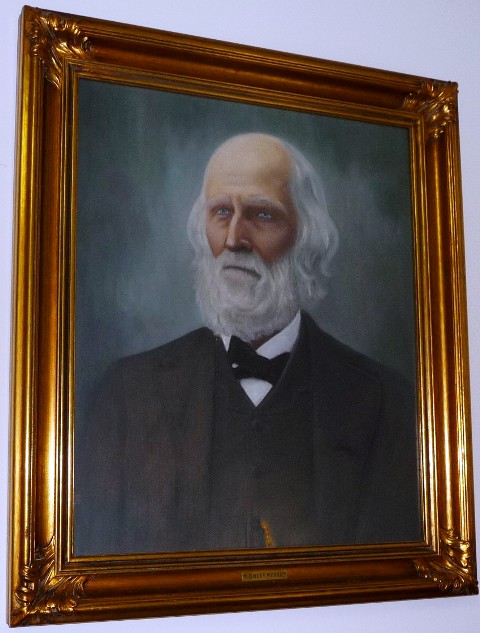
At this point in our series we have begun to show what the leaders of the opposition to the Two Seed heresy began to say in their attacks upon it. We began with Elder John Watson in earlier chapters, and have mentioned a few others, such as Elder Hosea Preslar. In the past few chapters we have seen what Elder Grigg Thompson wrote in 1861 against Two Seedism and those who were promoting it. In the next few chapters we will look at what Elder Lemuel Potter and others wrote in their attacks upon Two Seed ideology. But, before we do this I want to write some things about the suspected Two Seedism of Elder W. M. Mitchell of Alabama. Recall that in chapter thirty of this series, I cited Grigg Thompson who wrote the following about Elder Mitchell (pictured above), citing from this mid 19th century leader of the "Primitive Baptist Church":
"Eld. Wm. Mitchell, of Ala., says, that "the penalty of the law given to Adam was death, and when the transgressor dies, he has paid the penalty, and that is the end of him." Another says that, "These bodies are only adapted as a temporary residence for the spiritual man to dwell in, and that when this spiritual man leaves it, God will have no farther use for it; that it will return to the earth, and be destroyed with the earth. "I know of none of them in Georgia but what teach that "the Adam man, soul, body, and spirit, dies, and sinks down into the grave." (pgs. 88-89)
I then wrote this in commenting upon this citation:
"Elder Mitchell, a leader of the "Primitive" or "Old School" Baptists in Alabama, was a Two Seeder, a fact that today's Hardshell Baptists in that state want to hide. Thompson thinks he was. If one reads old issues of the "Signs of the Times" or "The Southern Baptist Messenger" he will see Elder Mitchell writing in support many times. If what Thompson says is correct, it appears that Elder Mitchell did not believe in the resurrection of the bodies of the wicked. He also says that a large number of Two Seed Primitive Baptists believed in annihilation for the wicked non-elect."
Elder Mitchell became associated with Elder Respess as an associate editor of "The Gospel Messenger" in 1881, a paper to which Elder Sylvester Hassell also became a contributing editor, and who became its owner after the death of Elder Respess. But, prior to Mitchell becoming an editor of that periodical, he was a frequent writer to "The Southern Baptist Messenger" and I have just read through many of his writings in that periodical for the years 1860 and 1862. So far these are the only years available on the Internet. (See here) So far I have not found where Mitchell wrote anything in support of Two Seedism, nor in scanning through those issues have I noticed where anyone else wrote about it. Elder Grigg Thompson, however, believes that Mitchell was a Two Seeder and cites the few words of his above (but does not tell us where Mitchell wrote them) where he seems to believe that the wicked are annihilated at death. Elder Sylvester Hassell did not believe in Two Seedism and I would think that when Mitchell was an editor of "The Gospel Messenger" that he had abandoned Two Seedism or he would not have been on the editorial staff with elders Hassell and Respass.
I rather believe that Elder Mitchell, like Elder Potter, accepted Two Seed views when he first started preaching, as this was the popular view in Alabama when he began to preach. I believe, however, as time went on and Two Seedism was slowly but surely having fewer adherents, that many preachers got off the Two Seed bandwagon and jumped onto the anti Two Seed bandwagon. I believe this was the case with Grigg Thompson when he wrote against it in his 1860-61 book "The Measuring Rod" and also with Elder Lemuel Potter in 1880 when he wrote his own diatribe against Two Seedism. Recall that Potter says that when he first began to preach that he favored the Two Seed view, but sometime later rejected it. He for years regularly wrote to the "Signs of the Times" and expressed support for Beebe and Trott, knowing that they were promoting Two Seedism, and he wrote extensively for the "Southern Baptist Messenger," both being, as Grigg Thompson said, clearly Two Seed periodicals. So, if he did not believe in Two Seedism at first, he at least raised no objection to it. But, as we will see, he seems to be questioning Two Seedism in 1880. Is this because of what Grigg Thompson wrote in 1861 or Potter wrote in 1880?
I want now to cite from Elder Mitchell, in the March 1st, 1880 issue of the "Signs of the Times" (See here) and show what he writes to Gilbert Beebe and asking him for clarification for his views on Two Seedism. Wrote Mitchell (emphasis mine):
"Beloved Brother Beebe:--I know that you have explained and re-explained so frequently on the subject of the new birth, that it would seem like an attempt to annoy you to even suggest a further explanation from you; yet I know you are not fully understood by even some of your warmest friends and brethren, who I am quite certain have no design to misrepresent or injure you. Or if they do understand you, they are not yet prepared to indorse or accept the position which you are understood to take on one point. You, and the brethren generally, I think, are agreed that the very identical man that sinned, is the very man that has to be redeemed by Christ and born of the Spirit in order to enter the spiritual kingdom of God. I do not think there is any misunderstanding on this point. But the difficulty is that you are understood to hold that not only the man is born again, but that the self-existent spirit of God is also born of God. I will refer to your editorial in reply to brother Martin, in the Signs of January 1st, 1877, quoting only so much of your sentences as refer to this particular point. You say, "soul and body and spirit that were and are born of the flesh--sinful and depraved--necessitated to be redeemed, washed, cleansed, purified and born again." Then in the next sentence it is said, "The spiritual life which is given to us in the new birth is born of God." This is in the second column, tenth page; and then again on same page, third column, there is a repetition in substance of the same sentiment, that the "earthly nature and Adamic man is born of the Spirit," and also that "eternal life," that never was defiled, "is born of God" and it "cannot sin, because it is born of God." Again, you say, "This life in us is born of the Spirit, and is spirit; but it is not the spirit of the flesh, which is vile, but it is the spirit of him that raised up Jesus from the dead." Is there any scriptural authority for saying that both the sinner and the spirit of Almighty God are alike born of God? Or do you indeed intend to convey the idea, as some understand you do, that the spirit of Almighty God that raised up Jesus from the dead is born of God, or a subject of the new birth, as the sinner is? I have italicized the points which present the difficulty in the minds of some of your readers, and tried to state the matter in as short and concise a manner as possible. Be assured, my dear aged brother, that no unkind feelings have dictated the above. Affectionately your brother."
As we have seen in previous chapters, Beebe often spoke out of both sides of his mouth relative to Two Seed views on what it means to be regenerated, begotten, and born of the Spirit. This sometimes drew criticism from brethren Samuel Trott and T. P. Dudley, two leading advocates for Two Seedism. In the above queries from Mitchell he gives citations from what Beebe wrote about what it means to be begotten or born of God. Those citations do show that Beebe was perhaps confused at this point in his life about his former Two Seed views. Beebe responds to written questions that Elder Mitchell submitted to him and writes (emphasis mine):
"The points in our former writings to which our dear brother has called our attention, we will now consider. We do most certainly believe that the very identical man that sinned is the very same that is redeemed by Christ, and must be born of the Spirit in order to see or enter into the spiritual kingdom of God, for so our Savior has expressly declared with a double asseveration, John iii. 3. But we do not believe that the self-existent spirit of God is either begotten or born, for that self-existent Spirit is God himself. We know of no other self-existent, Spirit than that God who is a Spirit, and of whom we are told. that they that worship him must worship him in spirit and in truth.--John iv.24. But, while we believe that God is self-existent and independent, possessing all the eternal perfections of his supreme Godhead, we also read, that he is the Father of children which he has begotten, and who are in his own appointed time born of his spirit. The Spirit therefore by which they are begotten, and of which they are born, is self-existent but the children which are born of the Spirit are not self-existent; but being born of God, are children or sons of God, and that which is born of the Spirit is spirit: it is not flesh or blood, or earthly, but it is spiritual and heavenly. Every one who has this spirit which is born of the Spirit, and is led by it, is by is sealed with it..."
The first thing I want to address in regard to the words of Beebe is his statement that he did not believe that "the self-existent spirit of God is either begotten or born." He also says that "Spirit" is "God himself." One wonders why he did not capitalize "spirit" in the first citation but did in the second. Second, he believes, as we have seen in former chapters, that he believed that Christ and his people were "begotten" and "created in Christ Jesus" in eternity. Third, I have colored red the words "begotten" and "born" in the above words, because this will become important in our analysis of what Beebe is trying to say. In Beebe's mind, and in the mind of most "Primitive Baptists" in his day, being begotten was not the same as being born. A man was begotten before he was born. He often said "birth is not the beginning of the child." This is true in regard to physical birth, and those of us who fight against the abortion promoters constantly affirm this fact. Before I expand on this difference, I want to cite from what Elder Trott wrote in the "Signs of the Times" about the statement of Paul that "the second Adam was made a quickening spirit." (I Cor. 15: 45) This text, as we have seen, was much disputed and is the context around the discussions about this "self-existent spirit" that Mitchell raised, connected with Beebe's former writing which said "the spiritual life which is given to us in the new birth is born of God." In chapter 17 I cited these words of Elder Samuel Trott, a friend of Gilbert Beebe and writer for the "Signs of the Times":
Is Beebe now disagreeing with this in 1880?
What did Beebe mean when he said that the man who sinned is the same man who is born again of the Spirit? In earlier chapters we have seen that Beebe and Trott taught that "the new man" was that man who was begotten or made before the world began when Christ was begotten or made, and "the old man" was the human man who was of the seed of Adam. Under that framework the "new man" was "begotten" in Christ before the world began, but was not "born" until it entered into the human man and "manifested" itself. So, in Beebe's Two Seed paradigm there is actually two begettings and one birth. The first begetting occurred when Christ was begotten as the Son of God or Mediator (and which has nothing to do with his divinity) and the second begetting occurred when an earthly man was "regenerated." Then, sometime later after spending time in the womb (corresponding to the time under conviction of sin and in darkness about Christ and the way of salvation) there would be a "birth" (corresponding to the time when a person receives Christ or a hope in Christ).
If by being "born" Beebe means something like the "hollow log" metaphor of rebirth (that I wrote about in earlier chapters), then being "born" of God simply refers to a time when an eternal preexisting child of God enters a man as a rabbit enters a log, and where the entrance of the rabbit does not change the log nor the man, but only temporarily served the needs of the rabbit, then he doesn't believe the new birth changed the new man. The only change to the "old man" (the hollow log) was that it now was the residence of the "new man." This paradigm is behind these words of Beebe: "the Father of children which he has begotten, and who are in his own appointed time born of his spirit." A good follow up question to Beebe would have been - "when were the children begotten?" Another would be - "when is the begotten child born of the Spirit?" In the above words Beebe clearly believes that the begetting occurs before the birth. In his previous writings, as we have seen, he has affirmed that the children of God were begotten and made new creatures before the world began when Christ was begotten and made a Mediator.
Wrote Beebe further:
"Our reception of the first fruits of the Spirit was a birth produced by and of the Spirit; but what was born? Was it the old man, which is corrupt with its affections and lusts? If so, it could not have been born of incorruptible seed, or it would not now, subsequently to such a birth, be still corrupt. The old man is a child of the flesh, and it was born before we received the spirit by which we now cry Abba, Father. We understand the apostle to teach that it is the new man, which after God (not Adam) is created in righteousness and true holiness. It is a child born of the Spirit, a new man--not an old man reformed; it is an inner man, a treasure committed to earthen vessels, that the excellence of it may be of God, and not of man. It is Christ in us the hope of glory. The old man, which we are to deny, resist, keep in subjection, and crucify, is not Christ; but Christ by his spirit dwells in us, if we have indeed been made partakers of the divine nature; and this indwelling of Christ's spirit as a sacred seal assures us that this vile body shall in due time be changed, for flesh and blood cannot inherit the kingdom of God, neither doth corruption inherit incorruption."
Notice again that I have colored the words "birth" and "born" in red. Notice too that he holds to his old Two Seed position by saying "the old man" is not what experiences the new birth. What he really believes is that the "new man" was deposited within the old man and this may be called a birth of the old man, the man being a kind of pod holding the seed, or a womb for the new man ("a treasure committed to earthen vessels").
Wrote Beebe further:
"But we will notice more particularly the marked passages copied from our reply to brother Martin, to which brother Mitchell calls our special attention. We have said, as quoted, "soul and body and spirit that were and are born of the flesh-sinful and depraved--necessitated to be redeemed, washed, cleansed, purified, and born again;" and then in the next sentence, "the spiritual life which is given to us in the new birth is born of God." We have usually spoken of the implantation of the spirit, in which Christ is formed in us, as a new birth, and so we now understand it, as taught, John i. 13. and 1 Peter 1. 23. 24. And this work is performed in the sinner of Adam's race, who, as a natural man, is spoken of in the scriptures as possessing a soul, body and spirit, which is depraved and, sinful, to qualify him to see the kingdom of God. But we have labored to the extent of our limited ability to keep in view that a birth is the bringing forth into manifestation something that was begotten and which exist antecendently to its development by birth...Although sinners redeemed from Adam's race are the subjects of this work of the Spirit, still their flesh, born of the flesh, continues to retain its mortality and corruptibility after the incorruptible seed, the Word of God, which liveth and abideth forever, has brought forth by birth in them the new man, or life, or spirit, which after God is created in righteousness and true holiness. This new birth of the Spirit is not flesh, nor is it born of the will of the flesh, for it is the bringing forth only what is born from above, as in the marginal reading of John iii. 3, 7."
Though he believes that the soul, body, and spirit that makes up a fallen human being needs to be redeemed, cleansed, and born of God, yet he defines the new birth as simply an "implantation" of that new man that preexisted with Christ. The bold red letter highlighting reveals the basic paradigm. He says "a birth is the bringing forth into manifestation something that was begotten and which exist antecendently to its development by birth" and that this preexisting new man is "brought forth by birth." What we see in the above words of Beebe is what is called "double talk." In this paradigm nothing is originated when a sinner is born again.
Wrote Beebe further:
"...and in conclusion we will say that, of what we have written, this is the sum: the identical man who was chosen of God in Christ Jesus before the foundation of the world, and in him blessed with all spiritual blessings before he was brought forth into manifestation by either a first or second birth, had his spiritual, eternal life given to him in Christ Jesus, as the Adam who is the Lord from heaven. The same identical man had a natural life given him in the earthly Adam, which is of the earth, earthy, when man was formed of the dust of the ground. By a first and second birth these two distinct lives were destined to be developed severally, without changing the identity of the man, by, first in the order of time, a natural birth of the flesh like, and is common with all others of the human race; and afterward, their spiritual life in Christ the second Adam who is the Lord from heaven, to be developed or made manifest in him by a second birth. And as nothing spiritual, pure and heavenly can be born of the flesh, so neither can anything carnal, fleshly or impure be born of God. The same identical man possesses in his development by the two births, that which is born of the flesh, and is flesh, and when born again, of the Spirit, that which is not flesh, but is spiritual; and by this spirit in him, which is born, not of blood, nor of the will of the flesh, nor of the will of man, but of God, his Person is sealed until the day of redemption..."
When Beebe says "the identical man who was chosen of God in Christ Jesus before the foundation of the world," read "the identical man who was chosen of God in and existing in Christ Jesus." So, this preexisting chosen child of God would in time be "brought forth into manifestation by either a first or second birth." He surely does contradict himself when he says in one breath that the same depraved sinner is born again and then says in another breath that impure or sinful men cannot be born of God.
Wrote Beebe further:
"Christ was begotten from the dead as the first born among many brethren; and "if the spirit of him that raised up Jesus from the dead dwell in you, he that raised up Christ from the dead shall also quicken your mortal bodies by his spirit that dwelleth in you."--Rom. viii. 11, 19. If then his resurrection was a birth, the resurrection of his redeemed members is also a birth from the dead; for "if Christ be in you, the body is dead because of sin; but the spirit [of Christ which now dwells in you is life because of righteousness."--Rom. viii. 10. Therefore, as we said in the paper referred to by brother Mitchell, we still believe, that the spirit, of Christ which dwells in the saints is the same spirit by which God raised up Christ from the dead, and that it is born of God; not that God is himself born, but that he has by birth communicated to us personally and experimentally of his spirit; that God is the parent, or as it is written, "The Father of spirits," (Heb. xii.9,) and that the spirit which dwells in us is born of him, and is his child and his heir."
Here he seems to say that no change happens to a sinful man until the resurrection of the dead. So, though no change happens to the sinner man when he experiences being "born" of God, he will experience a marvelous change in the resurrection of the dead.
Wrote Beebe further:
"The soul, body and spirit, all that constitutes the man in the flesh whom God has chosen unto salvation through Jesus Christ our Lord, fell in Adam, dies in Adam, and is born of corruptible seed, required to be redeemed, washed, cleansed, purified and born again; not only by the manifestation of the firstfruits of the Spirit, but by being ultimately born from the dead in the final resurrection of the dead."
Here he is even more clear and says what I just said about what he said.
In the rest of this chapter I want to cite from what Elder Mitchell wrote in the Gospel Messenger for 1882 under the title "Eternal Vital Union Of Christ And His Church" Elder Mitchell writes (See here):
"How, or by whom, the phrase "Eternal Vital Union" originated, we do not know; but we do know, that in the past thirty years, much has been very profitably written, and much very unprofitable, and even hurtful. It is not, therefore, our design nor desire to re-open the discussion, nor the wounds that have been created thereby; but rather to remind our brethren, that it is enjoined upon Christians, to "Follow after the things that make for peace, and things whereby one may edify another." — Rom. 14; 19...If need be, every ambiguous phrase, or hurtful, unscriptural word, should be abandoned for the sake of peace within the sacred walls of Zion."
The first thing I want to say in commentary on the above words of Mitchell is how he says that it was over the last thirty years that the subject of "eternal vital union of Christ and his church" had been a topic of discourse, and that some of it was profitable and some not. So, what part was profitable and what part was not? Also, since he is writing this in 1882, then the "thirty years" he is writing about spans the time from 1852-1882. Surely he knows that in the 1820s through 1840s period that much had been written about that subject. Surely he knows about Daniel Parker's books on it from the 1820s. Perhaps he also knew about Thompson's books on eternal vital union in his book "Simple Truth" also from the 1820s. Did he not know that Samuel Trott and Gilbert Beebe and others had written much on it in the Signs of the Times in the 1830s and 1840s?
Mitchell says that brethren should quit speaking of "eternal vital union" since those exact words are not in scripture. Why should they if the sentiment is taught in scripture? If the sentiment is not taught in scripture, then why does Mitchell not denounce the sentiment instead of simply saying let us not use that terminology? If he thought both the terminology and the sentiment were wrong, why did he wait till 1882 to say so? Mitchell says things that his associate, Elder Sylvester Hassell, also would say, possibly parroting what Mitchell here said. It also reflects what Alexander Campbell often said when beginning his reform movement, exhorting all to use bible terms.
Wrote Mitchell further:
"But we wish now to come a little more closely to this Vital Union question. The earth is the Lord's and the fullness thereof, yet he has a people — a part of the Adamic race — that he claims in a special and peculiar sense from others. "This people, saith the Lord, have I formed for myself; they shall show forth my praise." — Isaiah. That they are related in some special and peculiar sense to Jesus Christ as their Saviour, Husband, Head and Redeemer, we presume none will deny. Nor have we ever heard any Primitive Baptist dispute the relation of Christ and his people as being Eternal in some qualified sense. Each, however, wants his own peculiar way of expressing this relation, but all agree that it is Eternal in some way. Some say that it is an Eternal vital or life union; some, an Eternal love union; others say that it is an Eternal covenant relation; and some will have it that it is an Eternal purposed union; and, lastly, some whittle it down to a union only in prospect. All agree that the relation is an Eternal one in some qualified sense, but yet not one of these peculiar forms of expression is found in the Scriptures, and the strife as to their use is often to a great extent a "strife about words to no profit, but to the subverting of the hearers."
So, what is Mitchell's view on eternal union?
Wrote Mitchell further:
"But notwithstanding all the strife that ever has been or may yet be, it is certain that to deny the relation of Christ and his people in some sense, is to deny every principle of the gospel of God. The only hope of salvation for any sinner is based upon his relation to, and identity with, Jesus Christ as his Surety and Saviour."
Again, we ask - what is Mitchell's view?
Wrote Mitchell further:
"Christ does not redeem sinners to make them his people, but because they were his before. "He shall save his people from their sins."
But, in what sense were people God's people before they were born into the world? If they were already his actual children from eternity, why do they need to be made children in time by a birth of the Spirit?
So, in conclusion I say that it seems that Mitchell was a Two Seeder for many years but in later years began to turn away from Two Seedism.
In the next chapter we will begin to examine the things that Elder Lemuel Potter wrote in 1880 against Two Seedism.
Saturday, December 27, 2025
Two Seed Baptist Ideology (XXXI)
The above text cautions us about being carried about by various kinds of "strange doctrines." Few will deny that Two Seedism is such a doctrine. It is indeed a "doctrine of demons" (I Tim. 4: 1). It is interesting that when true Bible "doctrine" is referred to in scripture, it is in the singular, whereas false doctrine is often in the plural, "doctrines."
In this chapter we will conclude our examination of what Elder Grigg Thompson wrote in 1860-1861 against Two Seedism in his book "The Measuring Rod."
Thompson wrote:
"They also deny that the washing of the saint's feet is an ordinance established by Christ, and that it is the duty of saints to attend to it in obedience to his teaching." (pg. 109)
How true this is I cannot say. I do know that some Two Seeders and those who favored the name "Old School" Baptists did practice feet washing. Also, some who opposed Two Seedism and favored the name of "Primitive Baptist" did not practice feet washing.
Wrote Thompson:
"If it was the purity of the seed, or the particular quality or nature of those chosen, that caused their election, then the election was not of grace, but of works, for the elected procured their own election. On this point Beebeism, or modern Two Seed, Arianism, is as much at fault as Armenianism (sic), for while Beebeism makes election rest upon an actual spiritual, holy nature, possessed by the elect; Armenianism places it upon foreseen virtues, which by their own act they are to possess themselves of: either of these views destroy the doctrine of election by grace, which is an unconditional act of the Divine mind. The elect were sinners of Adam's race, for they were chosen out of the world, from among men, and were ordained unto eternal life, or to be conformed to the image of Jesus. This election was not based upon the actual existence of those elected as taught by Beebeism, but upon the foreknowledge of God." (pgs. 139-140)
In previous chapters we have mentioned how Two Seedism contradicts the idea that God chose to salvation unconditionally, his choice not being based upon any merit or distinguishing quality in the ones chosen. Beebe and the Two Seeders say, however, that God chose the elect because they were "in Christ" from eternity, and that Christ was obligated to save them because of this fact. As we will see in the next few chapters Elder Lemuel Potter in 1880 also attacked Two Seedism's consequences for the doctrine of unconditional election. If Christ was obligated to save the church because she was his wife from eternity, then salvation is not by grace, not unmerited.
Wrote Thompson:
"We have already seen that the church of Christ cannot be of the Beebe, Two Seed, Arian faith, because their articles are at variance with the teachings of Christ and the apostles, and destroy the idea of a visible church, composed of men and women of Adam's family, who have been regenerated and born again. For if their views are correct, the church is a mystical, invisible, spiritual existence, that was created before time, and has no connection with fallen men and women." (pg. 167)
Thompson was a reader of the writings of Dr. J. R. Graves, who was contemporary with him, and seems to accept many of the Landmarker views of Graves, the recognized spokesman for Landmarkism. One of the ideas of many Landmarkers is to deny that the word "church" (Grk. eklesia) denotes a universal church composed of all the elect, affirming that it always refers to local churches or assemblies, or to the visible institution and not to an "invisible" church. Not all "Primitive" or "Old School" Baptists agreed with this view, affirming that the "church" sometimes refers to all the saved, and not only to local assemblies. The former definition has been referred to as the "invisible" church since no one can see the whole assembly of saints (though that will change when all are assembled together at the second coming of Christ and afterward), and as the "universal" church because it is a body that contains all the saved, it being believed that not all the saved became members of a local church. So, in this area Thompson is not correct in saying that a belief in such a universal invisible church "destroys the idea of a visible church." What Beebe and the Two Seeders were wrong about is their view that says the church, or elect, had an actual existence in Christ before the world began, and their saying that the church or spiritual seed had "no connection with fallen men and women."
Thompson wrote:
"The practice of passing non-fellowship resolutions against men without giving them a hearing, is unjust and iniquitous, and will destroy the peace and prosperity of any community of saints. This practice has of late prevailed to a considerable extent among the Bebeeite Baptists. The Hanes' Creek church, in Yellow River Association, passed a resolution declaring nonfellowship for me, and all who were friendly with me, without ever giving me a hearing, or even letting me know that they had aught against me. When I heard of the action of the church, I wrote them a letter, asking for a trial, and offering to come to their own church, and be tried by their own members, if they would give me a fair hearing; but they would not do it, knowing that their conduct would not bear investigation. In fact, this has been the course pursued by the Beebe party in Georgia, from first to last, where they have had a majority. A solitary instance cannot be pointed out, where they have ever given a member a fair trial, and allowed him to defend himself, who has dissented from their views. When Eld. T. P. Dudley, of Ky. , first made his assault upon me, I wrote him a private letter, begging him to meet me, and to submit our differences to our brethren, and to let them decide between us, but he refused; and subsequently, when Beebe made his attack upon me, in the "Primitive Baptist, " I wrote to him twice, begging of him to meet me, and to refer the matter to brethren chosen by us both, and let them judge between us, but he would not. I done the same thing with D. W. Patman, and J. R. Teat, and others of the party, who publicly made attacks upon me, but I never could get one of them to consent to have a fair investigation, and to submit the matter to our brethren...But where the Beebe party have been in the minority, they have refused to stand a trial, but have abruptly withdrawn, and refused to hear the church, or to be tried by them" (pg. 189-191)
The practice of the Beebe or Two Seed party in their mistreatment of Thompson, if true (and I tend to believe it is true), reveals the spirit that was motivating them. But, sadly, as I know from my years of being in the "Primitive Baptist Church" and from studying their history, both sides, Two Seeders and non Two Seeders, were guilty of such things.
I have not spent the time to go through all the issues of the "Primitive Baptist" periodical to find where Beebe "made his attack" upon Thompson. As I have shown in previous chapters, Elder Joshua Lawrence, who was the impetus in the creation of that periodical and wrote many articles for it, was not a Two Seeder and considered Elder Beebe to be unsound and would not recognize him. So, it is surprising that Beebe would write for that paper. Perhaps it was published after the death of Lawrence (1843), and after the departure of Elder Mark Bennett, its first editor, and when Elder Burwell Temple was its editor.
Thompson wrote:
"The Primitive Baptists, of late, have had a Diotrephes among them, who has obtained the exclusion of many brethren where he has had the majority. He has had the control of the press, and the communications of the brethren, Diotrephes like, have been suppressed, so that the brethren have never got to see them. This modern Diotrephes is to be found in the person of Eld. G. Beebe; and I can produce a number of instances where worthy brethren have been slandered, and falsely accused in his paper, and he has refused to let those brethren say one word in self-defence; but one or two cases may suffice." (pg. 198-199)
The "Primitive" or "Old School" Baptists have had many splits, many wars and fights since their beginning, the kind that James wrote about in James chapter four ("whence comes wars and fightings among you"). They have split over so many issues, and every time the in-fighting has been ferocious, vicious, where the combatants were biting and devouring one another as Paul spoke about. (Gal. 5: 15) In these fights the combatants often used associations, and councils, and presbyteries, as weapons against their enemies. Recall that Elder Daniel Parker threatened to "burst the association" if the associations did not declare non-fellowship for mission societies, seminaries, Sunday schools, etc. These threats were the means of forcing others to kowtow to them. I wrote about how my father and I, and our church, experienced this first hand when the Powell Valley Association held a council over father's view on the origin of Satan and his fall from heaven. You can read about that in my online writing titled "The Hardshell Baptist Cult," which has its own blog with all the chapters. (See chapter two titled "Personal Experiences" here) When a schismatic faction wants to force their views on others they will begin to ask candidates for ordination their views on the questions dividing the Hardshells. This was another way to force others to kowtow. I also had this happen to me in my second ordination when I was a Hardshell Baptist.
I also believe that Beebe did crave being the head dog among the newly created cult. He was at the Black Rock Convention when that convention declared non-fellowship against fellow Baptists who were supporting mission societies, religious education, tract distribution, and a host of other things and he was chosen by the ministers in that convention to represent them by starting the "Signs of the Times" periodical with their support. So, I agree with Thompson that Beebe was like Diotrephes in desiring preeminence. But so too did Samuel Trott. So too have a host of others. Grigg's own father seemed to enjoy being put on a pedestal and being admired by many Hardshell Baptists.
In 1846 in the trial over church doctrine in Indiana, in the White Water Association, Wilson Thompson led the no-means side, and the editor who published the record of that trial called him "the leader, the Ajax" of that side. (See here for my post on that) I also think that Grigg Thompson too was probably jealous of the influence of Beebe, coveting that for himself. I saw such a spirit when I was with the Hardshells, how each association or area had one minister who was the "ringleader" or pope, the one whom the other ministers feared. In the early church there were those who only sought a following, and who had "men's persons in admiration because of advantage." (Jude 1: 16 kjv) Even many "historians" of the "Primitive" Baptist church have said that many of their associational divisions resulted from ministers fighting for supremacy.
Thompson wrote:
"When I reviewed Eld. T. P. Dudley's circular on the "Christian Warfare," he (Dudley) wrote a letter to Beebe, and it was published in the "Signs of the Times," calling me a "libeler," and many other hard things. I then wrote a letter to Beebe denying Dudley's charges, and proposing to meet Dudley, and submit the matter to our brethren; but he refused to publish my letter, and would never let me say one word in self-defence. Shortly after the division in the Licking Association, Ky., between the Primitive Baptists and the Dudleyites of that Association, Eld. J. F. Johnson, then of Indiana, wrote a letter, which Beebe published in the "Signs of the Times," stating that he had just been a tour through Ky. , and in it, he, in the strongest kind of language, said that the Primitive Baptists, who had left the Licking Association, denied the doctrine of eternal, personal, and unconditional election. The charge was false, as the articles of faith adopted by those brethren and published to the world showed; and Eld. Beebe knew the same, for he had seen the articles. I again wrote to him, desiring that he would let me correct the falsehoods published against the brethren by Johnson, but he would not suffer it, and the brethren had to lay under the false charge, without any means of defence. Thus, where the brethren who loved the truth would write, their letters were suppressed by this Diotrephes who loveth pre-eminence, and with malicious words heaps reproach upon the brethren, and will not receive them himself, and forbiddeth them that would, and casteth them out of the church." (pgs. 199-200)
I find it interesting that each side in the Two Seed debate accused the other side of denying the Calvinistic doctrine of unconditional election. We have already taken notice of this and have stated that the Two Seed view does in fact deny that doctrine. In the next chapter, when we look at what Elder Lemuel Potter wrote against Two Seedism in 1880, we will see how Potter also says that Two Seedism denies unconditional election or election by grace.
Though there were no doubt some formal debates on Two Seedism, whether in oral or written debates, I have not found any. We will see where Beebe did make a formal reply to Potter, and have seen where Beebe responded to Elder Samuel Williams' criticisms of Two Seed ideas, but nothing was extensive. It seems that the Two Seeders, like Beebe and Dudley, were not interested in debating their views, but chose rather to force them on others.
Thompson wrote:
"I became a Baptist about the time that Campbellism began to interrupt the peace of our churches. I passed through that war, and next came the machinery system of modern missions, which brought with it another war, and division in our denomination. I was called to bear my part in that struggle, and to suffer in common with my brethren. But we had hardly got through that war, and began to enjoy peace and union among ourselves, before the Arian, Two Seed notions of Beebe & Co. were introduced into our churches, and produced another war among us which has effected a third split, and built up a Beebe, Two Seed party in our midst. This last war has been conducted in a different way from either of the other two."
I have written about the Campbellite schism several times through the years. That schism clearly showed one thing that destroys many things that the Hardshell Baptists say about the state of the Baptist denomination at the beginning of the 19th century. They have said that the Baptists, prior to the anti mission schism, were all believers in the peculiar tenets of Hardshellism. They say that they all at that time believed in the "no means" view of regeneration and salvation, and that they all opposed Sunday schools, mission societies, theological education, revivals, etc. All of this is untrue, however. The fact that Campbell led off many Baptists into his movement shows that many of the Baptists, at the start of the 19th century, were Arminian or semi Arminian. Actually, history shows that nearly all Baptists at first had no qualms about supporting the things that the Hardshells would later declare to be heresies. Even Wilson Thompson supported missions at first and believed that the Gospel was a means in salvation. I have shown this to be true in many postings through the years. His book "Simple Truth," published in 1821, shows this to be the case, as does his "autobiography."
I find it interesting that Grigg does not mention the fact that his father believed in Two Seed tenets, a fact we have shown to be the case in previous chapters. He speaks of the split over Two Seedism, it being "a third split," as having occurred at the time of his publishing "The Measuring Rod." However, that is not quite true either. It is true that some churches and associations had begun to declare non fellowship with Two Seedism, yet many others had not yet. Just as the splits over "missionism" occurred over several decades, so too the split over Two Seedism. We have already shown how the Powell Valley Association did not split over it until 1879. In a previous chapter we showed this to be the case, citing Lawrence Edwards who gave us what the minutes of that association for that year declared. (See my posting here) The same is true about two other doctrines that split the churches in the 19th century. After the Civil War there began to be disputes and divisions over the doctrine of "absolute predestination of all things" and over the question of whether God uses the means of the Gospel or word of God to effect regeneration, new birth, or eternal salvation. The truth is, prior to all these splits, the "Primitive Baptist Church" had within it both sides, and existed together for several decades before a formal split occurred, each side tolerating the other for several decades prior to the formal splits.
Thompson wrote:
"The Beebe party have on all occasions shunned investigation; and whenever their doctrines have been called in question by any one, they would at once make it a personal business, and at once assail the moral character of the brother, and do all they could to destroy his good name."
The shunning of open debate, however, is alive and well today among those who called themselves "Primitive," "Old School," or "Hardshell" Baptists. In the Powell Valley church council that I write about in my series "The Hardshell Baptist Cult" that occurred when I was a young member of that association in the early 1970s it was clear that the opposers of father's view (that Satan was a fallen angel from heaven) did not want to debate the merits of his view from the scriptures, though father tried to get them to do so. Consider also the fact that as time went on, the Hardshells had fewer and fewer debates with those of other denominations. Though they had many in the late 19th century, and the early 20th century, they had very few in the late 20th century, and only one or two in the 21st century. This is the same thing that we often see among the liberals in politics today. Rarely do they want to debate the issues with conservatives, but rather make personal ad hominem attacks upon conservatives.
Thompson wrote:
"When Eld. T. P. Dudley began to preach this doctrine in Kentucky, I met him at Mount Gilead church, Mason County, and publicly opposed him, and invited him to discuss the subject; but he refused, and in a secret and under-handed way, immediately began to put in circulation reports prejudicial to my character, and offered them as reasons why he would not meet me. The reports put in circulation by him, which have since been published by Beebe in substance, though changed a little in phraseology, and last of all, by Eld. W. C. Cleaveland, will be fully explained and refuted by the following letter from the Hamilton Primitive Baptist church, in Butler County, Ohio..." (pgs. 225-227)
Why did Thompson not "publicly oppose" his own father for believing in Two Seedism? Was it not because he thought it might hurt his influence? If so, then is he not also like Diotrephes? Why did he not object to Two Seedism in the 1830s, or 1840s, or 1850s? He often wrote affectionate letters to the Signs of the Times in those decades and I have yet to find where he ever raised an objection to Two Seedism. Perhaps he waited till 1860 because at that time more and more of his brethren began to oppose it.
Thompson wrote:
"For I have been known among the Baptists for thirty years, and from the time I was restored by the Hamilton church up to now, have never had a charge preferred against me in any church; and up to fifty one or two, was a constant writer for the "Signs of the Times," edited by Eld. Beebe, and all these things were no objection to me with him, until he came out with his new doctrine, and I opposed it. He then saw that his only chance was to blacken my character if possible, and as his pen was accustomed to slander, it did not take him long to concoct and publish anything without regard to truth, that he could think up. Eld. D. W. Patman visited several Associations in Georgia, and read a letter to many of the brethren, which he said was from my father, stating that I had been twice excluded from the church, once for lying, and a second time for abandoning my family. I wrote to him for a copy of the letter, but I could not get it. I then wrote to my father, and asked him if he had ever written such a letter, and I got a letter, bearing date at Acton, Ind. , May 3, 1860, in which he says, "Patman, nor any other man, has not now, nor ever had, nor will have, any such a letter as you allude to, written by me, for I never wrote any such letter to any one." (pgs. 229-230)
Here, it is clear that Thompson is writing a false narrative, and the only reason I can surmise for it is the fact that he did not want to do anything to hurt his own influence prior to 1860. He says that he was a "constant writer" to the Signs of the Times and implies that during those times that Beebe did not advance Two Seedism in his periodical. But, that is simply not true. I have in previous chapters cited from the Signs of the Times from the 1830s, 1840s, and 1850s and have shown where Beebe and Trott were promoting Two Seed ideas in those decades. So, Thompson is not telling the truth when he says that Beebe did not "come out with his new doctrine" until the late 1850s. I don't doubt that he was unfairly treated by the Two Seeders.
Why did Thompson want people to think that Beebe did not promote Two Seedism prior to the time that Thompson finally went public with opposition to it (1860)? Especially since it is not true? Why did Thompson not write to that paper in the years from 1833-1860 and object to the Two Seedism, as did men like Elder Samuel Williams? We cited from him in previous chapters for that time period. By his saying that he was a "constant writer" to Beebe's periodical he implies that Beebe had not yet "come out with his new doctrine," or else Thompson would have publicly opposed it. Why did he in 1860 not just simply and honestly say - "I saw Two Seedism as a serious error but did not oppose it till now, and I should have"? I think that Thompson, like many of the frontier lay preachers, did not want to do anything to lesson his standing and support, financial or otherwise. It was not until he saw the tide turning away from Two Seedism that he got on the bandwagon of the opposition.
Further, since his father Wilson Thompson believed in the chief tenets of Two Seedism, he may have been held back from denouncing it. Elder John Clark of Virginia (who began his paper "Zion's Advocate" to oppose the views of Beebe and the Signs) and Elder John Watson of Tennessee (who wrote the "Old Baptist Test" to combat Two Seedism) were friends of Grigg. In the 1850's both of them waged a war against Two Seedism. Grigg finally jumped on their bandwagon. Of course, I am also fairly certain that he did not believe Two Seedism, at least in 1860 when he wrote "The Measuring Rod." Elder Lemuel Potter, who wrote his diatribe against Two Seedism in 1880, said that when he first began preaching in Illinois, a place where Two Seedism was widely believed, that he rather favored it. Perhaps that was true of Grigg Thompson also.
The same seems to be true also of Elder W. M. Mitchell of Alabama (1819-1901). Throughout the decades of the 1840s through the 1870s, Mitchell frequently wrote to the Signs of the Times and to the Southern Baptist Messenger, both Two Seed publications, and never objected to Two Seedism, though I have not read every issue of both. However, in 1880, the year before Beebe's death, and the year wherein Elder Lemuel Potter wrote his treatise against Beebe and Two Seedism, we find Mitchell writing to Beebe and the Signs and questioning Two Seedism (Signs of the Times March 1st, 1880; Vol. 48, No 5; See here). In the previous chapter we cited Thompson's citation of Mitchell, which showed that he was a Two Seeder who denied the resurrection, at least of the non-elect, and affirming annihilationism for them. We will delve into what Mitchell wrote to Beebe and of Beebe's response in the next chapter. It seems that many of the first anti mission Baptists jumped on to the Two Seed bandwagon when Parker first gave it prominence by his first books on that subject. However, as time went on, the opposers of Two Seedism began to increase, so that it appeared that Two Seedism had lost its glitter; And, for those seeking popularity and a following, they saw it better to abandon ship and get on board the Anti Two Seeder bandwagon.
Thompson wrote:
"But, last of all, W. C. Cleaveland came out with a letter in the "Southern Baptist Messenger," an Arian, Two Seed sheet, published at Covington, Ga., reiterating all these charges as though they were something new with him, when he and I had talked them all over in 1857, and he had been active in defending me against them. While I was at the Echonna Association, in 1857, W. C. Norris was there, and was secretly whispering thes e things, and W. C. Cleaveland said that "He thanked no drunken preacher for coming there and trying to injure good men." But in 1859, he whirled over to Beebeism, and like all the rest, began to slander all who would not go with them. In the "Herald of Truth" I published him guilty of falsehoods, and proposed to meet him before a tribunal of brethren, and prove it by as good Baptist testimony as could be found, but he refused to meet me." (pgs. 232-233)
Both the Signs of the Times and the Southern Baptist Messenger were leading Two Seed publications, and Gilbert Beebe was the editor of the former and his son William L. Beebe was the editor of the latter. Elder John Watson, prior to his death in 1866, spoke of the need to have Two Seedism debated through a paper called the "Herald of Truth." I have searched through the years trying to find a library that might have old issues of that periodical. I know that in the later 19th century that Elder T. S. Dalton, a person who became a leader among the Hardshell Baptists, took over the editorship of that paper. Dalton (1846–1931) served as the editor of the Primitive Baptist publication The Herald of Truth from February 1891 until 1898. The Herald of Truth was originally established in January 1858 by Elder Fain, it seems. Dalton purchased the paper in 1891 and merged it with his own existing publication, retaining the name The Herald of Truth. He was succeeded as editor by Elder John R. Daily in 1898. The Primitive Baptist Library in Carthage, Illinois, says (See here):
"After his (Elder John Clark) death, in 1882, it ("Zion's Advocate") was published for several years by Elder C. H. Waters (1849-1920) as editor, and Bro. J. G. Wiltshire as publisher. In February 1891 the paper was purchased by Elder T. S. Dalton (1846-1931), who merged it with the Herald of Truth, and served as editor until 1898. Elder John R. Daily (1854-1920) then served as editor for eight years."
I believe that Elder R. W. Fain, a fellow "Primitive Baptist" minister, doctor, and friend of Elder John M. Watson, who helped Watson to revise his book "The Old Baptist Test" before his death in 1866, and who would later promote Watson's book and begin the periodical "The Baptist Watchman" with Elder J. B. Stephens (also a doctor) and others, which was a leading periodical in the 1870s, carried on the debate over Two Seedism through the "Herald of Truth."
According to the Primitive Baptist library (here) Dr. Fain was editor of the "Herald of Truth," for they say:
"HERALD OF TRUTH Elder R. W. Fain, (1807-1876), Shelbyville, Tennessee, founder, in 1858. Elder John M. Watson may have later served as editor of this paper. No issues of this paper have been located yet."
I cited this in a post on Elder Fain, where I also had a picture of him (which took me years to find). You can read that (here). I have read recently where the library has obtained a few copies of that periodical, probably when Elder Dalton took it over.
I find it strange that Grigg Thompson would be writing articles in "The Herald of Truth" against Two Seedism, for that periodical promoted the view that the gospel or word of God was a means in the eternal salvation of sinners, which was the view of Watson and Fain and Stephens. Yet, Thompson would at some time reject that view, as he did in his debate with Elder Mark Bennett, first editor of the "Primitive Baptist" periodical, which debate first occurred in 1853. (See my write up about it here) So, though Thompson would deny the means view, at least in "regeneration," he nevertheless still associated with Elders Watson, Fain, and Stephens, and John Clark, who believed in means. Keep in mind also that a denial of means first developed among the Two Seeders who came after Elder Daniel Parker. Elder Dalton, who took over the Herald of Truth in 1891 when he took ownership of Clark's paper "Zion's Advocate," believed, as I have shown in several postings through the years in my "Old Baptist Test" blog, in means at first, but later jumped ship when he saw that the anti means side was gaining the ascendency in the latter part of the 19th century. (For instance, see this post here)
With this chapter we conclude our look at what Elder Grigg Thompson wrote against Two Seedism in 1860-1861 via his book "The Measuring Rod." In the next several chapters we will look at what other elders would later say in their disputes over Two Seedism.