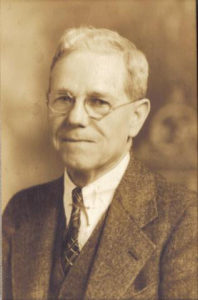
Elder C.H. Cayce
1871-1945
He joined the "Primitive Baptist Church" in 1866 and was ordained an elder in 1878. It also mentions that he was engaged in many debates with others. The "Primitive Baptist Library" has a web page that lists many of S.F. Cayce's debates (here). I find it interesting that one of those debates was with Dr. W.P. Throgmorton in 1896. Throgmorton held several debates with the Hardshell Baptists. In 1878 he held his first debate with Elder Lemuel Potter, of whom we have already been citing. Potter and Throgmorton actually held another debate in 1887. Throgmorton would also have a debate with Elder John R. Daily, and perhaps more than one, and perhaps with other Hardshells.
In S.F. Cayce's first debate with Throgmorton Cayce affirmed that eternal salvation was unconditional, that a person did not have to do anything to be saved, which echoes the Two Seed proposition that says that nothing a person does in his life determines whether he goes to heaven or hell.
Elder S. F. Cayce met Elder Lee Jackson (a Campbellite) in a public debate at Lafayette Springs, Mississippi, in November 1895. The first proposition was: "The eternal salvation of sinners, as set forth in the Scriptures, is the work of God, independent of any conditions to be performed by man." In support of this proposition Elder S. F. Cayce gave thirty-six affirmative arguments. I give these thirty six arguments in this blog post (here) and give my rebuttal to them.
I find it quite interesting that Elder S.F. Cayce named his periodical "The Primitive Baptist." The first paper by that name, as we have seen in previous chapters, was begun in January 1836 and ceased in 1879. It was at first edited by Elder Mark Bennett and supported by Elder Joshua Lawrence and the Kehukee Association. Those who supported it were believers in God's use of the means of gospel preaching to give birth to children of God. Bennett later left the "Primitive Baptists" and became a Missionary Baptist. He even held debates with Elder Grigg Thompson, who we have cited much from in previous chapters, after he left the Hardshells, about supporting missionaries. See these posts about that (here, here). Elder Lawrence believed in means and wrote against Two Seedism, as we saw in previous chapters. You can find articles about Lawrence and his views on means (here, here, here). In the first of these I cited from the 1838 issue of "The Primitive Baptist" where Lawrence wrote the following about the parable of the soils:
"The first parable showeth the effect of the gospel preached by the Son of man with its effect on different persons, compared to the way side, stony ground, thorn, and good ground hearers; which showeth that three-fourths of his gospel preaching is lost, as only the good ground hearers bro't fruit. And this is true under the preaching of all his ministers, as well as his. So then the field in the first parable is the world, in which the gospel or word is preached; the field, in the second parable, is the world, in which the effects of the preaching of that gospel on good ground hearers produces the children of his kingdom. Hence it is said, born not of flesh, blood, or will of men; but of the word of God, that liveth and abideth forever. And again: I have beggotten you through the gospel..." (pg. 306)
"Although Christians are sons and daughters of God, yet they are not begotten of a woman; but through the gospel by the same Spirit that begot the body of Christ by Mary; therefore he is not ashamed to call them brethren." (pg. 310)
In my series "What The First Hardshells Believed" I cited much from this periodical to show that the first "Primitive Baptist" periodical believed in means and in the perseverance of the saints, two doctrines that would be denied by S.F. Cayce and his son C.H. Cayce and such denial was one of the foundational beliefs of the latter "Primitive Baptist" periodical. This post will give you links to many of the posts in that series (here).
So, what can we deduce by Elder S.F. Cayce naming his paper "The Primitive Baptist"? The first periodical by that name ended in 1879 and Cayce's periodical began in 1886. Surely he wanted to give the impression that he was carrying on the principles of the first periodical. However, that was a farce, for in his denial that people had to do anything to be saved, and his denial that God uses the means of his word or gospel in begetting children, and in his denial of the perseverance of the saints, and his denial of the predestination of all things, he was not continuing the views of the former periodical. This was deceitful and what Elder Watson called "serpentine."
I also find that the year 1879 was an important date in the history of the Hardshell Baptists. Not only did the first "Primitive Baptist" publication cease, but so too did the "Primitive Baptist" publication "The Baptist Watchman" cease about that time. Elder R.W. Fain was an associate of Elder John M. Watson of whom we have cited much in previous chapters. We have also mentioned Elder Fain and his opposition to Two Seedism. Elder Fain, says the Primitive Baptist Library (here), began the periodical "Herald of Truth" in 1858, and was the paper Elder Watson recommended as the place to debate the issues involved in Two Seedism in his book "The Old Baptist Test."
Elder Fain was also a physician as Dr. Watson in middle Tennessee. Another Elder and physician who was an editor of the Baptist Watchman was Elder J.B. Stephens. The older "Primitive Baptist" periodical generally supported means, so did elders Watson, Fain, and Stephens, and the Baptist Watchman. So, by the end of the 1870s we have the older periodicals that supported the means view going out of existence and being replaced by periodicals that embraced a denial of means, denied that a person had to do anything to be saved, all Two Seed ideas. Recall also how in former chapters I cited from the 1879 minutes of the Powell Valley Association of Primitive Baptists which said:
"We as an association advise our sister churches to have no fellowship with what is generally known as the two-Seed Heresy or those who teach the doctrine of an Eternally damned or Eternally Justified outside of the preaching of the gospel of the Kingdom of God and teach that the unbeliever is no subject of gospel address. We believe that God makes use of the Gospel as a means of calling his Elect and this means is the work of the Spirit in the church." (See my post here)
Also, Elder John Clark, a first generation leader of the newly formed "Primitive Baptist" church and an opposer of Beebe and his Two Seed views, and who started his paper "Zion's Advocate" in 1854 out of Luray, Virginia, was a believer in means, and he died in 1882. After his death Hardshell elders who denied means took over the editorship. (See these posts about what Clark said about means -- here, here)
Two leading elders of the "Primitive Baptist Church" who lived in the time when that denomination was created were elders John M. Watson and Hosea Preslar. In previous chapters I have cited from both of them as they were opponents of Two Seedism and both stated what were the tenets of Two Seedism. In my post titled "Elder Hosea Preslar & Watson" (See here) I cited from Preslar's book "Thoughts on Divine Providence" where he wrote the following about the beliefs of Two Seeders:
"And as to their views of the use and design of the gospel being for nothing but for the edification of the Church, and believers being the only subjects of gospel address, I believe it not." (Page 186)
Preslar however believed what had been the historic teaching of his Baptist forefathers, that the gospel "is moreover to be for a witness unto all nations; Matt. 24: 14; and for the awakening of sinners, who are dead in trespasses and in sin." (page 187)
He goes further (same page), saying this about Two Seed beliefs:
"But some object to these ideas and say all this is the work of the spirit of God; and the gospel has nothing to do with it. Ah, a gospel without a spirit! Well, God save me from a gospel that has not His spirit. God says His word is quick and powerful, and He says by Peter, This is the word which by the gospel is preached unto you; I Peter 1: 25. And as to the subjects of Gospel address, it is to every creature the disciples were commanded to preach the gospel; and Paul said, Whom we preach warning every man, and teaching every man, in all wisdom, etc.; Col. 1: 28. So we see that their idea on that point is false as the balance, and we will now give their last, but not least error a passing notice."
Preslar however believed what had been the historic teaching of his Baptist forefathers, that the gospel "is moreover to be for a witness unto all nations; Matt. 24: 14; and for the awakening of sinners, who are dead in trespasses and in sin." (page 187)
He goes further (same page), saying this about Two Seed beliefs:
"But some object to these ideas and say all this is the work of the spirit of God; and the gospel has nothing to do with it. Ah, a gospel without a spirit! Well, God save me from a gospel that has not His spirit. God says His word is quick and powerful, and He says by Peter, This is the word which by the gospel is preached unto you; I Peter 1: 25. And as to the subjects of Gospel address, it is to every creature the disciples were commanded to preach the gospel; and Paul said, Whom we preach warning every man, and teaching every man, in all wisdom, etc.; Col. 1: 28. So we see that their idea on that point is false as the balance, and we will now give their last, but not least error a passing notice."
In another post titled "Elder Preslar on Two Seedism" (See here) he gave a list of the erroneous beliefs of Two Seeders, and one of them was given as follows:
"Sixthly: That the gospel never was designed for anything else, but for the edification of the body of Christ, and that believers are the only subjects of gospel address." (Page 184)
"And as to their views of the use and design of the gospel being for nothing but for the edification of the Church, and believers being the only subjects of gospel address, I believe it not." (Page 186)
"But some object to these ideas and say all this is the work of the spirit of God; and the gospel has nothing to do with it. Ah, a gospel without a spirit! Well, God save me from a gospel that has not His spirit. God says His word is quick and powerful, and He says by Peter, This is the word which by the gospel is preached unto you; I Peter 1: 25. And as to the subjects of Gospel address, it is to every creature the disciples were commanded to preach the gospel; and Paul said, Whom we preach warning every man, and teaching every man, in all wisdom, etc.; Col. 1: 28. So we see that their idea on that point is false as the balance, and we will now give their last, but not least error a passing notice." (pg. 187)
"But some object to these ideas and say all this is the work of the spirit of God; and the gospel has nothing to do with it. Ah, a gospel without a spirit! Well, God save me from a gospel that has not His spirit. God says His word is quick and powerful, and He says by Peter, This is the word which by the gospel is preached unto you; I Peter 1: 25. And as to the subjects of Gospel address, it is to every creature the disciples were commanded to preach the gospel; and Paul said, Whom we preach warning every man, and teaching every man, in all wisdom, etc.; Col. 1: 28. So we see that their idea on that point is false as the balance, and we will now give their last, but not least error a passing notice." (pg. 187)
Watson in his book "Old Baptist Test," of which we have cited from much already, also identified the no means view with Two Seeders, and the view that says that the gospel is only to be preached to the elect or those already regenerated. He certainly did not believe, as S.F. Cayce, that there were no conditions for being saved, which was a Two Seed tenet. He wrote (as cited by me here) the following from the above book, first published in 1858:
"The reader should be reminded that there is a difference between the conditions of the first covenant under the law, and those of the Gospel under the second, or new covenant, Heb. 8: 9, 19...The condition, do and live was performed by Christ, and the benefits of it are enjoyed by faith, and by our compliance with it; for by nature we are morally unable to do so." (page 355)
Next Watson cites Perkins:
"William Perkins writes equally as clear on this subject as follows: "In the covenant of grace, two things must be considered, the substance thereof, and the condition. The substance of the covenant is, that righteousness and life everlasting is given to God's people by Christ. The condition is, that we for our part are by faith to receive the aforesaid benefits; and this condition is by grace as well as the substance." And no less in point is the following: "He freely provideth and offereth to sinners a Mediator and life and salvation by Him, and requiring faith as the condition to interest them in Him, nourisheth and giveth his Holy Spirit to all his elect to work in them that faith with all other saving graces, and to enable them to all holy obedience of the truth of their faith."
"William Perkins writes equally as clear on this subject as follows: "In the covenant of grace, two things must be considered, the substance thereof, and the condition. The substance of the covenant is, that righteousness and life everlasting is given to God's people by Christ. The condition is, that we for our part are by faith to receive the aforesaid benefits; and this condition is by grace as well as the substance." And no less in point is the following: "He freely provideth and offereth to sinners a Mediator and life and salvation by Him, and requiring faith as the condition to interest them in Him, nourisheth and giveth his Holy Spirit to all his elect to work in them that faith with all other saving graces, and to enable them to all holy obedience of the truth of their faith."
"So that the subject of the conditions of the Gospel, which have been confounded by many with those of the law and have given rise to so many Arminian errors, admits of a very satisfactory exposition. The Lord did not under the first covenant, promise to give grace to the fallen sinner to enable him to keep the whole law, that being the condition of justification and life; but under the new covenant it was both promised and given." (page 356)
"Means admit of a similar exposition. The Lord has gone out before us also in them. He not only gave us His Gospel, but ordained means by which it would become savingly efficacious to all His chosen. Isa. 55: 11...So we may say of Gospel means, without the power of God they never prevail over the hearts of sinners; but means in His power, whether great or small, in our estimation, are always efficacious. He derives no strength or advantage from them as adjuncts to His work. He employs them because it is His will to do so. Eph. 1: 11." (page 357)
"Paul, however, does not affirm, like some of our modern innovators, that means or instrumentalities are not employed by the Lord in the divine plan of salvation; for he asks: "How shall they hear without a preacher?" (pages 399-400)
So, here are three witnesses that show that the belief that 1) there are no conditions for being eternally saved and that 2) the gospel or word of God is no means in saving sinners from eternal condemnation, are tenets of Two Seedism. Watson called these two tenets "innovations" and their proponents "ultraists," "modern innovators," and "antinomians." He wrote the following in "The Old Baptist Test" about the Two Seeders:
"Some of our ultraists are occasionally heard to say, in our pulpits, that they have no authority to preach to sinners, and they seem to glory in their fancied exemption. Nothing appears to give them greater offence, or savors more of Arminianism with them, than for sinners to be exhorted to repent!" ("Old Baptist Test," pages 327, 328)
"The Antinomian will not regard any thing in the light of means, and in his doctrine will not allow even the Lord to employ them, says that the Lord is not dependent on means, and can do all His work without them. Now, the truth is, had it been the will or the way of the Lord, He could have breathed upon the dry bones as well without the prophesying of the prophet as with it, and could have given repentance to John's converts, or to Paul's, without their preaching; but their preaching to such, even to those dead in trespasses and sins, had been included in the divine plan, and it needs must be done, let it be termed means, the will or way of the Lord, as you please." (pages 327-28)
"Paul, however, does not affirm, like some of our modern innovators, that means or instrumentalities are not employed by the Lord in the divine plan of salvation; for he asks: "How shall they hear without a preacher?" Rom. 10: 14. Paul, it is true, preached the Gospel in word only, while the election of God was manifested in the power and assurance of the Holy Spirit imparted to his words; when received by the elect which apart from that power and assurance would have been received in word only, as it really was by others not embraced in the divine election. I Thess. 1: 4." ("Old Baptist Test," pages 399, 400)
Elder C.H. Cayce on Two Seedism
Prior to the death of the senior Cayce, Elder Claud Cayce began to have his first debates, and before his death in 1945 had engaged in more debates than all other Hardshells combined. I have read somewhere that he had over three hundred debates. He also took over the editorship of the "Primitive Baptist" after the death of his father, a death that Claud said brought him great grief. By Claud's influence he made his periodical one of the most, if not the most, influential and widely read periodical of his day. Claud also was born in Kentucky as his father, but joined the "Primitive Baptist" church in Martin, Tennessee in 1889. He also traveled extensively through many states. He later moved to Thorton, Arkansas.
Back in the mid 1970s I went to Thorton, Arkansas with my father and with Elder Harold Hunt and visited with Claud's son Hartsel. I was amazed by the large library that was located in the printing office. Hartsel became editor of the "Primitive Baptist" after the death of Claud, and Hartsel passed away in 2015. Father (Elder Eddie K. Garrett, Sr.) and I got to preach in some of the churches where Claud Cayce preached. We spent time in the home of Hartsel Cayce and he was a good humble man.
As we will see, though S.F. and Claud Cayce opposed Two Seedism, yet they promoted several of the leading tenets of Two Seedism, as do most "Primitive Baptists" today, with some exceptions. They denied God used the means of his word in the regeneration or eternal salvation of sinners, and affirmed that nothing a person did in life determined whether he went to heaven or hell (or unconditional salvation), another Two Seed tenet, as we have previously shown, and from these views he, like his brethren, had to throw away any belief in the perseverance of the saints.
In my post titled "Effects Arising From Denying Means" (here) I cited from Cayce's Editorials for October 10th, 1905 where Elder C.H. Cayce wrote the following under the article titled "Our Works Endorsed" wherein he wrote:
"The Forked Deer Association met with the church at Flowers Chapel, near Rutherford, Gibson county, Tenn., on Friday before the second Sunday in September, 1905. Elder John Grist, of Friendship, Tenn., was moderator, and L. J. Law, Trenton, Tenn., was clerk. The following appears in their minutes as the third and fourth items of their business on Saturday:
By motion and second, agreed that we adopt as the sense of this association the action of five of our churches as expressed in their letters, that we declare non-fellowship for the idea of a federal form of government, that the commission was given to the church and not to the apostles or ministry, that it is the duty of the ministry to admonish the alien sinner to repent and believe the gospel, and against affiliation in and with secret institutions."
By motion and second, agreed that we adopt as the sense of this association the action of five of our churches as expressed in their letters, that we declare non-fellowship for the idea of a federal form of government, that the commission was given to the church and not to the apostles or ministry, that it is the duty of the ministry to admonish the alien sinner to repent and believe the gospel, and against affiliation in and with secret institutions."
These views were Two Seed tenets and are the views of most of those today who call themselves "Primitive Baptists" and yet they want others to believe that they no longer have fellowship with Two Seedism.
In the next chapter we will continue to look at what Elder C.H. Cayce had to say about the beliefs of the Two Seed Primitive Baptists.

No comments:
Post a Comment